A framed sketch of the scene depicted on
this site's homepage, the execution of thirty-eight
Sioux on December 26, 1862, used to fascinate me when,
as a boy in Mankato, Minnesota, I would visit the Blue
Earth County Historical Museum. Apart from its
macabre appeal, the picture impressed me because it
captured the most famous event in the history of my
hometown (easily surpassing in significance the death
there of an obscure Vice President who died while
changing trains on his way to the Black Hills).
The hanging, following trials which condemned over three
hundred participants in the 1862 Dakota Conflict, stands
as the largest mass execution in American history. Only
the unpopular intervention of President
Lincoln saved 265 other Dakota and mixed-bloods
from the fate met by the less fortunate
thirty-eight. The mass hanging was the concluding
scene in the opening chapter of a story of the
American-Sioux conflict that would not end until the
Seventh Cavalry completed its massacre at Wounded Knee,
South Dakota, on December 29, 1890.
In 1862 the Sioux Nation stretched from the Big Woods
of Minnesota to the Rocky Mountains. There were
seven Sioux tribes, including three western tribes,
collectively called the Lakota, and four eastern
tribes living in Minnesota and the eastern Dakotas
called the Dakota. About 7,000 members of the
four Dakota tribes lived on a reservation bordering
what was in 1862 the frontier, the Minnesota River in
southwestern Minnesota. The Dakota Conflict (or Dakota
War or Sioux Uprising) involved primarily the two
southernmost Dakota tribes, the Mdewakantons and
Wahpekutes. Tribes consisted of bands, each with
a leader or chief. The Mdewakantons, for
example, were divided into nine bands. A majority of
the 4,000 members of the two northern tribes, the
Sissetons and the Wahpetons, were opposed to the
fighting. A large number of Sissetons and Wahpetons
had been converted both to farming and Christianity,
and had both moral objections and strong reasons of
self-interest for keeping peace with the whites.
In addition to pure-blood Indians, there were many
so-called mixed-bloods, the products of relationships
between Indians and settlers. A majority of
mixed-bloods sided with whites or avoided
participation in the Conflict altogether.
A decade before the Dakota Conflict, the Minnesota
Territory, stretching from the upper Mississippi to
the Missouri River, was still mostly Indian
country. The conifer forest and lakes of
Northern Minnesota belonged to the Ojibway (or
Chippewa), while the deciduous forests and prairie of
southern Minnesota was shared by the Dakota and a much
smaller number of Winnebago. In 1851, however,
the Dakota by treaty agreed to give up most of
southern Minnesota. The land was ceded to the
United States in return for two twenty-mile wide by
seventy-mile long reservations along the Minnesota
River and annuity payments totaling $1.4 million
dollars over a fifty-year period. Seven years
later, in exchange for increased annuity payments, the
Dakota ceded about half of their reservation land. [LINK
TO MAP SHOWING RESERVATION LAND]
The Conflict
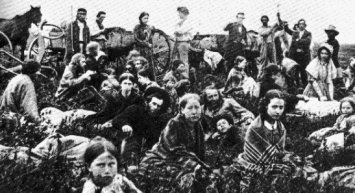
Refugees during the Dakota Conflict of
1862
The causes of the the Dakota Conflict are many and
complex. The treaties of 1851 and 1858
contributed to tensions by undermining the Dakota
culture and the power of chieftains, concentrating
malcontents, and leading to a corrupt system of Indian
agents and traders. Annuity payments reduced the once
proud Dakota to the status of dependents. They
reduced the power of chiefs because annuity payments
were made directly to individuals rather than through
tribal structures. They created bitterness
because licensed traders sold goods to Indians at 100%
to 400% profit and frequently took "claims" for money
from individual Dakota paid out of tribal funds.
No effective means of legal recourse was available to
wronged Dakota, leading some Dakota to talk of another
option open to them: robbery and violence. The fact
that the Dakota people were squeezed into a small
fraction of their former lands made it easy, according
to Minnesota historian William Folwell, "for
malcontents to assemble frequently to growl and fret
together over grievances."[LINK
TO BISHOP WHIPPLE'S DISCUSSION OF CAUSES OF WAR]
Annuity payments for the Dakota were late in the
summer of 1862. An August 4, 1862 confrontation
between soldiers and braves at the Upper Agency at
Yellow Medicine led to a decision to distribute
provisions on credit to avoid violence. At the
Lower Agency at Redwood, however, things were handled
differently. At an August 15, 1862 meeting
attended by Dakota representatives, Indian Agent
Thomas Galbraith, and representatives of the traders,
the traders resisted pleas to distribute provisions
held in agency warehouses to starving Dakota until the
annuity payments finally arrived. Trader Andrew
Myrick summarized his position in the bluntest
possible manner: "So far as I am concerned, if
they are hungry, let them eat grass."
Unbeknownst to those gathered at the Lower Agency, the
long delayed 1862 annuity payments were already on
their way to the Minnesota frontier. On August 16, a
keg with $71,000 worth of gold coins reached St.
Paul. The next day the keg was sent to Fort
Ridgely for distribution to the Dakota. It
arrived a few hours too late to prevent an
unprecedented outbreak of violence.
On Sunday, August 17, four Dakota from a breakaway
band of young malcontents were on a hunting trip when
they came across some eggs in a hen's nest along the
fence line of a settler's homestead. When one of
the four took the eggs, another of the group warned
him that the eggs belonged to a white man. The
first young man became angry, dashed the eggs to the
ground, and accused the other of being afraid of white
men, even though half-starved. Apparently to
disprove the accusation of cowardice, the other Dakota
said that to show he was not afraid of white men he
would go the house and shoot the owner. He
challenged the others to join him. Minutes later
three white men, a white woman, and a fifteen-year old
white girl lay dead.[LINK TO CARTOON STORY OF
FIRST VIOLENCE]
Big Eagle, a Dakota Chief, recounted what happened
after the young men reached Chief Shakopee's camp late
on the night of August 17:
The tale told by the young men created the
greatest excitement. Everybody was waked up
and heard it. Shakopee took the young men to
Little Crow's house (two miles above the agency),
and he sat up in bed and listened to their
story. He said war was now declared.
Blood had been shed, the payment would be stopped,
and the whites would take a dreadful vengeance
because women had been killed. Wabasha,
Wacouta, myself and others still talked for peace,
but nobody would listen to us, and soon the cry was
"Kill the whites and kill all these cut-hairs who
will not join us." A council was held and war
was declared. Parties formed and dashed away
in the darkness to kill settlers. The women
began to run bullets and the men to clean their
guns....
At this time my village was up on Crow creek, near
Little Crow's. I did not have a very large
band -- not more than thirty or forty fighting
men. Most of them were not for the war at
first, but nearly all got into it at last. A
great many members of the other bands were like my
men; they took no part in the first movements, but
afterward did. The next morning, when the
force started down to attack the agency, I went
along.... The killing was nearly all done when I got
there. Little Crow was on the ground directing
operations. I saw all the dead bodies at the
agency. Mr. Andrew Myrick, a trader, with an
Indian wife, had refused some hungry Indians credit
a short time before when they asked him for
provisions. He said to them; "Go and eat
grass." Now he was lying on the ground dead,
with his mouth stuffed full of grass, and the
Indians were saying tauntingly: "Myrick is eating
grass himself." When I returned to my village
that day I found that many of my band had changed
their minds about the war, and wanted to go into
it. All the other villagers were the same way.[Big
Eagle's Account, Through Dakota Eyes]
Events moved quickly. Forty-four Americans were
killed and another ten captured in the first full day
of fighting in and around the Lower Agency at Redwood.
Nearly two hundred additional whites died over the
next few days as Dakota massacred farm families and
attacked Fort Ridgely and the town of New Ulm.
Panicking settlers fled eastward from twenty-three
counties, leaving the southwestern Minnesota frontier
largely depopulated except for the barricaded
fortifications at Fort Ridgely and New Ulm. On August
23, a second Dakota attack on New Ulm left most of the
town burned to the ground, and 2,000 refugees, mostly
women, children, and wounded men, set off in wagons
and on foot for Mankato, thirty miles away. On August
26, three days after Governor Alexander Ramsey
appointed Colonel
Henry Sibley, a former governor, to command
American forces that would attempt to suppress the
uprising, Sibley advanced from the east with 1,400
soldiers toward Fort Ridgely. The next day, Sibley and
his men succeeded in lifting the Dakota siege at Fort
Ridgely, and the second phase of the Dakota Conflict--
an organized American military effort to defeat and
punish the Sioux-- began.
The Dakota offensive continued to achieve success
through early September. At dawn on September 2
at Birch Coulee Creek, Dakota warriors attacked a
170-man party of soldiers sent out to bury the bodies
of settlers, killing twenty soldiers and ninety
horses. Other Dakota attacks were made at Acton,
Hutchinson, and Fort Abercrombie. Little Crow is generally
acknowledged to have been the leader of the warring
Dakota, but Chiefs Mankato, Big Eagle, Shakopee and
others played significant leadership roles.
By mid-September, the initiative had shifted to the
American forces. On September 23, in the
decisive Battle of Wood Lake, 700 to 1,200 Dakota
warriors were forced to withdraw after suffering heavy
casualties. Meanwhile, divisions among Dakota on
the war increased. To the north, chiefs of the
Upper Agency Sisseton and Wahpeton continued to oppose
the fighting. Chiefs Red Iron and Standing
Buffalo threatened to fire upon any of Little Crow's
followers that entered their territory. During the
Wood Lake Battle, "friendlies"
(Dakota opposed to the war) were able to seize
control of white captives and bring them into their
own camp. In late September, the friendlies
released 269 white prisoners to the control of Colonel
Sibley. Penned in to the north and south, facing
severe food shortages and declining morale, many
Dakota warriors chose to surrender. Together
with those taken captive, the ranks of Dakota
prisoners soon swelled to 1,250. The six-week
war was over, having cost the lives of between 400 and
600 whites and hundreds (no more reliable estimate has
been made) of Dakota. A decision had to be made.
What should be done with the Dakota prisoners? [LINK
TO CARTOON STORY ABOUT WOOD LAKE BATTLE AND
SURRENDER]
The Trials and Mass
Execution
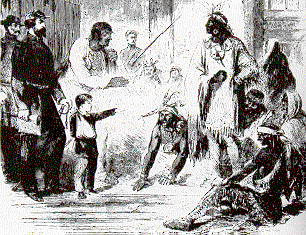
A boy accuses a Dakota warrior in one of
the 393 trials
On September 28, 1862, Colonel Sibley appointed a five-member
military commission to "try summarily" Dakota
and mixed-bloods for "murder and other outrages"
committed against Americans. Whether Sibley had
authority to appoint such a commission is a matter of
substantial dispute. The commission was convened
immediately, meeting first near Camp Release (close to
modern-day Montevideo, Minnesota). [PHOTO
OF LOG COURTHOUSE] Later,
the trials were moved to the the summer kitchen cabin
of trader Francois LaBathe, at the Lower Sioux
Agency. Sixteen trials were conducted the first
day at Camp Release, resulting in convictions and
death sentences for ten prisoners and acquittals for
another six. Over the six weeks that followed,
the military court would try a total of 393 cases,
convicting 323 and sentencing 303 to death by hanging.
Reverend
Stephen Riggs, a man who spoke Dakota and was
not unsympathetic to their plight, reportedly served
as a virtual grand jury, gathering evidence and
witnesses.
The trials were quick affairs, getting quicker as
they progressed. The commission heard nearly
forty cases on November 3, the last day it met. The
commission believed that mere participation in a
battle justified a death sentence, so in the many
cases, perhaps two-thirds of the total, where the
prisoner admitted firing shots it proceeded to a
guilty verdict in a matter of a few minutes.
Somewhat more deliberation was required for trials in
which the charge was the murder or rape of settlers,
because admissions were much rarer in these
cases. After the defendant gave whatever
response he cared to make to the charge, prosecution
witnesses were called. Where prosecution
witnesses contradicted the testimony of the defendant,
the commission almost invariably found the prisoner to
be guilty. The best witnesses for the
prosecution turned out to be some of the
accused. A mixed-blood named Godfrey, or Otakle,
who was the first prisoner tried [GODFREY'S CASE],
gave evidence in fifty-five cases and was described by
Recorder Isaac Heard
as "the greatest institution of the commission."
With his "melodious voice" and "remarkable memory" he
seemed to Heard "specifically designed as an
instrument of justice." [HEARD'S
ACCOUNT
OF TRIALS]
Critics have challenged the fairness of the
trials. In addition to raising concerns about
the sufficiency of the evidence supporting convictions
and the rapidity of trials, critics have charged
commission members of harboring prejudice against the
defendants. The critics may have a point. The
commission members, though men of integrity, were also
military men whose troops had recently been under
attack by the very men whose cases they were judging.
Critics of the trials also have argued that the
commission was wrong to treat the defendants as common
criminals rather than as the legitimate belligerents
of a sovereign power. Finally, they have
suggested that the trials should have been conducted
in state courts using normal rules of criminal
procedure rather than by military commission. [WERE
THE TRIALS FAIR?]
Colonel Sibley may well have viewed summary trials by
a commission as necessary to avoid vigilante justice
by angry mobs of Minnesotans. As it was, the 303
condemned prisoners were attacked in New Ulm on
November 9 as they being transported to Mankato to
await their execution[SKETCH OF ATTACK IN NEW ULM].
Another planned attack of the prison camp by several
hundred armed local citizens on December 4 was foiled
by soldiers guarding the Dakota prisoners.
The final decision on whether to go ahead with the
planned mass execution of the 303 Dakota and
mixed-bloods rested with President Lincoln.
General John Pope, having been sent to Minnesota after
his defeat at Bull Run, campaigned by telegraph for
the speedy execution of all the condemned.
Virtually all of the editorial writers, politicians,
and citizens of Minnesota agreed with Pope. One
of the few who did not was Henry
Whipple, the Episcopal Bishop of
Minnesota. Whipple traveled to Washington to
meet with Lincoln and discuss the causes of the Dakota
Conflict. By Lincoln's own account, the visit
impressed him deeply and he pledged to reform Indian
affairs. Lincoln knew well that the lust for
Dakota blood could not be ignored; to prevent any
executions from going forward might well have
condemned all 303 to death at mob hands. Lincoln
asked two clerks to go through the commission's trial
records and identify those prisoners convicted of
raping women or children. They found only two
[cases2 and 4].
Lincoln then asked his clerks to search the records a
second time and identify those convicted of
participating in the massacres of settlers. This
time the clerks came up with the thirty-nine names
included in Lincoln's handwritten order of execution
written on December 6, 1862. [PHOTO
OF LINCOLN'S ORDER]
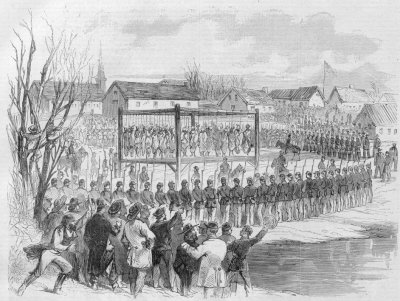
The mass execution in Mankato [Harper's Weekly
(January, 1863)]
In Mankato, at ten o'clock on December 26,
thirty-eight (one person was reprieved between the
date of Lincoln's order and the execution) prisoners
wearing white muslin coverings and singing Dakota
death songs were led to gallows in a circular scaffold
and took the places assigned to them on the
platform. Ropes were placed around each of the
thirty-eight necks. At the signal of three
drumbeats, a single blow from an ax cut the rope that
held the platform and the prisoners (except for one
whose rope had broke, and who consequently had to be
restrung) fell to their deaths. A loud cheer
went up from the thousands of spectators gathered to
witness the event. The bodies were buried in a mass
grave on the edge of town. Soon area doctors,
including one named Mayo, arrived to collect cadavers
for their medical research. [ACCOUNT
OF EXECUTIONS]
Epilogue
In April, 1863, Congress enacted a law providing for
the forcible removal from Minnesota of all
Sioux. Most Dakota, after suffering through a
harsh Minnesota winter at a Fort Snelling encampment [PHOTO
OF ENCAMPMENT], moved to South
Dakota. Prisoners previously held at Mankato
were transported on the steamboat "Favorite" down the
Mississippi to Camp McClellan, near Davenport, Iowa.
On March 22, 1866, President Andrew Johnson ordered
the release of the 177 surviving prisoners. They were
moved to the Santee Reservation near Niobrara,
Nebraska.
Little Crow was not among the Dakota tried by the
military commission. He, along with 150 or so of
his followers, fled to present-day North Dakota and
Canada. In June 1863, Little Crow returned to
Minnesota on a horse-stealing foray. On July 3,
a farmer shot Little Crow while the Dakota chief
picked berries with his son near Hutchinson. The
farmer received a $500 reward from the state.
The Sioux Wars went on for many years. A
military expedition carried the fighting into the
Dakota Territory in 1863 and 1864. As the
frontier moved westward, new fighting erupted.
Finally, in 1890 at Wounded Knee, the generation of
warfare that began at Acton, Minnesota in August of
1862 came to an end.
Recently, an effort has been launched to pardon one
of the thirty-eight Dakota, a warrior who was
wrongfully executed in Mankato in 1862.
We-Chank-Washta-don-pee (often called Chaska, the
defendant in Case 3) was one of the prisoners whose
sentence was commuted by President Lincoln. The
evidence at trial showed that Chaska had taken a
woman, Sarah Wakefield, and her children prisoner, but
had treated them kindly and protected them from other
Dakota who would have abused or killed them.
Wakefield, testifying before the military tribunal,
said: "If it had not been for Chaska, my bones would
now be bleaching on the prairie, and my children with
Little Crow." Chaska's execution was most likely
a mistake, as another convicted Dakota who was
scheduled to die, but was spared, had a similar name:
Chaskey-etay. (Chaskey-etay had been convicted
of murdering a pregnant woman.) A prison
chaplain later wrote to Wakefield, distressed over
learning of Chaska's death, "Chaska was hung instead
of another, I doubt whether I can satisfactorily
explain it." Minnesota Senator Al Franken has
indicated that he intends to consider proposing
legislation that would extend a posthumous pardon to
Chaska.

![[PHOTO OF LOG COURTHOUSE]](CTROOM.jpg)
![[SKETCH OF ATTACK IN NEW ULM]](citizen.GIF)
![[PHOTO OF ENCAMPMENT]](PRISON%7E2.jpg)