×
Check-out the new Famous Trials website at www.famous-trials.com:
He shook Randy's hand, shook
the hands of the defense team, and—as he always did—let
the jury in on his fear as if it were some secret. “I’ve been at this
for over
forty years, and I never begin any case the way I feel right now. . . .
I think
to myself, can I do what I need to do now? . . . I need to be the best
lawyer I
can be in the next two hours and thirty-five minutes.” And
then he talked about the jury. Two jurors were in their seventies,
three in
their sixties, and only one was younger than forty-three. Spence said
he hoped
he didn’t offend them, but he guessed their average age was forty. “You
may be
the most important jury that’s come along in a decade,” he said. “This
is a
watershed case. . . a case kids in law school are going to read about.” During
the trial, Judge Lodge had ruled that Spence had to remain in one
place,
something the lawyer called “a spastic embrace” with the podium. Now
Spence was
allowed to move around the courtroom and he ran like an unleashed dog.
He
walked over and knelt next to Randy, looking into his eyes. “Randy,
I’ll tell
you what you’re guilty of. You’re guilty of being one stubborn mother.
You are
guilty of being afraid.” He looked up the jury. “And aren’t we all
guilty of
being afraid?” Spence
threw everything he could think of into his argument. This was no time
to be
subtle. He accused the government of a cover-up and spun out new
theories—Vicki
was murdered because they thought she was a witness at the roadblock.
Degan’s
own men shot him. He told a story about a talking swan and another
about a boy
who crushes a bird. Federal agents were “the Like
a man stumbling around in a dark room, Spence’s argument was all over
the place
until—as always—he found the switch and turned on the lights. His
voice boomed through the courtroom. “Marshals aren’t supposed to shoot
little
boys in the back!” Sara shuddered. “A little boy whose voice hadn’t
even
changed!” Rachel sat up straight and squeezed her aunt’s hand. “This is
a man
who has been the victim of a smear and had his wife and son killed. And
I don’t
want him hurt anymore. “This
is a murder case,” Spence said. “But the people who committed the
murder have
not been charged, and the people who committed the murder are not here
in
court. “Randy
Weaver was not a criminal,” Spence said. “He had no propensity to
commit
crimes. This is a man who never even had a traffic accident, never even
had a
traffic ticket. Never been charged with a crime of any kind and
honorably served
his country. “I
want to talk to you about. . . punishment. Randy Weaver would willingly
go to
the penitentiary for the rest of his life if he could have his boy
back. Randy
Weaver would go to the penitentiary for the rest of his life. . . if he
could have
Vicki back. Hasn’t he been punished enough? Doesn’t this terror and
this horror
have to end sometime? Shouldn’t it end with you, and shouldn’t it end
without
having to compromise? Shouldn’t this jury have the courage to stand up
and say,
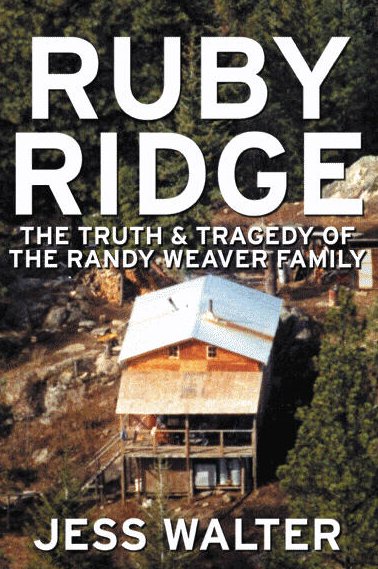
‘No, they overexercised their power.’ I ask you to do that.” [From Jess
Walter's Ruby Ridge: The Truth
and Tragedy of the Randy Weaver Family (Harper, 1995), pp.
352-353.] |