1. In the Beginning: Two
Stories of Creation
by
Doug Linder (2004)
In the
beginning, about 3,000
years ago*, Jewish desert dwellers in what is present-day southern Israel
told a story around campfires about the creation of the first man and
first
woman. The story they told, and passed
on to generations of future desert dwellers, described a pre-creation
scene
much like the desert landscape in which they daily struggled for
existence. From the dry desert dust the
Creator forms a man and breaths life into him, and then places him in a
beautiful
oasis-like garden, abundant with fruits. The
Creator takes a personal interest in this first man,
and sets about
trying to find him a suitable companion. When
none of the creatures He first forms provides the man
the comfort
He had hoped, the Creator makes the first woman. Everything
goes well for a spell, in the
story told in the desert, but then the Creator is disobeyed and bad
things
start to happen.
Four
or five centuries
later, five-hundred-plus miles to the east in what is most likely
present-day
Iraq, a remarkable Jewish writer—whose name we do not know—set about
the
ambitious task of constructing a primary history of his people. Evil
Merodach reigned
in this dark time of Jewish exile, around 560 B.C., and
the writer hoped that his
history would help his people endure their many trials. The writer was
most
likely a priest, and might have been assisted in his work by other
priests and
scribes. To accomplish his mission, he
acquired at least two pre-existing writings on Jewish history. The prior writings came from different places
and different times. One set of writings
used the Canaanite term, “Elohim,” as the name of the creator god. A second set of writings, more ancient than the
first, used a Judean
term,
“YHWH” (translated “Jehovah” in English), to describe its deity.
The priest wove the two
texts together, trying to avoid repetition and altering them where
necessary to
avoid blatant inconsistencies. The
priest confronted an additional problem: the two texts originally
reflected views
about two different gods in a time of polytheism, but by the time he
compiled
his history, belief in a single god had become prevalent among Jews. The priest, therefore, sought to remove
passages supporting the polytheism of an earlier age—and, except for a
few
hints here and there, he succeeded. Finally,
he added some writing of his own, or of his
priestly
contemporaries, that reflected the ideas of his own, more mature,
period of
Judaism.
The story the writer put together from
the various
texts is a compelling one. “The greatest
story ever told,” it is now often called. Without
question, it is the most significant history—if
that term is
appropriate for such a blend of real events and legends—ever written. Some of the events he described are consistent
with other historical records, but many others—generally those before
the time
of Saul and David, or about 1000 B.C.—cannot be tested for accuracy,
and are no
doubt shaped to reflect the priest’s religious and political goals. The history includes dramatic accounts of
persecution, escape, exile, sacrifice, and global devastation by a
great
flood. It tells of a creator god who
watches over his people, tests his people, and promises them great
things if
only they honor his commandments. As any
great story must, the history has villains and it has heroes. No figure plays a more heroic and central
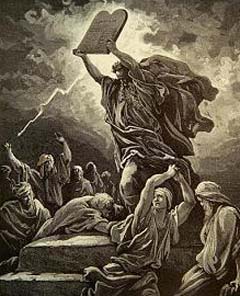
role in the priest’s work than a prophet by the name of Moses, born in
Egypt in
the 13th century B.C. Remarkably, memory of
Moses
survived in the writer’s people through seven centuries—and was, in
fact, the
inspiration for the task he gave himself.
The
writer believed that his story would not be complete without an
explanation of
how things--the sun, the earth, the seas—and life--plants, animals, and
humans--came
to be. For good measure, the writer
decided to include two such explanations. He
did so even though the two stories contradicted each
other on several
points.
The
priest opened his history with a creation story that might be his own,
or one
of his priestly contemporaries. The Creator in this story is
impersonal, almost
force-like. The
pre-creation setting is
a watery chaos. Creation takes place
over six days. He begins by creating the heaven
and the
earth. Light comes next, followed by
land rising from amidst the “gathered together” waters.
The creation of living things occupies parts
of the next three days. “Grass,” “fruit
trees,” and “herbs” are created on the third day. Curiously,
the sun, moon, and stars come into
existence the day after the plant
kingdom is created. On the fifth day,
God brings forth fish, “great whales,” and “every winged fowl.” Finally, on the sixth day, God creates
“cattle, and creeping thing, and beasts of the earth.”
The creation story culminates with God
bringing into existence his crowning creation: man made “in the image
of
God.” Man, the priest explains, is “to
have dominion over the fish of the sea and over the
fowl of the air, and over
the cattle, and over the earth, and over every thing that creepeth upon
the
earth.”
Immediately
after the first creation account, the priest inserted a second story, a
version
of the ancient tale that was first told centuries earlier around desert
campfires. The deity in this second story is a personal god with
human-like
emotions, the Lord of the Plantation. The
story opens on a barren landscape on which “no shrub of the field
had yet appeared”. God had not yet
“caused it to rain upon the earth.” Creation begins in the form “a mist
from
the earth” that waters the parched plain. God
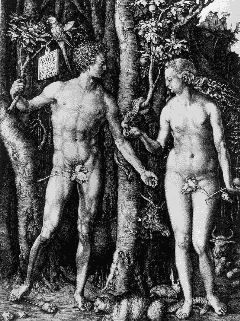
then forms from “the dust of the earth” the first man,
Adam, and
breathes “into his nostrils the breath of life.” Finding
a suitable home for Adam is God’s next
concern. (This God takes a paternalistic interest in the first human,
his very
special creation.) God “plants” an oasis-like garden in Eden. Proclaiming, "It is not good for the man to be
alone. I
will make a
helper suitable for him," God forms “all the beasts of the field and
all
the birds of the air.” When none of the
beasts proves to be on much comfort to Adam, God takes one of the first
man’s
ribs and makes the first woman, Eve. Adam
and Eve anger God by eating a forbidden fruit, but
they are
nonetheless permitted to have sex and reproduce. From
this first union of man and woman, the
writer explained, have come all of us.
Later,
of course, commentators noted that it was not possible for both
creation
stories to be literal history, but writing a literal
history was never the priest’s goal anyway. How
could anyone not see the
contradictions? Most obviously, the
order of creation is different in the two stories.
In the six-day creation story, the order of
creation is plants, birds and fish, mammals and reptiles, and finally
man to
reign over all created before him, while in the Adam and Eve story, the
creation order is reversed, with man coming first, then plants and
animals. The
two creation stories also have different narrative rhythms, different
settings,
and different names for God. In the
six-day story, the creation of humanity occurs through a single act and
the creator,
seeming more cosmic than human-like, is present only through a series
of
commands. In the Adam and Eve story, on
the other hand, man and woman are created through two separate acts and
God is
present in a hands-on, intimate way. The
pre-creation setting in the six-day story is a watery chaos, while in
the Adam
and Eve version, the setting before creation is a dry dessert. Finally, in the six-day story, the creator is
called “Elohim,” while in the other version of events, the creator is
“the Lord
God” (“Yahweh”).
Note
*The statement is not to be taken literally, of course.
The universe might be 15 billion years old, the earth 4.5 billion years
old, but the creations stories accepted by most Americans have their
origins only about 3,000 years ago.

===============================================
2. The Creator-God of Moses
by Doug Linder (2004)
In the court of Pharaoh
Ramses II, in the thirteenth
century B.C., a young child observed the mistreatment of the enslaved
Hebrews. The boy’s name was Moses,
derived from the Egyptian moser, meaning “is born.” What the boy saw, and what he held within,
somehow came together to create one of the great transforming ideas of
history.
The world-changing idea that the prophet Moses (the biography of whom
fills
most of Exodus through Deuteronomy) carried to the West was that of a
single,
all-powerful Creator. Although other creation stories predate those of
Genesis,
notably the Sumerian “Seven Tablets of Creations” (Enuma Elish),
these
other stories typically described creation by gods—not the one
omnipotent deity
of Moses, “Yahweh.” The name, a transliteration from Hebrew, literally
means
“He who brings into being.” Moses introduced a deity who made in
natural to
conceive of the Creation as a unified, rational product—something that
could
scarcely be imagined in a world populated by many gods. (Trading one
difficulty, for another, however, Moses caused his fellow monotheists
to
wrestle, as Christians and Jews today famously do, with the troubling
question
of evil and suffering. Why would a
beneficent, all-powerful Creator tolerate these things in his Creation?)
The novelty
of Moses’ vision is
hard for most Americans to comprehend. Before
the time of Moses, most cultures and religions
showed relatively
little interest in explaining the origins of the cosmos and life on
earth. We are conditioned to assume
anything that is,
once was not—but that assumption was not generally shared in the
ancient
world. A brief survey of major cultures
and religions reveals the paradigm-shattering nature of Yahweh. The
early
Chinese, for example, seem never to have given the question of creation
serious
attention at all. Hindus pondered
creation, but for them creation seemed less a riddle to be explained
than it
was a cause for awe. The Vedas, sacred
hymns in Sanskrit written between 1500 and 900 B.C., celebrate the
radiance of
the world made possible by the fragmenting of the original Oneness into
thousands of limited forms. Hindus thus
reverse western notions of creation: nothingness is not transformed
into
everything; everything has emerged from a Oneness that was there at the
beginning. Taoists, believing in the
unity and timelessness of the world’s processes, saw no need for a
Creator who
could make the new. For the Buddha, too,
the question of creation was one without answers. Among
the fourteen unanswerable questions
listed by the Buddha were “Is the universe eternal or not eternal, or
both?”
and “Is the universe infinite in space or not infinite, or both or
neither?” The Buddha, in a commonsense
way that has made his philosophy attractive to millions, asked, “What
use would
it be to have the beginnings of things revealed?” Homeric
epics, fashioned orally in Greece
sometime after 1000 B.C., showed no signs of interest in how the world
came
into being. The epics begin with a world
populated by fully mature gods and goddesses.
While Hindus, Buddhists, and
Confucians look
primarily inward for the meaning of life, the Creator-God of Moses
invites
speculation as to the nature of man, salvation, and the beginning and
end of
time. It is especially in the
theology
that owes its existence to Moses that the theory of evolution presents
serious
threat. The most defining belief of the
Christian West until the early twentieth century was that of a God who
created
the earth and humans, and who guided the course of history. What
happens to
that God when science produces compelling evidence of a natural
process,
characterized by contingency and purposelessness, explaining the
world’s
amazing diversity of life? Does that God
die, or does He retreat to the gaps of still-unanswered questions?
There is a
second transforming
aspect of Moses’ vision. This capable priest and savvy politician saw
man as
made “in the image of God.” If God is
first and foremost a creator, and we are made in his image, are we then
not
also the possessors of creator-like qualities? Prior
to the time of Moses, most people thought of
themselves as
instruments or playthings of gods. Usually
people imagined themselves as victims─as persons
incapable of
changing the environment that so often seemed to conspire against their
hopes. Moses—himself a kind of
creator—helped changed this arguably pathetic conception people had of
their
role in the world.
Pulitizer-Prize
winning
historian Daniel Boorstein called Moses “a messenger of the new.” In his book The Creators, Boorstein
put Moses front and center in Part One of his “History of the Heroes of
the
Imagination.” The influence of Moses’
creation could scarcely be overstated, Boorstein believed.
Indeed, he identified it as the source of the
scientific theories and hypotheses that would one day come to threaten
the very
religious concepts he fathered. Without
Moses, in other words, Darwin
would never have been possible.
===============================================
Genesis in the Scopes Trial
Two-thousand-four-hundred-and-eighty-five
years
(plus or minus a year or two) after the writing of Genesis, Judge John
T.
Raulston read to grand jurors and the crowd assembled in the Rhea
County
Courthouse in Dayton,
Tennessee the first
thirty-one verses of
Chapter One of Genesis. The judge
explained that he found it “proper” to “call attention” to the Biblical
story
of creation because the defendant in the case he had just called, State
vs.
John Thomas Scopes, stood accused of violating a new Tennessee
statute,
called the Butler Act, that made it a crime “to teach any theory that
denies
the divine creation of man as taught in the Bible,and to teach instead
that man had descended from a lower order of animals."
The Biblical creation story that Judge
Raulston read
as the historic trial opened came from Chapter 1 of Genesis, as it
appeared in
the King James translation. The judge
does not read the strikingly different creation story found at Genesis
2:4b to
2.25, the “Adam and Eve story.” Those
inclined toward Biblical literalism are forced to accept only one of
the two
stories as real history, and must treat the other account as partially
fiction—although fiction with a true message.
Given the more fanciful nature of the Adam and Eve story, with its
creation from rib bone and its walking, talking snakes, the six-day
creation
story of Genesis 1 has been the obvious candidate for literalists to
rally
around.
Two-thousand-four-hundred-and-eighty-five
years
(plus or minus a year or two) after the writing of Genesis, Judge John
T.
Raulston read to grand jurors and the crowd assembled in the Rhea
County
Courthouse in Dayton,
Tennessee the first
thirty-one verses of
Chapter One of Genesis. The judge
explained that he found it “proper” to “call attention” to the Biblical
story
of creation because the defendant in the case he had just called, State
vs.
John Thomas Scopes, stood accused of violating a new Tennessee
statute,
called the Butler Act, that made it a crime “to teach any theory that
denies
the divine creation of man as taught in the Bible,and to teach instead
that man had descended from a lower order of animals."
As
the trial progressed, it became clear that the contradictions between
the two
Genesis accounts did not escape the attention of defense attorneys for
teacher
John Scopes. The defense demanded that
the prosecution show which of the two creation stories it is that the
Butler
Act forbids teachers to “deny.” Does a
biology instructor risk prosecution, Arthur Garfield Hays wondered
aloud, if he
or she questions whether the first woman was made from the rib of a man? The impossibility of determining which account of the “divine creation of man as
taught
in the Bible” could not be “denied” by Tennessee
teachers, contended the defense, is a fatal flaw in the law: the law is
unconstitutionally
vague. Clarence Darrow
threw down a challenge: “Tell us
the origins of man as shown in the Bible. Is there any human being who
can tell
us?” Answering his own question, the nation’s most famous defense
attorney said
it is impossible: “There are two conflicting accounts in the first two
chapters.” Without a clear statement in the law as to what “the story
of divine
creation” actually is, Darrow contended, Scopes cannot be prosecuted. Tennessee, he
drawled,
must identify “the chief mogul that can tell us what the Bible means.” If the state law provided “you must teach
that man was made of the dust” or that “Eve was made of Adam’s rib,”
then at
least the law would be clear,” he argued. The
law provides no hint which creation story must not be
denied. Charges against Scopes, Darrow
concludes,
must be dropped.
Prosecutor
William Jennings Bryan, unsurprisingly, saw none of the defense’s
problems with
the wording of the statute. “The statute
is brief and free from ambiguity,” he asserted. Judge Raulston sided with Bryan. He
denied the defense’s motion to quash, on
the ground of vagueness, the indictment of Scopes.
===============================================
|
Genesis
1
1 In the beginning God created the
heaven and the earth.
2 And the earth was without form, and
void; and darkness was upon the face of the deep. And the Spirit of God
moved upon the face of the waters.
3 And God said, Let there be light:
and there was light.
4 And God saw the light, that it was
good: and God divided the light from the darkness.
5 And God called the light Day, and
the darkness he called Night. And the evening and the morning were the
first day.
6 And God said, Let there be a
firmament in the midst of the waters, and let it divide the waters from
the waters.
7 And God made the firmament, and
divided the waters which were under the firmament from the waters which
were above the firmament: and it was so.
8 And God called the firmament
Heaven. And the evening and the morning were the second day.
9 And God said, Let the waters under
the heaven be gathered together unto one place, and let the dry land
appear: and it was so.
10 And God called the dry land Earth;
and the gathering together of the waters called he Seas: and God saw
that it was good.
11 And God said, Let the earth bring
forth grass, the herb yielding seed, and the fruit tree yielding fruit
after his kind, whose seed is in itself, upon the earth: and it was so.
12 And the earth brought forth grass,
and herb yielding seed after his kind, and the tree yielding fruit,
whose seed was in itself, after his kind: and God saw that it was good.
13 And the evening and the morning
were the third day.
14 And God said, Let there be lights
in the firmament of the heaven to divide the day from the night; and
let them be for signs, and for seasons, and for days, and years:
15 And let them be for lights in the
firmament of the heaven to give light upon the earth: and it was so.
16 And God made two great lights; the
greater light to rule the day, and the lesser light to rule the night:
he made the stars also.
17 And God set them in the firmament
of the heaven to give light upon the earth,
18 And to rule over the day and over
the night, and to divide the light from the darkness: and God saw that
it was good.
19 And the evening and the morning
were the fourth day.
20 And God said, Let the waters bring
forth abundantly the moving creature that hath life, and fowl that may
fly above the earth in the open firmament of heaven.
21 And God created great whales, and
every living creature that moveth, which the waters brought forth
abundantly, after their kind, and every winged fowl after his kind: and
God saw that it was good.
22 And God blessed them, saying, Be
fruitful, and multiply, and fill the waters in the seas, and let fowl
multiply in the earth.
23 And the evening and the morning
were the fifth day.
24 And God said, Let the earth bring
forth the living creature after his kind, cattle, and creeping thing,
and beast of the earth after his kind: and it was so.
25 And God made the beast of the
earth after his kind, and cattle after their kind, and every thing that
creepeth upon the earth after his kind: and God saw that it was good.
26 And God said, Let us make man in
our image, after our likeness: and let them have dominion over the fish
of the sea, and over the fowl of the air, and over the cattle, and over
all the earth, and over every creeping thing that creepeth upon the
earth.
27 So God created man in his own
image, in the image of God created he him; male and female created he
them.
28 And God blessed them, and God said
unto them, Be fruitful, and multiply, and replenish the earth, and
subdue it: and have dominion over the fish of the sea, and over the
fowl of the air, and over every living thing that moveth upon the earth.
29 And God said, Behold, I have given
you every herb bearing seed, which is upon the face of all the earth,
and every tree, in the which is the fruit of a tree yielding seed; to
you it shall be for meat.
30 And to every beast of the earth,
and to every fowl of the air, and to every thing that creepeth upon the
earth, wherein there is life, I have given every green herb for meat:
and it was so.
31 And God saw every thing that he
had made, and, behold, it was very good. And the evening and the
morning were the sixth day.
==============================================
Genesis 2
1 Thus the heavens and the earth were
finished, and all the host of them.
2 And on the seventh day God ended
his work which he had made; and he rested on the seventh day from all
his work which he had made.
3 And God blessed the seventh day,
and sanctified it: because that in it he had rested from all his work
which God created and made.
4 These are the generations of the
heavens and of the earth when they were created, in the day that the
LORD God made the earth and the heavens,
5 And every plant of the field before
it was in the earth, and every herb of the field before it grew: for
the LORD God had not caused it to rain upon the earth, and there was
not a man to till the ground.
6 But there went up a mist from the
earth, and watered the whole face of the ground.
7 And the LORD God formed man of the
dust of the ground, and breathed into his nostrils the breath of life;
and man became a living soul.
8 And the LORD God planted a garden
eastward in Eden; and there he put the man whom he had formed.
9 And out of the ground made the LORD
God to grow every tree that is pleasant to the sight, and good for
food; the tree of life also in the midst of the garden, and the tree of
knowledge of good and evil.
10 And a river went out of Eden to
water the garden; and from thence it was parted, and became into four
heads.
11 The name of the first is Pison:
that is it which compasseth the whole land of Havilah, where there is
gold;
12 And the gold of that land is good:
there is bdellium and the onyx stone.
13 And the name of the second river
is Gihon: the same is it that compasseth the whole land of Ethiopia.
14 And the name of the third river is
Hiddekel: that is it which goeth toward the east of Assyria. And the
fourth river is Euphrates.
15 And the LORD God took the man, and
put him into the garden of Eden to dress it and to keep it.
16 And the LORD God commanded the
man, saying, Of every tree of the garden thou mayest freely eat:
17 But of the tree of the knowledge
of good and evil, thou shalt not eat of it: for in the day that thou
eatest thereof thou shalt surely die.
18 And the LORD God said, It is not
good that the man should be alone; I will make him an help meet for him.
19 And out of the ground the LORD God
formed every beast of the field, and every fowl of the air; and brought
them unto Adam to see what he would call them: and whatsoever Adam
called every living creature, that was the name thereof.
20 And Adam gave names to all cattle,
and to the fowl of the air, and to every beast of the field; but for
Adam there was not found an help meet for him.
21 And the LORD God caused a deep
sleep to fall upon Adam, and he slept: and he took one of his ribs, and
closed up the flesh instead thereof;
22 And the rib, which the LORD God
had taken from man, made he a woman, and brought her unto the man.
23 And Adam said, This is now bone of
my bones, and flesh of my flesh: she shall be called Woman, because she
was taken out of Man.
24 Therefore shall a man leave his
father and his mother, and shall cleave unto his wife: and they shall
be one flesh.
25 And they were both naked, the man
and his wife, and were not ashamed.
===============================================
Science's Eve
Dr. Lynn Margulis thinks humans are,
essentially, a
colony of closely associated bacteria. When
she first proposed her theory in The
Origin of Eukaryotic Cells in 1970, the ideas proved so
controversial that they “could not even be discussed at respectable
scientific
meetings.” Today, however, the theory
that most scientists rejected out of hand has earned, in the words of
biologist
Richard Dawkins, “triumphant near-universal acceptance.”
The human story, as Margulis first saw
it, began
about 3.2 billion years ago when the only inhabitants on earth were
bacteria. About that time, two primitive
species of bacteria, a “mother” bacteria (Bdellavibrio) and a “father”
bacteria
(Thermoplasma acidophillium) started “exchanging energy” in a stable
and
dependable way that led to the formation of all subsequent life forms. This happened when the free-living bacteria
took up residence in large “eukaryotic” cells. Confined
within the large cells, the bacteria transformed
into swarming
elliptical membrane-filled bodies called mitochondria.
With the formation of mitochondria began the
flow of a river
of DNA that
sweeps through
three billion years to include us all.
According to Margulis, each one of the
hundred
trillion cells in the human body is an enclosed garden of specially
tamed and
always multiplying bacteria. Not only is
every man not an island, in the vision of Margulis, he is in essence a
community of communities. The
mitochondria perform essential functions, such as allowing chain
reactions to
occur that are critical to breathing and digestion.
As Richard Dawkins notes, “Without our
mitochondria, we’d die in a second.”
Mitochondria, with their own simple
DNA that is not
affected by sexual mixing, come from our mothers only.
Your mitochondria came exclusively from your
mother’s mother’s mother--and so on, back generation after generation,
to the
beginning of our species. The culture of
mitochondria in the female egg seeds a newborn’s body, while whatever
mitochondria might be in the sperm are lost with the tail at the time
of egg
fertilization. The female-only
transmission of mitochondria, coupled with its slow rate of genetic
mutation,
make its DNA ideal for tracing and dating maternal ancestry.
Researchers in the 1980s used
computers to analyze
samples of DNA drawn from 135 diverse women from all over the
globe—Chinese,
African tribeswomen, Australian Aborigines, Native Americans, Europeans. The researchers discovered that the family
trees of these women all led back to Africa. Remarkably, the analysis demonstrated that
genetic differences among the various people within Africa
all are twice as great as the differences between all other population
groups. This strongly suggests that all
the population groups outside Africa are descended from a small band of
humans
that left Africa—probably about
50,000 to
80,000 years ago. In a sense, we are all
Africans.
The ancestral human population that
lived in Africa started to split up
roughly 150,000 years ago,
when the mitochondrial tree makes its first branches within the African
continent. The very root of the
mitochondrial tree seems to lie in the northwestern Kalahari Desert in
southern Africa.
The true home of Eve—Mitochondrial Eve—is not a lush
Garden of Eden, but
a hot African desert. The mitochondrial research matches nicely
with recent genetic research using the Y chromosome, transmitted
exclusively by
males, which also points to southern Africa
as
the home of Adam. Unlike the Genesis
version of human origins, however, the Y chromosomal Adam and
Mitochondrial Eve
that our genetic trees trace back to did not have the planet to
themselves—there
probably, in fact, were thousands of other humans living at the time. Moreover, other humans had lived and died
long before they did. All we know is
that these two humans, alone among the population of their time, can
claim an
unbroken line of sons and daughters that persists to this day.
Biologist
E. O. Wilson sees the human story, as
revealed by genetic research, as the possible basis for spiritual
values. “We
need to create a new epic based on the
origins of humanity,” Wilson
asserted, adding: “Homo sapiens have had one hell of a history! And I
am
speaking of deep history—evolutionary, genetic history—and then, added
on to
that and interacting with it, the cultural history recorded for the
past 10,000
years or so.”
===============================================
Philo
and Origen
During
the high renaissance of Greek culture, in the mid-third century B.C.,
Ptolemy
II summoned seventy-two Jewish scholars to Alexandria, Egypt. Their task was to translate Genesis and the
other books making up the primary history of the Jewish people, often
called
simply “The Law,” from its original Hebrew into Greek.
Never before in history had so massive an
exercise in translation from one language to another been attempted.
Impetus for the
translation project came from the large Jewish colony in Alexandria, many
of whom held important
commercial positions in the city. Jews
in Alexandria,
understandably, wanted the Law read in the synagogues to be in the
tongue of
the people. They probably recognized another important benefit of a
Greek
translation: for the first time, the Greek-speaking, non-Jewish world
could be
introduced to their history and faith.
What happened after the seventy-two
scholars reached Alexandria
is a
subject of debate, but what follows is the somewhat suspect traditional
account. The elders arrived bearing a copy
of The Law
written in letters of gold on rolls of skins. Seven
days of banqueting followed the scholars’ arrival.
At one of the feasts, the king asked the
elders difficult questions to test their proficiency.
When the week of banquets finally ended, the
elders were transported, along with necessary supplies, to the Island of Pharos, where they undertook
their
work. Seventy-two days later, the elders
completed their translation, called the Septuagint, and it was
then read
to the Jewish community. Alexandria Jews
received the new translation with such enthusiasm that (this is where
the
traditional account becomes most controversial) a solemn curse was
placed on
anyone who would dare to add to, or subtract from, the translation. Finally, the king expressed his
pleasure with the work and ordered that it be preserved with the
greatest
care.
Preserved with care it was. The translation made in Alexandria As
the oldest record, it is
generally considered the most authoritative, and the one most closely
examined
by Biblical scholars. After the death of
Jesus, when as the Christian community spread around the Mediterranean,
the Septuagint took another name within that growing group of
believers: The Old Testament. The text survived,
and predates by over a
thousand years the earliest extant Hebrew version (916 A.D.) of the
primary
history.
Some two
centuries after
scholars produced the Septuagint, during a period of Roman indifference
to
religion in the first century B.C., a brilliant and wealthy Jewish
resident of Alexandria,
Philo Judaeus
(20 B.C.-40 A.D.), read the Greek translation. Philo,
whose family had recently moved from Palestine to
what had become
the cultural center of the Roman Empire, developed a deep knowledge of
the
sacred text and emerged as the leading spokesman for the several
hundred
thousand persons who comprised the Jewish community in Alexandria. Philo saw, as none before him had, that the Septuagint
held more meaning than appeared on the surface. Drawing
both from his knowledge of rationalistic Plato and
his
understanding of the teachings of Moses described in Greek translation
of the
primary history, Philo invented theology.
Philo’s masterwork, On Allegory,
explores the
deeper messages buried in the Biblical text and transforms Moses from a
political and religious leader into a philosopher. Philo, in On
Allegory,
rejected simple and literalistic interpretations of the Bible,
including the
creation story as told in Genesis 1. “It
is quite foolish,” Philo wrote, “to think that the world was created in
the
space of six days or in a space of time at all.” Six,
as he saw it, represented to Moses
(Philo assumed Moses to be the author of Genesis) not a number of days,
but “a
perfect number” signifying the perfection of God’s creation. No one,
not even
Moses, “could ever give expression in an adequate manner to the beauty
of
[God’s] ideas respecting the creation of the world.” So the author of
Genesis
did the best that he could. Although “it
is in the nature of God to create all things simultaneously,” the
number six is
“the most suitable for creation,” Philo contened. The
reasons for adopting a six-day creation
story rather than, say, a five-day or nine-day creation, might seem
more
compelling to a mathematician than the average Christian today. Philo pointed out that the number six is
unique among numbers in that it is equal both to the product of its
factors
(1x2x3) and to the sum of its factors (1+2+3). He
also attached sexual significance to the choice of six,
arguing that
it is the product of an even (female, he believed) number and an odd
(male)
number. Seeing a symbolism likely to
escape the notice of most, Philo wrote that because creation required
“birth
from couplings it was necessary that it should be shaped to correspond
to the
first mixed (odd-even) number which has the characteristics of the male
who
sows the seed and the female who receives it.” One
can say what one will about Philo’s theory of numbers;
the key point
is that the Biblical text, as Philo saw it, was just a departure point
for
exploration of God’s purposes. (Most
Biblical scholars today believe that the author of Genesis chose a
six-day
creation because it fit best with the sabbatarian beliefs that had
developed in
the Jewish community by the time of the Books writing in the
sixth-century
B.C.)
When Moses wrote that
the world was created in six
days, Philo argued, he did so to show God’s love of order.
“The law corresponds to the world,” Philo
declared, “and the world to the law.” Philo believed that creation in
fact
happened all at once, “not in external action but in thought.” God thought, therefore everything is. “The great Moses,” Philo explained, “thinking
that a thing which has not been created is as alien as possible from
everything
which is visible before our eyes…has attributed eternity to that which
is
invisible and discerned only by our intellect.” From
the simple fact “this world is visible,” Philo
concluded it “must
have been created.” Moses wrote the
creation story of Genesis, according to Philo, to give us “a very
venerable
account of God”—a God who modeled the physical universe to reflect the
forms
first “conceived” in his own unfathomable mind.
When God created the
universe, Philo
argued, he also
created time: “Before the world, time
had no existence.” So when Moses wrote
“In the beginning” he meant, in Philo’s view, in the beginning of
time. God existed before the
beginning—as did
the idea that the universe represents.
===============================================
In the early third-century, the
rapidly spreading
religion of Christianity still lacked a system of theology that could
provide a
basis for orthodoxy. Persons claiming to
be Christians remained scattered into dozens of sects, each believing
it to be
the true torchbearer of the faith. Believers
debated intensely which writings should be
considered
canonically scriptural within the Church.
In the midst of this relative chaos,
two hundred
years after the time of Philo, in the same city of Alexandria, a new theologian, Origen
(185 –254
A.D.), offered himself as the first theologian and philosopher of the
Christian
Church. His goal is to create a form of Christianity palatable to
intellectuals, one that at its heart rests on his belief that the
Christian
faith offers believers “the key to the perfection of the mind.”
Entering the debate over
the meaning of Genesis, Origen—like
Philo before him—challenged the prevailing belief among early Christian
fathers
that the days of Genesis were literal days. Each of the days of
Genesis, Origen
asserted, might in fact have been a period of time.
Taking a decidedly non-literal reading of
Biblical text, he questioned how anyone could read either the six-day
creation
story or the Adam and Eve story as an actual description of a real
event in the
physical universe:
For who that has
understanding will suppose that the first day, and second and third
day, and
the evening and the morning existed without a sun, and moon, and stars?
And
that the first day was, as it were, also without a sky? . . . .And if
God is
said to walk in paradise in the evening, and Adam is to hide himself
under a
tree, I do not suppose that anyone doubts that these things
figuratively
indicate certain mysteries, the history having taken place in
appearance and
not literally.
Origen
theorized that before
God created the universe, he created—before the start of time—a group
of
rational beings which he called logika,
but which might be thought of today as “souls.” These
rational beings, Origen suggested, had God-like
qualities. With eternity on their hands,
they passed
time endlessly contemplating divine mysteries. Finally,
however, these beings or souls tired of their
contemplation and
started drifting away from God. Time
began. Souls began to have an existence
separate and apart from God. The only
soul who escaped this fate, Origen argues, was “the soul of Christ” who
returned to point the path back to the true function of all souls, all
rational
beings: contemplation of divine mysteries.
Origen was by any measure a gifted and
original
thinker. His allegorizing led him to
challenge, in addition to literal notions of Creation, a variety of
Christian
concepts ranging form Hell to salvation. Though
unknown to most Christians today, Origen ranks
among the greatest
of all Christian theologians—and to some Fundamentalists, the first of
a long
line of troublesome Christian heretics.
For all his originality, however,
Origen could not
imagine a world much older than man. The
very idea of Earth sitting around waiting for man, the species for whom
the world,
sun, and stars were so obviously created, likely never occurred to
Origen or
most of his Christian contemporaries. Origen,
despite his belief that the days of Genesis were periods of time,
confidently
expressed the view that the earth was “very much under” 10,000 years of
age.
By the end of Origen’s
life, the battle lines that
would carry all the way into Dayton
were already drawn. On one side stood
“The School of Alexandria,” which included theologians such as Origen. The School of Alexandria
favored an allegorical approach to scriptural interpretation and
believed that
scripture revealed “intellectual truths” rather than historical truths. Literal senses, they believed, should yield
to the spiritual sense—the critical thing is that scripture be read
with “eyes
of faith.” On the other side, opposing
Origen and the “School
of Alexandria,”
stood “The
School of Antioch.” The School
of Antioch,
boasting
superior numbers, included those church leaders who insisted that all
events
described in the Bible actually took place in history.
Scripture, to these Christians, meant exactly what it
seemed to mean. Sacred
writings described reality; they were not merely
pregnant with
allegorical meaning.
|