×
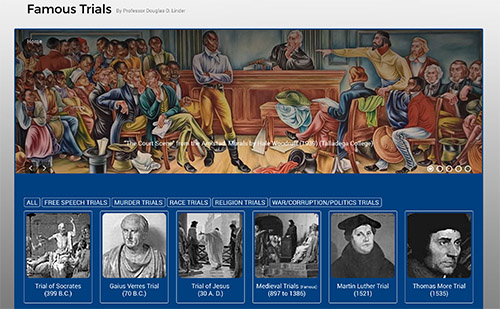
Check-out the new Famous Trials website at www.famous-trials.com:
|
Our guess is that many of the invaders will be surprised to learn that the rank and file of Mississippi Negroes are far more intelligent than is commonly believed in areas from whence cometh these self-important missionaries for "civil rights." And it will probably come as a shock for them to learn that many Negroes who are registered voters didn't bother to vote in our recent elections which found a number of colored candidates seeking major offices. Quite a few of the student invaders have preconceived notions about Mississippi . . . hound dogs sleeping in the dust and under shade trees along Capitol Street . . . almost everybody illiterate, ragged, backward, living in hovels, eating sowbelly and cornpone three times daily . . . toting shotguns and plotting secession . . . In turn, Mississippians have preconceived notions about the invading students -- smug, shrill know-it-all extroverts with a saviour complex . . . problem brats defiant of parental restraint . . . sexually promiscuous, addicted to interracial love-making . . . brainwashed in Communist doctrines with no clear idea of Americanism . . . more hostile to the White South than to Red Russia . . . It is no preconception but established fact that many of the invading students are coming here from places where racial segregation is the custom, where human life is unsafe on the streets even in broad daylight, and where the local crime rate is among the nation's highest. Mississippi, in case they don't know it, has had the nation's third lowest rate of major crime . . . according to official FBI figures. Our parks and streets are generally safe for peaceful, law-abiding people. One can patronize our public transportation facilities without being razored or raped by rat packs like those found in New York, Los Angeles, Chicago and other crime jungles which are furnishing volunteers for this "Project Mississippi" intrusion. While professing to believe in "equality," these self appointed reformers evidently regard themselves as mentally and morally superior to Mississippians.
What the students think of us is not very important . . . because
the invaders couldn't possible think less of us than the majority here
thinks of them and their sponsors . . . An editorial in the Harvard Crimson, which was given wide circulation in Mississippi, declared that "this summer will witness a massive, daring, probably bloody assault on the racial barriers of Mississippi." Central to the project, the editorial said, is "the anticipated lawlessness of Mississippi whites. The planners reason that massive non-violence will precipitate a crisis of violence which they consider a prerequisite for further progress." The invasion of these young busybodies therefore was planned far in advance and, incredibly, has the support of the National Council of Churches. The students were schooled in invasion at Western College for Women in Oxford, Ohio. The Chicago Tribune they were even taught "how to fall if pushed off lunch counter stools and how to lock themselves into a bundle and make themselves harder to drag away." One of the lecturers at the school was a gentlemen from the Department of Justice who was booed when he told the invaders that the federal government would not promise to protect them.
So there you have it. An "invasion" planned in advance with the
announced
strategy of creating trouble.
This newspaper a long time ago pointed our that [a part of the Communist plan in the United States is to stir up racial strife]. The ultimate aim is . . . a black revolution. The invasion of Mississippi this summer is . . . part and parcel of this plan. These young people who have gone to Mississippi have been attending training schools which can be described as nothing short of inflammatory . . . The naive inexperience of these youngsters has been preyed on, and they have been stirred up by tales of horror and violence that simply don't exist in Mississippi.
Entirely aside from the arrogance and the holier-than-thou attitude of
these college students, who are going to Mississippi with no knowledge
of the Negro problem, the really serious aspect of this invasion . . .
is [that it] it is part of an over-all scheme to destroy the United
States
by way of a racial revolution. A week ago last monday people in these parts were preparing for the coming work week. Pulpwood trucks began their treck (sic) to the forests, store owners were busy sweeping out, the old men began moving to their usual places on the steps of the brick courthouse in the middle of the business district which forms a square. A week ago diesel trucks braked to a halt on the main highway which runs in front of the courthouse. A few Choctaw Indians had arrived in town early for shopping. A group of young boys skipped down the street thinking about a swim later in the day. A week ago the main problem facing Philadelphians was the coming Neshoba County fair. And for Philadelphians and others, that wasn't really a problem. A week ago there was some talk around the courthouse about three so-called civil rights workers being arrested for speeding. After they had posted bail, a deputy sheriff had followed them part of the way back to Meridian. The old men, long experts of the courthouse talk, first heard from local officials of the three having disappeared. A week ago there was not much to get excited about. The trio (were) unknown locally, and who know which way they might have gone when they left Philadelphia. Then Monday a burned station wagon, used by the three, was found about 12 miles northeast of town. Since that time Philadelphia has led most news stories all over the world. During the past seven days, Neshoba Countians have seen hundreds of federal agents, highway patrol personnel, and even members of the U.S. Navy trampling over the countryside. They have heard the President of the United States talk about their town. They have read about a visit by Allen Dulles to Mississippi to discuss their town. They have seen one of the largest groups of news media personnel ever to gather in Mississippi. They have seen their town Philadelphia, through the eyes of national television; they have heard about their town on radio; they have seen their town through the "eyes" of newsprint and pictures. They have seen their town tried and found guilty by many outsiders . . . an observer can hear phrases of displeasure, particularly concerning national television personnel who have. . . attempted to outdo each other. . . . An observer. . . immediately gets the feeling that Philadelphians would rather just be left alone. "If people would 'tend to their own business, everything would be alright," one old courthouse sitter said. "If it was boiled down to gravy there wouldn't be much to it, nohow," another responded. An inquirer gets the feeling that these Mississippians don't know what happened to the three. And after the treatment they have received from national news media, they wouldn't care to cooperate with visiting television folk.
Monday afternoon was like most Monday afternoons have been in
Philadelphia
for years. And Philadelphia will be here for many more Mondays to
come. Four hundred sailors, scores of FBI agents -- employees of Uncle Sam -- push through dust, weeds, branches, mud and water not far from this national dateline. Eleven hours a day they hunt for clues of three missing men. Few Mississippians, officials or otherwise, seem to be doing very much active searching. A Mississippi highway patrolman accompanies each squad of sailors. Their mission, said Gov. Paul Johnson, is to "be certain that the people's houses and property of this area are protected at all times." Some state investigators, including some brass, spend a good portion of every day under a giant pecan tree behind the small Philadelphia City Hall. One top investigator, pistol on, lies stretched out in an aluminum, web lounge chair, arms up behind Ms head. Four or five other chairs under the sheltering tree are for other state men who come and go. . . . State people for the most part seem to be standing by. Federal agents carry the burden of effort to find the missing men. It is a distinctly pleasant sort of Southern scene-state investigators behind City Hall eat lunch calmly-sardines, cheese, crackers, dill pickles, cold sweet milk. Sometimes there is baloney and souse meat. Last Tuesday morning several highway patrol cars stood parked near a church to the west. Maybe more such are present than are needed. These officers only stood around talking to each other. "We were just told to park here," said one.
The Philadelphia police chief and his assistants haven't been evident
much
in the searching either. Most of the time they seem busy about
their
duties in town. . . . The FBI, quite obviously, is keeping almost strictly to itself. Its information is close-guarded. State men give no evidence that federal agents tell them much when they do sit down together. There is a careful courtesy between local and state officers and federal investigators. But there is an obvious distance between them too. State people appear to feel that the FBI ought to be confiding more in them. Equally apparent, the FBI -- which usually says as little as possible -- seems to feel its facts are best kept to itself. "Cooperation" in Nesboba County is more ritual than reality. Gov. Johnson of Mississippi has said, "this [search] is a joint effort. This is a cooperative effort between local, state and federal agents. . . ." The federal agents do not mix. They attend to their business and mind their tongues. They are quartered in a small motel due west of Philadelphia. They do not tarry long at City Hall when they must visit it. Monday a federal agent pulled his car up to park near City Hall. His vehicle blocked a woman clerk's car as she worked inside. A state man suggested someone ought to tell the agent, so he could move his car. "Wait until he's walked up here," said another state officer under the pecan tree.
"This is a cooperative effort," the governor had said.
Gov. Paul Johnson said today he was "satisfied" that every. thing possible was being done to locate the three civil rights workers missing since earlier this week in East-Central Mississippi. Johnson told newsmen the disappearance of the three was something that "could happen anytime" in any part of the country. "It happens in New York every night," he said, adding that Mississippi has the second lowest crime rate in the nation. "I'm satisfied that everything is being done that could be done to find them," he said. Johnson also acknowledged that a second wave of volunteer workers, mostly college students, was expected to arrive in Mississippi during the weekend to participate in the so-called "summer project."
But he said he understood the number may have decreased from earlier
expectations.
He said he had beard reports that a number of the students had decided
against taking part in the project, some on their own and some because
of their parents. Meridian
Star, June 26, 1964
Martin
Luther King, Jr., July 24, 1964
(while visiting Philadephia, Miss.) "Does
everybody
understand what I'm saying? The man who talks is dead, dead,dead!"
(quoted by William Huie in Three Lives for Mississippi) "Maybe the best course for everybody is just to let the bodies lie and let the excitement gradually die down. Once the bodies are found, then there is a great hue and cry to convict somebody . . . to put somebody in jail. And that's a power I don't have. That power doesn't exist in Mississippi. Not even Paul Johnson has any such power. There is no way in the world, in open court, where a twelve-man jury verdict must be unanimous, and where every juror can be polled in open court and made to say how he voted--there's no possible way to ever put anybody in jail. Instead of reducing hate, all a trial can do is spread it. So why should we have all that hue and cry, and a big circus trial, with everybody goddamming Mississippi? What's the use of it? Since a murder like this was expected, why don't we all just admit that we got what we expected and devote ourselves to trying to prevent another one?" An unnamed Philadelphia businessman "Many
people
in our state assert that there is just as much evidence, as of today,
that
they are voluntarily missing as there is that they have been abducted."
Senator James Eastland (7/22/64) "And I want us all to stand up here together and say just one more thing. I want the sheriff to hear this good. WE AIN'T SCARED NO MORE OF SHERIFF RAINEY!" Ben Chaney, age 11 (8/16/64) "I must commend the Federal Bureau of Investigation for the work they have done in uncovering the perpetrators of this dastardly act. It renews my faith in democracy." Martin Luther King, Jr. So far as I have been able to determine, they had no authority to be [in Neshoba County]. They broke the laws of that county by speeding and they violated the American Constitution by messing in local affairs in a local community . . . .Mississippians rightfully resent some hairy beatnik from another state visiting our state with hate and defying our people. ". . .
. the
federal government is not invading Philadelphia or Neshoba County . . .
[but rather] these defendants are tried for a crime under federal law
in
a Mississippi city, before a Mississippi federal judge, in a
Mississippi
courtroom, before twelve men and women from the state of
Mississippi.
The sole responsibility of the determination of guilt or innocence of
these
men jremains in the hands where it should remain, the hands of twelve
citizens
from the state of Mississippi." John Doar, Prosecutor "I think it's better. That was a bad period. It was thrust on us all of a sudden, and we acted hastily, probably. We've got to accept this is the way things are going to be and that's it." Cecil Ray Price (1977, New York Times Magazine) "If nobody had paid those boys any mind, they'd have come and gone and they wouldn't have meant a thing . . . nothing, nothing at all." Lawrence Rainey (quoted in
Cagin and Dray,We Are Not
Afraid)
[There
is]
an anxious, fearful, frustrated group of marginal white men, who exist
in every Mississippi community. It makes no difference whether these
people
are suffering from their own personal inadequacies or whether they are
overwhelmed by circumstances: they escape from their troubles
periodically
into the excitement of racial conflict. They are impelled to keep
the Negro down in order to look up to themselves. . . . Racial bigotry
transcends reason in Mississippi because, for varying motives, so many
leaders are willing to exploit the nameless dreads and alarms that have
taken possession of most white people. The poor whites may not
raise
their low standard of living by blaming it on Negroes, but they do
release
an aggressive energy upon a socially accepted scapegoat.
Themselves
last in everything else, they can still rejoice in having the "nigger"
beneath them. At least in the short run, nearly every white man
does
stand to derive economic, political, or social status from keeping
Negroes
in their place. Mississippi:
The Closed Society, Professor James W. Silver
|