In 1741,
English colonists in New York City felt anxious. They worried
about Spanish and French plans to gain control of North America.
They felt threatened by a recent influx of Irish immigrants, whose
Catholicism might incline them to accept jobs as Spanish spies.
And, above all, they feared that the city's growing slave population,
now numbering about 20% of the 11,000 residents of Manhattan and
increasingly competing with white tradesmen for jobs, might
revolt. When a series of thirteen fires broke out in March and
April of 1741, English colonists suspected a negro plot--perhaps one
involving poor whites. Much as in Salem a half century before,
hysteria came to colonial America, and soon New York City's jails were
filled to overflowing. In the end, despite grave questions about
the contours of the suspected conspiracy, thirty-four defendants were
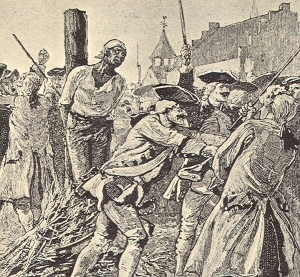
executed. Thirteen black men burned at the stake and seventeen
more hanged. In addition, four alleged white ringleaders--two men
and two
women--made trips to New York City's gallows....[continued]