×
Check-out the new Famous Trials website at www.famous-trials.com:
|
A Journal of
the Proceedings in the Detection of the Conspiracy (1744):
The Trials of Cuffee and Quack by Justice Daniel Horsmanden 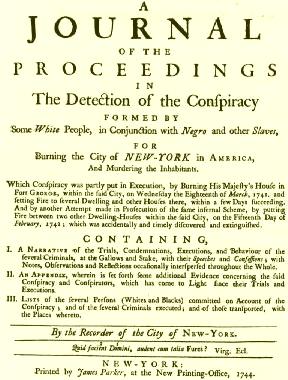 TUESDAY, MAY 12 Arthur Price having been found by experience to be very adroit at pumping out the secrets of the conspirators, in the two instances of Peggy and Sarah Hughson the daughter, before set forth; the undersheriff was ordered to put Cuffee (Mr. Philipse's negro) into the same cell with him, and to give them a tankard of punch now and then, in order to cheer up their spirits, and make them more sociable. These directions were accordingly observed, and produced the desired effects; and one of the judges being acquainted that Arthur had something to communicate he went up this morning in order to examine him. Deposition taken before one of the judges, No.3. - Arthur Price being duly sworn, saith,
2. "That Cuffee told him, that Quack was
married to a
negro wench who is cook to the fort, to the governor as he understood;
that
they were all to meet at Hughson's the Sunday after Quack was sworn;
but some
came and some did not. That the deponent, upon some further discourse,
asked
Cuffee how Quack could do it? (meaning the setting fire to the house in
the
fort) Cuffee answered, he could not tell how he did it; but that Quack
was to
do it, and did do it. 3. "That Cuffee said, they were to meet and
have a club
at John Hughson's in the Easter holidays, but that the d-d constables
hindered
them. 4. "That he asked Cuffee, whether he did not
think that
the firing would be found out; he replied, no, by G-d, he did not think
it ever
would. 5. "That he further asked Cuffee, if he was not afraid, that the two negroes who were to be executed on Monday, would discover (the affair about the firing of the fort and town meaning) Cuffee answered, he was not afraid of that; for that he was sure they would be burnt to ashes before they would discover it; he would lay his life on it. 6. "That yesterday the deponent having some
further
discourse with Cuffee, he said, he wondered why they only took up the
Long
Bridge boys, and did not take up those of the Smith's Fly; for he
believed, if
the truth was known, they (the Smith's Fly negroes meaning) were
as much
concerned as they (of the Long Bridge meaning.)" Upon this deposition, Quack ( WEDNESDAY, MAY 13 Deposition before the
judges, No.2. - Mary Burton,
being duly sworn, deposed, 1. "That a day or two after she was examined
before the
grand jury, she was coming by Vaarck's door in the Broadstreet of this
city,
and saw a negro of the said Vaarck's, who (now at the time of her
examination
being produced) called himself by the name of Bastian, but used to be
called by
the negroes, Tom Peal, who asked the deponent, whether she had
discovered any
thing about the fires? To which the deponent answered no. To which he
replied, d-n you, it was not best for you, for fear
you
should be burnt in the next. 2. "That Quack the negro man now produced to
her, she
has often seen at Hughson's door along with Philipse's Cuff, Caesar
(Vaarck's),
and Prince (Auboyneau's), but never saw Quaco within Hughson's house,
as she
remembers. 3. "That she has seen Jack (Sleydall's, the
tallow-chandler) very often at Hughson's house, and believes he was
very well
acquainted with Hughson's eldest daughter Sarah; but does not remember
she ever
saw him there at the times of the meetings of the negroes, when they
talked
about fires; but from the kindness shewn to him by Hughson, his wife,
and
daughter aforesaid, she had great reason to think he was in their
secrets. 4. "That she hath often times seen many
negroes at
Hughson's house, she believes thirty together, especially on a Sunday;
many of
them playing at dice, whose faces she could remember if she saw them;
and she
believes there were thirty of them concerned in the conspiracy about
the fires;
and some country negroes, particularly one Jamaica. 5. "That Hughson arid his wife, and Peggy,
and Sarah
Hughson the daughter, used, at the meetings of the negroes, to be the
forwardest
of any of them in talking about fires, (that is to say) that they would
burn
the fort; then they would go to the Fly and burn the whole town, and
destroy
all the people; to which all the negroes present were consenting; and
by name
Cuff, Caesar and Prince, Albany,
Tom Peal, alias Bastian,
amongst the rest. ... 7. "That she knows Jonneau (Vaarck's negro) and has seen him at Hughson's house a drinking with other negroes; but don't remember he was present at any time of the discourse about the fires, or killing the white people." Jonneau, THURSDAY, MAY 14 This day Sandy alias Sawney (Niblet's negro
boy) was brought
down from Deposition before the
judges-No. 3.-Mary 1. "That at the time when she saw the
meetings of the
several negroes at Hughson's house, as mentioned in the deponent's
deposition
of yesterday, the said Hughson said, they
were all sworn, meaning the negroes and all the white
people
present, (as she understood) that is, Hughson himself, his wife, and
daughter
Sarah, and Peggy, and she understood by Hughson, that the purport of
the oath
was that they were not to discover the
secrets about firing the fort, the houses at the fly, and the whole
town; and
about murdering the white people: and Hughson said to the negroes
present,
which were Cuff, Caesar and Prince; now you
must take care, for you are all sworn; and the deponent at
the time
saw a bible (as she took it to be) in Hughson's hand; and when the
deponent
came into the room, he laid it upon the table: and then Caesar spoke to
the
deponent, and cautioned her not to tell; and Hughson made answer, that
she
dared not; and Cuff said, d-n his bl-d, if he would tell of any, if he
was burnt; and so said the other two
negroes; and so said Hughson, his wife, their daughter Sarah, and Peggy. 2. "That Hughson asked Caesar if he could
get any
others (meaning the negroes) to help them? Caesar answered, he could
get
enough, who dared not but go if he spoke. 3. "That she saw Caesar pay Hughson twelve
pounds in eight
shilling Spanish pieces, as Hughson said, after counting them; which
was paid
him, in order to buy guns; and that Hughson afterwards went abroad with
his
boat, and was about three days, or thereabouts, and brought back with
him seven
or eight guns, three pistols and four swords, which were hid away under
the
boards in the garret floor in Hughson's house." FRIDAY, MAY 22 The grand jury having been informed that
Sawney, Niblet's
negro boy, was brought to town and committed upon suspicion of being a
confederate
in the conspiracy, they requested the court that he might be brought
before
them; which being accordingly done; upon interrogation Sawney
denied he knew any
thing of the fires, or any conspiracy concerning them. The grand jury
for a
long time argued with him, to persuade him to speak the truth; being
convinced
from the evidence of Mrs. Carpenter's negro, who already had been
examined by
them, that he could give some account of the fires. They told him if he
would
speak the truth, the governor would pardon him, though he had been
concerned in
them; and this was the time for him to save his life by making a free
and
ingenuous confession; or in words to this purpose. He answered, that
the time
before after that the negroes told all they knew, then the white people
hanged
them. The grand jury assured him, that it was false; for that the
negroes which
confessed the truth and made a discovery, were certainly pardoned, and
shipped
off: (which was the truth) - and upon this assurance he began to open,
and gave
the following evidences. Examination
of
Sawney (Niblet's negro) before the grand jury, No. I.-He said, 1. "That about three weeks before the fire
at the fort,
Quack (Mr. 2. "That he heard the said Quack and Mr.
Philipse's
Cuffee say; they would set fire to Mr. Philipse's storehouse. 3. "That Cuffee said, d-n him, that hang him
or burn
him, he would set fire to the town. 4. "That William (Capt. Lush's Spanish
negro) told him,
that if they did not send him over to his own country, he would ruin
the city. 5. "That Curracoa Dick said, he would set
fire to Mr.
Van Zant's storehouse; and that he was to be a captain. 6. "That Juan (Capt. Sarly's negro) said, he
would set
fire or help to set fire to Hilton's house; and was to be captain of
the fly
company. 7. "That Francis (Capt. Bosch's negro) threw
fire into
Mr. Bancker's yard, and told him so. 8. "That Anthony (Mr. Peter Delancey's negro
Spaniard)
said, he would burn his master's house. 9. "That Augustine (McMullen's Spanish
negro) said, he
would burn his master's house; and was to have been an officer. 10. "That Jack and an old man (Gerardus
Comfort's)
said, they would set fire to their master's house, and assist in their
designs. 11. "That Cuffee (Gomez's) said, he would
burn his
master's house; and was to have been an officer in the Fly company;
said so to
a country fellow, and he heard him. 12. "That just by Coenties-market he heard
Patrick
(English's negro) and Cato (Col. Moore's) say; they would set fire to
their master's
houses. 13."That Fortune (Wilkins') was to set fire
to his
master's house. 14. "Sawney being asked what the negroes
proposed by
rising and doing all this mischief? He answered, 'that their design was
to kill
all the gentlemen, and take their wives;' and that Quack and Cuffee
(Philipse's) were particular persons that talked so. 15. "That while he was in jail, Francis (Capt. Bosch's) said, he would kill him if he told any thing; and that when Mr. Mills came for him, several negroes winked as he came out. 16. "Being asked if Quack (Mr. Walter's
negro) was
knowing or concerned in the affair: he answered, no, though he was
always cursing
the white people. 17. "Being asked if he had much acquaintance
with
Danby, the governor's negro, and if he knew any thing? He answered, he
had very
little; and he believed not. 18. "That Caesar (Vaarck's) that was hanged
was
concerned and was to have been captain of the Long Bridge Company. 19. "That about a fortnight before the fire
at the
fort, at Comfort's house, he overheard Jack and the old man (Cook) in
company
with four other negroes he did not know, talk about the rising of the
negroes;
and Jack said, that there was not enough of them, and he would stay
longer, or
to that purpose." FRIDAY, MAY 29 [Quack (Roosevelt's) and
Cuffee (Philipse's) were indicted for conspiracy to murder the
inhabitants of Court: Did the prisoner Cuffee ever threaten you so?
"That about three weeks after she came to Hughson's, which was about midsummer last, the negroes were there talking of the plot and some of them said perhaps she would tell; and Coffee said no, she would not, he intended to have her for a wife; and then run up to her; and she had a dishclout in her hand, which she dabbed in his face, and he ran away. "That at a meeting of the negroes at
Hughson's house,
Hughson said they were all sworn, negroes and white people present, as
she
understood; that is, Hughson, his wife, daughter Sarah, and Peggy, and
that the
purport of the oath was, that they were not to discover the secrets
about
firing the fort, the houses at the Fly, and the whole town, and about
murdering
the white people; and Hughson said to the negroes present, which were
Coffee,
Caesar and Prince, now you must take care, for you are all sworn; and
at the
same time the witness saw a bible, as she took it to be, in Hughson's
hand, and
when the witness came into the room he laid it upon the table; and then
Caesar
spoke to the witness and cautioned her not to tell, and Hughson made
answer
that she dared not; and Coffee said, d-n his bl-d, if he would tell of
any, if
he was burnt; and so said the other two negroes, and so said Hughson,
his wife,
daughter Sarah, and Peggy." [Arthur
Price also restated an earlier deposition of May 12 (no. 3), in
which he testified that Cuffee had confessed to being
part of a sworn conspiracy and to being part of a theft ring. He added:] "That after Quack, the other prisoner at the
bar, was
committed, Cuffee never mentioned any thing concerning the former
discourse to
the witness, but read sometimes, and cried very much." [Six white witnesses testified that they
had seen Cuffee
at the fire at Col. Philipse's storehouse. One testified that he saw
Cuffee
whistling and dancing as he intentionally spilled buckets of water that
could have been used to subdue the fire. A slave named Fortune
testified that nd purposely spilling the buckets of water with which
the brigade was attempting to put out the fire. A slave (Fortune)
testified
that Quack had told him that he was going to burn down the fort.
Another slave
(Sandy) stated that Quack had admitted to burning the fort.] Witnesses called at the request of the
prisoners. - Jacob
Bursen, Peter Jay, Lewis Parent, Gerardus Beckman, Mr. Niblet, Captain
Rowe,
John Roosevelt and his son, Catherine Wells, Adolph Philipse, Esq. Adolph Philipse, Esq. (Cuffee's master)
said, that all he
could declare about him was, "that the afternoon his nephew's (col.
Philipse's) storehouse was on fire, he had left him at home not long
before the
alarm of the fire at work, sewing a vane upon a board for his boat;
that as to
his character he could say nothing." Quack's master (Mr. Roosevelt) and his son, both declared, "that Quack was employed most part of that morning the fort was fired, from the time they got up, in cutting away the ice out of the yard; that he was hardly ever out of their sight all that morning, but a small time while they were at breakfast; and that they could not think he could that morning have been from their home so far as the fort." Captain Rowe and Beckman said, "Quack was
employed last
year to work at the new battery, and that he minded his business very
well." The other witnesses called at the request of the prisoners, said
nothing more material. The Prisoners being asked what they had to
offer in their defense,
they offered nothing but peremptory denials of what had been testified
against
them, and protestations of their innocency. Mr. Smith [William Smith Sr., a lawyer for the
prosecution] then proceeded to
sum up and remark upon the evidence, and
spoke as followeth: "May it Please your honours, and you,
gentlemen of
the jury, "The part assigned to me on this trial, is
to sum up
the evidence which you have heard; and in general it may be observed,
that a
most horrid conspiracy has been formed, to burn this city, and to
destroy the
white people. "That great numbers of persons have been
concerned in
the plot; some whites, and many blacks. That the place of their general
rendezvous
was the house of John Hughson. That there thirty negroes have met at a
time.
That their meetings were chiefly on Sundays. That Hughson, as the
captain of
this hellish band, swore himself and others into this dark confederacy.
That some
arms and ammunition were provided by Hughson for the purpose; and that
the
night season was agreed on for the putting it in execution. "Gentlemen, no scheme more monstrous
could have
been invented; nor can any thing be thought of more foolish, than the
motives
that induced these wretches to enter into it! What more ridiculous than
that
Hughson, in consequence of this scheme, should become a King! Caesar,
now in gibbets, a Governor! That the white men should be all
killed, and
the women become a prey to the rapacious lust of these villains! That
these
slaves should thereby establish themselves in peace and freedom in the
plundered wealth of their slaughtered masters! It is hard to say
whether the
wickedness or the folly of this design is the greater; and had it not
been in
part executed before it was discovered, we should with great difficulty
have
been persuaded to believe it possible, that such a wicked and foolish
plot
could be contrived by any creatures in human shape. ''Yet, gentlemen, incredible as such a plot
would have
seemed to have been, the event has in part proved it to be real. Whence
else
could so many fires have been lighted up all around you in so short a
time,
with evident marks of willful design? A design that could not be
executed but
by several hands. "Now gentlemen, the prisoners at the bar
stand charged
with being principal parties in this tragical design, and two of the
prime incendiaries:
Quack for burning his majesty's house in the fort, and Cuffee for
burning col.
Philipse's storehouse." Then concluded, "Thus, gentlemen, I have distinguished the
several points
of the evidence against the prisoners, and have repeated the substance
of what
each witness has said to each point, and shall leave it to you to
determine
whether the prisoners are guilty or not. I have endeavored to lay no
more
weight upon any part of the evidence, than it will well bear; and I
hope I have
not urged any consequence which the fact proved will not fairly warrant. "Gentlemen, the prisoners have been
indulged
with the same kind of trial as is due to free men, though they might
have been
proceeded against in a more summary and less favourable way. The negro
evidence,
in the manner in which it has been produced, is warranted by the act of
assembly that has been read to you; the law requires no oath to be
administered
to them, and indeed it would seem to be a profanation of it, to
administer it
to a Heathen in the legal form. You have seen that the court has put
them under
the most solemn caution, that their small knowledge of religion can
render them
capable of. The being and perfections of an Almighty, all knowing, and
just
God, and the terrors of an eternal world, have been plainly laid before
them,
and strongly pressed upon them. Unless they were professed Christians,
and had
taken upon them the bonds and obligations of that religion, their word,
with
the cautions that have been used, I suppose will be thought by you, as
satisfactory as any oath that could have been devised. But, gentlemen,
the
court has no power to administer an oath, but in the common form, and
if Pagan
negroes could not be received as witnesses against each other, without
an oath
in legal form, it is easy to perceive that the greatest villainies
would often
pass with impunity." Then the jury were charged, and a constable
was sworn to
attend them as usual; and they withdrew; and being soon returned, found
the
prisoners guilty of both indictments. The prisoners were asked, what
they had
to offer in arrest of judgment, why they should not receive sentence of
death?
and they offering nothing but repetitions of protestations of their
innocence;
the third justice Justice Horsmanden proceeded to sentence, as followeth: Quack
and Cuffee, the criminals at the bar, ''You both now stand convicted of one of the
most horrid and
detestable pieces of villainy, that ever satan instilled into the heart
of
human creatures to put in practice; ye, and the rest of your colour,
though you
are called slaves in this country; yet you are all far, very far, from
the
condition of other slaves in other countries; nay, your lot is superior
to that
of thousands of white people. You are furnished with all the
necessaries of
life, meat, drink, and clothing, without care, in a much better manner
than you
could provide for yourselves, were you at liberty; as the miserable
condition
of many free people here of your complexion might abundantly convince
you. What
then could prompt you to undertake so vile, so wicked, so monstrous, so
execrable
and hellish a scheme, as to murder and destroy your own masters and
benefactors? nay, to destroy root and branch, all the white people of
this
place, and to lay the whole town in ashes. "I know not which is the more astonishing,
the extreme
folly, or wickedness, of so base and shocking a conspiracy; for as to
any view
of liberty or government you could propose to yourselves, upon the
success of
burning the city, robbing, butchering, and destroying the inhabitants;
what
could it be expected to end in, in the account of any rational and
considerate
person among you, but your own destruction? And as the wickedness of
it, you might
well have reflected, you that have sense, that there is a God above,
who has
always a clear view of all your actions, who sees into the utmost
recesses of
the heart, and knoweth all your thoughts; shall he not, do ye think,
for all
this bring you into judgment, at that final and great day of account,
the day
of judgment, when the most secret treachery will be disclosed, and laid
open to
the view, and everyone will be rewarded according to their deeds, and
their use
of that degree of reason which God Almighty has entrusted them with. "Ye that were for destroying us without
mercy, ye
abject wretches, the outcasts of the nations of the earth, are treated
here
with tenderness and humanity; and, I wish I could not say, with too
great indulgence
also; for you have grown wanton with excess of liberty, and your
idleness has
proved your ruin, having given you the opportunities of forming this
villainous
and detestable conspiracy; a scheme compounded of the blackest and
foulest
vices, treachery, blood-thirstiness, and ingratitude. But be not
deceived, God
Almighty only can and will proportion punishments to men's offences; ye
that
have shewn no mercy here, and have been for destroying all about ye,
and
involving them in one general massacre and ruin, what hopes can ye have
of
mercy in the other world? For shall not the judge of all the earth do
right?
Let me in compassion advise ye then; there are but a few moments
between ye and
eternity; ye ought therefore seriously to lay to heart these things;
earnestly
and sorrowfully to bewail your monstrous and crying sins, in this your
extremity;
and if ye would reasonably entertain any hopes of mercy at the hands of
God, ye
must shew mercy here yourselves, and make what amends ye can before ye
leave
us, for the mischief you have already done, by preventing any more
being done.
Do not flatter yourselves, for the same measure which you give us here,
will be
measured to you again in the other world; ye must confess your whole
guilt, as
to the offences of which ye stand convicted, and for which ye will
presently
receive judgment; ye must discover the whole scene of iniquity which
has been
contrived in this monstrous confederacy, the chief authors and actors,
and all
and every the parties concerned, aiding and assisting therein, that by
your
means a full stop may be put to this horrible and devilish undertaking.
And
these are the only means left ye to shew mercy; and the only
reasonable ground
ye can go upon, to entertain any hopes of mercy at the hands of God,
before
whose judgment seat ye are so soon to appear. "Ye cannot be so stupid, surely, as to
imagine, that
when ye leave this world, when your souls put off these bodies of clay,
ye
shall become like the beasts that perish, that your spirits shall only
vanish
into the soft air and cease to be. No, your souls are immortal, they
will live
forever, either to be eternally happy, or eternally miserable in the
other
world, where you are now going. "If ye sincerely and in earnest repent you
of your
abominable sins, and implore the divine assistance at this critical
juncture,
in working out the great and momentous article of the salvation of your
souls;
upon your making all the amends, and giving all the satisfaction which
is in
each of your powers, by a full and complete discovery of the
conspiracy, and of
the several persons concerned in it, as I have observed to ye before,
then and
only upon these conditions can ye reasonably expect mercy at the hands
of God
Almighty for your poor, wretched and miserable souls. "Here ye must have justice, for the justice
of human
laws has at length overtaken ye, and we ought to be very thankful, and
esteem
it a most merciful and wondrous act of Providence, that your
treacheries and villainies
have been discovered; that your plot and contrivances, your hidden
works of
darkness have been brought to light, and stopped in their career; that
in the
same net which you have hid so privly for others your own feet are
taken: that
the same mischief which you have contrived for others, and have in part
executed,
is at length fallen upon your own pates, whereby the sentence which I
am now to
pronounce will be justified against ye; which is, "That you and each of you be carried from hence to the place from whence you came, and from thence to the place of execution, where you and each of you shall be chained to a stake, and burnt to death; and the lord have mercy upon your poor, wretched souls." Ordered, that the execution of the said
Quack and Cuffee be
on Saturday the 30th of this instant, between the hours of one and
seven
o'clock in the afternoon of the same day. SATURDAY, MAY 30 This day Quack and Cuffee were executed at the stake according to sentence. The spectators at this execution were very
numerous; about
three o'clock the criminals were brought to the stake, surrounded with
piles of
wood ready for setting fire to, which the people were very impatient to
have
done, their resentment being raised to the utmost pitch against them,
and no
wonder. The criminals shewed great terror in their countenances, and
looked as
if they would gladly have discovered all they knew of this accursed
scheme,
could they have had any encouragement to hope for a reprieve. But as
the case
was, they might flatter themselves with hopes: they both seemed
inclinable to
make some confession; the only difficulty between them at last being,
who
should speak first. Mr. Moore, the deputy secretary, undertook singly
to
examine them both, endeavoring to persuade them to confess their guilt,
and all
they knew of the matter, without effect; till at length Mr. Roosevelt
came up
to him, and said he would undertake Quack, whilst Mr. Moore examined
Cuffee;
but before they could proceed to the purpose, each of them was obliged
to
flatter his respective criminal that his fellow sufferer had begun,
which
stratagem prevailed: Mr. Roosevelt stuck to Quack altogether, and Mr.
Moore
took Cuff's confession, and sometimes also minutes of what each said;
and
afterwards upon drawing up their confessions in form from their
minutes, they
therefore intermixed what came from each. Quack's
confession at the stake. He said, 1. "That Hughson was the first contriver of
the whole
plot, and promoter of it; which was to burn the houses of the town;
Cuffee
said, to kill the people. 2. "That Hughson brought in first Caesar
(Vaarck's);
then Prince (Auboyneau's); Cuffee (Philipse's); and others, amongst
whom were
old Kip's negro; Robin (Chambers's); Cuffee (Gomez's); Jack (Codweis's)
and
another short negro, that cooks for him. 3. "That he Quack did fire the fort, that it
was by a
lighted stick taken out of the servants hall, about eight o'clock at
night,
that he went up the back stairs with it and so through Barbara's room,
and put
it near the gutter, betwixt the shingles, and the roof of the house. 4. "That on a Sunday afternoon, a month
before the
firing of the fort, over a bowl of punch, the confederates at Hughson's
(amongst whom were the confederates above named, Albany, and Tickle,
alias
Will, Jack and Cook (Comfort's); old Butchell; Caesar, and Guy
(Horsfield's);
Tom (Van Rants's); Caesar (Peck's); Worcester, and others) voted him
Quack, as
having a wife in the fort, to be the person who should fire the fort,
Sandy,
and Jack (Codweis's); Caesar, and Guy (Horsfield's); were to assist him
in it. 5. "That Hughson desired the negroes to
bring to his
house, what they could get from the fire, and Hughson was to bring down
country
people in his boat to further the business, and would bring in other
negroes. 6. "That forty or fifty to his knowledge
were concerned,
but their names he could not recollect (the mob pressing and
interrupting). 7. "That Cuffee (Gomez's); and Caesar
(Peck's), fired
Van Zant's storehouse. 8. "That Mary Burton had spoke the truth,
and could
name many more. 9. "Fortune (Wilkins's) and 10. "Being asked what view Hughson had in
acting in
this manner? He answered, to make himself rich. 11. "That after the fire was over, Quack was
at
Hughson's house, Jack (Comfort's), a leading man, Hughson, wife and
daughter
present, and said, the job was done, meaning the fire; that he went
frequently
to Hughson's house, and met there Tickle and Albany. 12. "Quack said his wife was no ways
concerned, for he
never would trust her with it: and that Denby knew nothing about the
matter. 13. " 14. "Said he was not sworn by Hughson, but
other
were." McDonald (the witness against Quack upon the trial) at the stake
desired Mr. Pinhorne to ask Quack, whether he had wronged him in what
he had
said of him at court? He answered no; it was true he did pass him at
the fort
gate, about eleven o'clock that morning. Cuffee's
confession at the stake. - He said, 1. "That Hughson was the first contriver of
all, and
pressed him to it: that he Cuffee was one of the first concerned. 2. "The fire was intended to begin at
Comfort's
shingles, and so through the town. 3. "Old Kip's Negro; Robin (Chambers's);
Jack
(Comfort's); and Cuffee (Gomez's); were of the conspirators: 4. "That he was sworn, and Caesar and Prince
also by
Hughson. 5. "That Cuffee (Gomez's) and Caesar
(Peck's); burnt
Van Zant's storehouse. 6. "That 7. "That he set fire to the storehouse as
sworn against
him, that when his master went to the Coffee-House, he ran out of the
other
door, and went the back way into the storehouse, having lighted
charcoal in his
pocket between two oyster shells, he put the fire between the ropes and
the
boards, and leaving it on fire, went home. 8. "That Hughson's people were to raise a mob to favour the design. 9. "That the evidence that Peterson, did see
him (was
true); that Fortune did see him the night before. 10. "That Fortune knew and was as deeply
concerned as
he; and 11. "There was about fifty concerned; and
that all were
concerned that a constable who stood by had seen all at Hughson's
house." After the confessions were minuted down
(which were taken in
the midst of great noise and confusion) Mr. Moore desired the sheriff
to delay
the execution until the governor be acquainted therewith, and his
pleasure
known touching their reprieve; which, could it have been effected, it
was
thought might have been means of producing great discoveries; but from
the
disposition observed in the spectators, it was much to be apprehended,
there
would have been great difficulty, if not danger in an attempt to take
the criminals
back. All this was represented to his honour; and before Mr. Moore
could return
from him to the place of execution, he met the sheriff upon the common,
who
declared his opinion, that the carrying the negroes back would be
impracticable; and if that was his honour's order it could not be
attempted
without a strong guard, which could not be got time enough; and his
honour's
directions for the reprieve being conditional and discretionary, for
these
reasons the execution proceeded. MONDAY, JUNE 1 Examination
of 1. "That he heard by captain Lush's house,
about six of
the Spaniards (about fourteen days before the fort was burnt) say, that
if the
captain would not send them to their own country, they would ruin all
the city;
and the first house they would burn should be the captain's, for they
did not
care what they did: He (Sandy) stood by Arden's door, and they did not
(as he
thought) see him; and that (pointing to Lush's house) they said, d-n
that son
of a b-h, they would make a devil of him: which was the first time he
ever
heard of the conspiracy. 2. "That the
second time Quack called to him by Coenties Market, and told him he
wanted to
speak to him; and said, will you help to burn the fort? and answered as
he said
at the trial, and in his examination before the grand jury; said that
Quack
told him the first time he met him, he would make an end of him. 3. "That the third time, at Comfort's house,
one
Sunday, when Comfort's Jack called to him to come to him, and he went
in, Sarah
(Burk's negro wench) d-d him, and bid him drink, having before refused. 4. "That there was a great number of negroes present, and about six Spanish negroes among them; but none of them were the same that he saw at Lush's. That he did drink. 5. "That Comfort's Jack brought out about
eleven
penknives, which were rusty; some complained their knives were dull and
would
not cut, which they went to sharpen on a stone; Jack (Comfort's) said
his knife
was so sharp, that if it came a-cross a white man's head, it would cut
it off;
on which he (Sandy) said, if you want to fight, go to the Spaniards,
and not
fight with your masters. 6. "That they asked him (and Comfort's Jack
in
particular) if he would help to burn some houses; he cried: on which
Jack
(Comfort's) said, d-n you, do you cry? I'll cut your head off in a
hurry, and surrounded
him; on which Burk's wench said he deserved it, if he would not say
yes, on
which he consented, and said yes; whereupon they did not threaten him,
but bid
him say nothing to black or white about it, and everyone would do his
part, and
take a round, and fire the town. 7. "That Jack (Comfort's) said they had not
men enough
this year, but next year would do it, everyone present was to set his
master's
house on fire first, and then do the rest at once, and set all the
houses on
fire in the town, which when they had done, they would kill
all the white men, and have their
wives for themselves .... 9. "That Augustine and Wilkins' Fortune were
to burn
their master's houses, which he heard them say, as they were talking by
Frazier's
corner, about a week before the fort was burnt. 10. "That at the aforesaid meeting at
Comfort's Jack,
the old man, and the old woman, and three of the Spaniards were sworn
to the
effect, that the first thunder that came, might strike them dead, if
they did
not stand to their words. 11. "That they
asked him to come again the next day to be
sworn;
the rest said they would come to be sworn the next day."
|