×
Check-out the new Famous Trials website at www.famous-trials.com:

|
Before March 16, 1968, there were 700 residents of the hamlet of My Lai 4 in Quang Ngai Provice. After March 16, 1968, My Lai 4 was no more. In just over four hours beginning about 7:30 A. M., over 500 villagers were killed. A number of the victims were raped before they were murdered. The thatch-roofed huts and red-brick homes of the village were burned or exploded. Livestock was killed, wells were poisoned. Only the bodies, growing putrid in the tropical sun, remained. It took over three days for survivors to bury the dead. It is not possible here to tell the stories of all the victims or survivors of My Lai 4. Most stories will never be known. Michael Bilton and Kevin Sim, in their book, Four Hours in My Lai (Viking Press, 1992), interviewed survivors and investigators to give readers a picture of the terror of that March morning. Here are a few of the stories from Bilton's and Sim's book: A Few Survivors
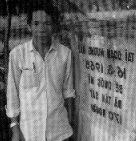
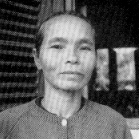
Truong Thi Le [pictured above],
aged 30, lost nine members of
her immediate family including her husband, mother, three brothers, and
a 17year old daughter. When the shelling started, he mother and
two
of her children hid in a corner of their home. The Americans
arrived
and dragged them away and she became separated from them. Instead
she was rounded up with her 6-year-old son,Do Ding Dung. When the
shooting began she pushed him into a paddy field beside the trail and
lay
on top of his boy, pressing him down, urging him not to cry. She
wanted to see if they could save themselves. Two corpses were on
top of her and when she raised her head slightly as the shooting
stopped
she could see soldiers still moving. They appeared to be pointing
toward people on the ground. They began shooting those who were
alive
all over again.
Eventually they left and Mrs. Le walked along the path unable to believe her eyes---women and children were lying dead everywhere. Her three brothers were killed in a bomb crater, but most sad of all, her daughter was sitting dying, holding her grandmother, who was already dead. She said to Mrs. Le: "Mother, I think I am very badly injured, maybe I'll die, I don't think I can survive. You have survived, you had better take little brother away. Please don't stay here as the Americans will shoot you." Mrs. Le cried her heart out. Virtually her whole family was dead. She carried her son into the paddy field and lay down again to hide. The world had ended. Her husband had left for the rice fields at first light that morning and she never saw him again. Nine members of her family had died. When the troops left she carried her child home in her arms, but there was no home left. It was burned to cinders . . . Truong Moi, an 18-year-old fisherman, was working at his nets in the river out in the paddies, seven hundred meters beyond the irrigation dike on the western side, when the Americans landed between him and the village. He had dropped his nets the previous evening and was up early at first light to check his catch and collect the fish. Soon after the shelling stopped, troops landed in waves about 500 meters away from his position. They then spread out before they entered the village, shooting as they went. He hid frightened behind a bush, worried that he might be shot but more concerned for his family, especially his mother. The helicopters continued firing around the edges of the paddies for half an hour. He could see smoke inside the village itself, coupled with explosions and a great deal of shooting. Trees were falling and homes were set on fire. In the afternoon he went back tot the village and found the charred remains of his elderly mother who had been shot dead in their home. All the farm animals had been slaughtered. He searched for the rest of his family. Along the paths
and in
the ditches beside the fields there were piles of bodies
everywhere. Entire families had been killed. The throats
of some of the children had been slit; others were disemboweled and
completely naked. Moi's sense of horror and outrage was combined
with a deep sense of injustice. His had been a very quiet
and peaceful community, virtually untouched by the war, apart from
the shelling and bombing. They saw few soldiers. The
Pham Thi Thuam, a 30-year-old widow caring for her
6-year-old
daughter, lost six members of her family---father, sister,
younger brother, and three nephews. She and her daughter were
pushed into the ditch just before the firing started. Hiding
underneath those dead on top of her, she pushed her child under her
stomach. With bodies weighing her down she put her
hand over her daughter's mouth and told her to keep quiet, not to cry,
and to pretend to be dead. The soldiers waited to see if
anyone moved and shot them again. They fired a second series
of shots sometime later, and then a third. Much later, a long
time after the shooting hd ended, she pushed some of the corpses away
to free herself. All around her were dead bodies
curled up. She grabbed her daughter and ran across to a
path.
They were seen escaping and more shots were fired. Another
woman running behind them was hit and fell down but Mrs. Thuam just
hung onto her daughter and did not stop. When she
Truong Ngu, 45, had crept back to his home from the paddies just as a soldier was escorting his family at gunpoint down the main trail. He stayed for hours listening to numerous bursts of gunfire before eventually coming out of hiding to discover his mother dead from wounds to the lower part of her body and his wife and three children also dead, shot in the head. Near them, just off the trail, were the bodies of his brother and sister-in-law and their four children. Ngu, working with another farmer called Do Hoa, placed fifteen people in one grave . . . Phan Chot, 37, was working in the fields before
first
light
and on hearing the helicopters ran to the rough dirt road leading to
Quang Ngai and crossed over, hiding in the lee of a geographical
feature
the locals called Elephant Hill. The Americans labeled it Hill 85
on their maps, because that was its height in meters. Phan
returned
to the burned-out rubble of his home to find his
daughter, Hai, shot in the back. Despite a long search he could
not find the rest of his family. In the darkness he carried his
Pham Thi Trine, 10, watched her family being wiped
out.
Before the massacre hers was among the most wealthy families in
the area. They lived at the northern end of the village in a
large, well-built home with a verandah, sheltered by tall bamboo
trees. When the shelling started the family hid in the tunnel
underneath the house. The Americans arrived from the rear of the
property and pulled them out of the tunnel, rounding them up
outside.
Three buffaloes in the stable were shot as Trinh hid
behind her mother's skirt. When the troops turned their guns
on the people she ran back into the house, and by some miracle,
the soldiers failed to spot her escape. A few minutes later she
heard her sister, Mui, shouting. Trinh peeked out from a
window and saw Mui naked on the ground trying to force off an American
who was on top of her. When he finished raping
Mui the GI got up, pulled on his pants, and shot her. Their
mother
was lying seriously injured on the verandah, holding Trinh's
seven-month-old brother in one arm, clutching her gaping wound with
the other. There was blood on her legs. When she
thought the Americans had gone Trinh went to assist her mother.
In a whisper she told the child to flee: "Run away and hide, so
you can live . . . as for me, I think I am going to die . . . I can't
live much longer." Other members of the family were lying
Pham Ky, aged 34, his wife, Nguyen Thi Meo, 32,
his
72-year-old
mother, Vo Thi No, and his daughters Tuong, aged 8,
Xiu, 4, and Pham Cu, 2, had hidden in a bunker as
soon
as they heard the sound of shells bursting on the village. The
Negro
ordered them out in Vietnamese and all three men took them to the
southeastern
edge of the village and told them to run for it:
"Di, di, mau!"---"Go, go quicky!" They fled across the fields
to the coast road and ended up at the village of Son Hoi. A Few Victims
Phuong Thi Moi, 13, and Do Thi Man, 12, were found inside their homes lying naked, their vaginas appearing to have been savagely ripped open. Pham Thi Nho, 19, had been shot in the stomach and had massive bruising on her legs . . . Do Thi Nguyen, aged 10, was found in Ba Xam's house by her mother, Pham Thi Day, a 45 year old widow who survived the killings. When Do Vien examined the little girl's body he could clearly see her clothes had been torn off. Her vagina had been ripped and there was blood all over the area. There were no bullet wounds or any other visible signs of injury . . .
|

 TRUONG
THI LEE
TRUONG
MOI
PHAM THI THUAM
TRUONG
THI LEE
TRUONG
MOI
PHAM THI THUAM