|
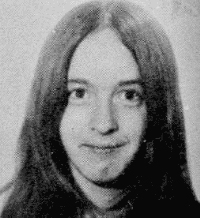
Susan Atkins (aka Sadie Mae Glutz)
As a young teen, Susan Atkins sang in
her church choir in San Jose, California and nursed
her mother, who was dying of cancer. After her
mother's death, however, her life went seriously off
course. She fought with her father, dropped out
of high school, and moved to San Francisco where
she became a topless dancer, hustler, and gun moll.
While living in San Francisco's
Haight-Ashbury district in 1967, Atkins met Charles
Manson. In her grand jury testimony,
Atkins said Manson "gave me the faith in myself to
be able to know that I am a women....I gave myself
to him." Atkins said there was "no limit" to
what she would do for "the only complete man I have
ever met." To Atkins, Manson "represented a
Jesus Christ-like person."
Atkins spent a year-and-a-half
traveling around the Southwest with other Manson
Family members on an old school bus, taking
lots of LSD, and practicing free love with Manson
Family members of both sexes. In 1968, she
bore a child, who Manson helped deliver, named
Zezozose Zadfrack Glutz. Atkins moved into the
Family's Spahn Ranch in 1969. On August 8 of
that year, she obeyed Manson's order to join
in the what would be the bloody attack that left
five dead at the home of actress Sharon Tate.
Atkins later admitted stabbing Voytek Frykowski and
holding down Tate while she was stabbed repeatedly
by Tex Watson. She also said she wrote "PIG"
using Tate's blood on a door of the residence.
While being held on other charges in
1969, Atkins explained her decision to participate
in the massacre at the Tate residence to another
inmate, Virginia Graham: "You have to have real love
in your heart to do this for people."
The LAPD proposed granting Atkins
prosecutorial immunity in return for her testimony
that could convict Manson and other Family
members. Prosecutor Vincent Bugliosi objected,
saying "We don't give that gal anything!" In
the end, the prosecution offered not to seek the
death penalty in return for her trial testimony--an
offer which Atkins, after testifying before the
Grand Jury, refused.
Atkins, then twenty-two, was
convicted of first-degree murder and sentenced to
death in 1970. Her sentence was reduced to
life imprisonment when the California Supreme Court
declared the state's death penalty unconstitutional.
Atkins continues to reside at this
writing at the California Institution for Women in
Frontero. In September 1974, Atkins said her
cell door opened and "a brilliant light poured over
her." Describing the experience in her 1977
book Child of Satan, Child of God, Atkins
said she believed the light was Jesus, telling her
she had been forgiven.
Although Atkins has had an exemplary
prison record, she was never paroled and died of
brain cancer on September 24, 2009. She was
61.
|
|
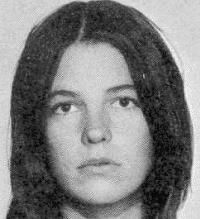
Leslie Van Houten
A psychiatrist, after evaluating Leslie
Van Houten, described her as "a psychologically loaded
gun which went off as a consequence of the complex
intermeshing of highly unlikely and bizarre
circumstances." The psychiatrist saw Van Houten
as "a spoiled little princess" who, from childhood on,
was impulsive, easily frustrated, and prone to
displays of temper. She admitted, for example,
to having beaten her adopted sister with
a shoe.
Although described as being the
least committed to Manson of the three female
defendants, Van Houten nonetheless agreed to
participate in the murderous raid on the LaBianca
home on August 10, 1969. She helped hold down
Rosemary LaBianca while Tex Watson stabbed her to
death. In a November 1969 interview with
police, Van Houten admitted to knowledge of the
Tate-LaBianca murders, but denied
participation.
Van Houten's first attorney, Donald
Barnett, was dismissed after crossing Manson.
Her second lawyer, Marvin Part, wanted to show that
Van Houten was "insane in a way that is almost
science fiction." Part saw her crime as
influenced by LSD and Charles Manson, but Van
Houten saw it differently: "I was influenced
by the war in Viet Nam and TV." At Manson's
urging, Van Houten fired Part and yet another
attorney was appointed. When Van Houten's
third attorney, Ronald Hughes, also began pursuing a
strategy that ran counter to that favored by Manson
(Manson opposed any strategy that suggested the
other defendants acted under his influence), the
Family had him killed. No one has ever been
charged with his murder.
Van Houten's first-degreee murder
conviction in the Tate-LaBianca trial was overturned
by a state appellate court in 1976 on the ground
that Judge Older erred in not granting Van Houten's
motion for a mistrial following the disappearance of
attorney Ronald
Hughes. In her first re-trial, the jury was
unable to reach a verdict. Released on bond
for a few months, Van Houten lived with a former
writer for the Christian Science Monitor.
She was tried a third time in 1978 and convicted of
first-degree murder after the jury rejected her
defense of diminished capacity as the result of
prolonged use of hallucinogenic drugs.
In prison at the California
Institution for Women , Van Houten accepted
responsibility for her crime: "Being a follower does
not excuse." She earned a degree from a
correspondence school (with a major in English Lit),
edited the prison paper, sewed for the homeless, and
wrote short stories. Although no one could
find fault with her prison record, she was again
denied parole in 2002. In 2016, the California
Parole Board recommended parole for Van Houten, but
Governor Jerry Brown, cognizant of the the politics
of the case, rejected the Board's recommendation and
Van Houten remained in prison. Van Houten's
life in prison is described in a recent book by
Karlene Faith, The Long Prison Journey of Leslie
Van Houten (2001).
|

|
Patricia
Krenwinkel ("Katie")
In September 1967, twenty-year-old
Patricia Krenwinkel joined the Family, leaving behind
her Manhattan Beach apartment, her car, her job, and
even her last paycheck. She joined many other
Family members on a drug-and-sex-filled eighteen-month
tour of the American West in an old school bus,
before settling into Spahn ranch in 1969. At her
sentencing, Krenwinkel idealized the Family's early
days: "We were just like wood nymphs and wood
creatures. We would run through the woods with
flowers in our hair, and Charles would have a small
flute."
In August 1969, Krenwinkel
participated in the murders at the Tate and LaBianca
residences. At the Tate home, Krenwinkel
dragged Abigail Folger from her bedroom to the
living room, fought with her, and stabbed her.
Later she would say, "I stabbed her and I kept
stabbing her." Asked about how it felt, she
replied, "Nothing--I mean, what is there to
describe? It was just there, and it was
right." The next night, Krenwinkel stabbed
Rosemary LaBianca and carved the word "WAR" on Leno
LaBianca's stomach.
Krenwinkel was arrested near her
aunt's home in Mobile, Alabama on December 1,
1969. Krenwinkel had gone to Alabama, she said
much later, because she feared Manson would find her
and kill her. In February, she waived
extradition proceedings and voluntarily returned to
California to stand trial with the other
defendants. Her trial attorney, Paul
Fitzgerald, offered only a weak defense. At
one point, Fitzgerald suggested that although
Krenwinkel's fingerprints were found inside the Tate
home, she might just have been "an invited guest or
friend." Krenwinkel spent much of the trial
drawing doodles of devils and other satanic figures.
At the California Institution for
Women in Frontero, Krenwinkel has been a model
prisoner. She has, with Leslie Van Houten,
counseled young drug offenders, completed a course
in data processing, and played on the prison
softball team. She has expressed deep remorse
for her role in the killings. In a 1994
interview broadcast on ABC, Krenwinkel said, "I wake
up every day and know that I'm a destroyer of life,
and living with that is the most difficult thing of
all. That's what I deserve--to wake up every
morning and know that."
|
|
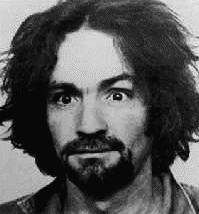
Charles Manson
Charles Manson was born to a
promiscuous sixteen-year-old girl named Kathleen
Maddox on November 12, 1934 in Cincinnati. His
presumed father was a "Colonel Scott" of Ashland
Kentucky, whom Manson never met. When Manson was
five, his mother received a five-year sentence for
armed robbery, and Manson moved in with his aunt and
uncle in West Virginia. His mother reclaimed him
in 1942 when she was paroled, but within five years
her heavy drinking led to Manson's being placed in a
caretaking school in Indiana. School officials
described young Manson as moody and suffering a
persecution complex--but "likable" during those
periods he was feeling happy.
At age 13, Manson began his life of
crime, robbing a grocery store and a casino.
For most of the next decade, Manson was shuffled
from one institution to another, usually committing
a series of crimes during his brief periods of
freedom. By age 16, Manson had been labeled
"aggressively antisocial." A prison
psychiatrist described Manson at age 18 as suffering
"psychic trauma," but still "an extremely sensitive
boy who has not yet given up in terms of securing
some love and affection from the world."
Released on parole in 1958, Manson
took to pimping. In June 1960, Manson was
arrested on a Mann Act charge. The Mann Act
charges were dropped, but Manson was given a
ten-year sentence for violating the parole terms
relating to an earlier federal conviction for
forging a Treasury check. Prison records from
the early 1960s show Manson as having interests in
Scientology, drama, softball, croquet,
and--especially --the
guitar. By the mid-1960s, Manson became
obsessed with the music of the Beatles. When
Manson's release date came on March 21, 1967, Manson
begged authorities to let him stay in prison, but he
was told they had no power to allow him to do so.
Manson, age 32, headed for San
Francisco and there gave birth to what would soon be
called "The Family." Manson became the
unquestioned head of the Family. He dominated
lives, even to the point of telling Family members
who they must have sex with. To some members
of the Family, Manson represented a "Christ-like"
figure. He encouraged such talk, sometimes
asking a Family member, "Don't you know who I
am?"
Combining ideas taken from the
Beatles White Album and the Bible's Book of
Revelation, Manson developed a bizarre prophecy that
blacks would soon rise up against the white
establishment and then turn to him--having survived
the coming "Helter Skelter in an underground
pleasure dome beneath Death Valley--to lead the
newly constituted nation. In August 1969, in
the hopes of giving Helter Skelter a push, Manson
sent a team of Family members on their murderous
missions to the Tate and LaBianca homes.
Convicted and sentenced to death
largely on the evidence of Family member Linda
Kasabian, Manson saw his death sentence commuted to
life in prison following a 1976 California Supreme
Court decision declaring the state's death penalty
law unconstitutional.
In his own testimony at trial,
Manson described himself as a chameleon-like
character: "Charlie never projects himself....People
see in Charlie their own reflection....Linda
Kasabian testified against me because she saw me as
the father she never liked....I do what love tells
me."
Since his conviction, Manson has
been denied parole twelve times, most recently in
2012. He is given almost no hope of ever being
released. In November 2014, Afton Burton, a
26-year-old woman who spent nine years working for
Manson's release, announced that she planned to
marry 80-year-old Manson. He currently
resides in a maximum security section of a
state penitentiary in Concoran, California.
|

|
Charles "Tex"
Watson (Tried Separately)
One of Charles "Tex" Watson's former
neighbors in Collin County, Texas described him as
"the boy next door." Watson was an "A" student
in a high school and a sports star. He held the
state record in the low hurdles. According to
his uncle, Watson's problems started when he began
taking drugs in college. In 1966, he dropped out
of college and the next year he was in California,
using and dealing drugs.
Watson joined the "Family" in 1967,
and soon became Manson's right-hand man.
Family member Al Springer told police that "Charlie
and Tex are the brains out there" on the
ranch. Springer described Watson as "just like
a college student." He said Watson "kept
his mouth shut" and enjoyed working on dune buggies.
In August 1969, Watson became the
principal killer in the Tate-LaBianca murders.
Announcing his arrival at the Tate residence, Watson
said, "I am the Devil and I'm here to do the Devil's
business." He shot Steven Parent and Jay Sebring,
and stabbed to death Voytek Frykowski, Abigail
Folger, Sharon Tate, and Leno LaBianca. After
the Tate murders, Watson told Manson, "Boy, it sure
was helter skelter."
Watson returned to McKinney, Texas
after the Tate-LaBianca murders. He was
arrested in Texas on November 30, 1969, after local
police were notified by California investigators
that his fingerprints were found to match a print
found on the front door of the Tate home.
Watson fought extradition to
California long enough that he was not included
among the three defendants tried with Manson.
Instead, Watson went on trial separately in August
1971. His defense attorneys produced eight
psychiatrists to prove the glassy-eyed Watson was
insane at the time of the murders--or at least
suffered from severely diminished capacity. On
the witness stand, Watson tried to portray himself
as Manson's unthinking slave. (He also
testified that the victims at the Tate residence
were "running around like chickens with their heads
cut off.") The jury convicted Watson of
first-degree murder.
Watson, who now resides at the Mule
Creek State Prison in Ione, California, has
renounced Manson and expressed "deepest remorse" to
his "many victims." In 1975, Watson became a
born-again Christian and, in 1983, an ordained
minister. He married a Norwegian wife and has
three children. In 1978 he co-wrote a book, Will
You Die For Me?
|