The Accused: "The
Rivonia 11"
The
Accused
|
Role/Notes
|
Trial/Epilogue
|
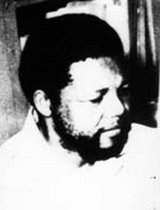
Nelson Mandela
(1918- )
|
Nelson
Mandela
was the son of a village chief from Mvezo,
in the Transkeiean
Territories. The first in his family
to attend school, Mandela
was a good student. After completing
his B.A. degree he entered
law studies at the University of
Witwatersrand. Mandela's life of
political activism began with the
apartheid-promoting National Party's
victory in 1948. In his early years
with the ANC, Mandela
supported a Gandhian policy of non-violent
resistance to apartheid, but
that changed with the government's banning
of the ANC following the
Sharpeville riot and shootings. He
saw armed struggle as the
necessary last resort. Mandela co-founded
the militant organization
Umkhonto we Sizwe, planned a strategy of
sabotage, raised funds for
weapons, and arranged military training
for possible guerrilla
warfare. In his clandestine role,
Mandela lived and worked at
Rivonia before traveling abroad
(illegally) to win foreign support for
his efforts. Upon his return to
South Africa, he was arrested,
tried, and convicted for leaving the
country without a passport and
inciting a strike. At the time of
the Rivonia raid, Mandela had
been imprisoned on Robben Island for over
eight months.
Defense attorney Joel Joffe described
Mandela as "a really great man."
According to Joffe, Mandela had all the
"attributes of a leader--the
engaging personality, the ability, the
stature, the calm, the
diplomacy, the tact, and the
conviction." Even prison officials
treated Mandela with respect, perhaps
recognizing in him a bigger man
than themselves. Mandela was,
without a doubt, the leader among
the Rivonia defendants.
|
Although
many
of the charged acts of sabotage occurred
after Mandela was in jail, his
prominent role in both the ANC and
Umkhonto we Sizwe (MK) made a
verdict of "guilty" all but
inevitable. Rather than be
cross-examined about his contacts and
specific underground work,
Mandela chose to offer a statement from
the dock. He saw it as
his duty as a leader in the liberation
movement to explain its goals.
In his four-hour long reading of his
statement, Mandela outlined the
history of racial oppression in South
Africa, the rise of the ANC, and
his felt necessity for turning to violence
and the establishment of
MK. Mandela insisted that MK planned
sabotage attacks against
facilities at times and places so as to
minimize the possibility that
lives would be lost. He ended his
statement dramatically, telling
the court, "I am prepared to die."
Mandela was convicted on all counts and
sentenced to life in
prison. He served 18 years on Robben
Island before transfer to a
prison in Cape Town. The last two
years of his imprisonment, up
to his release in 1990, were spent in a
bungalow and included periods
of secret negotiations with the South
African government for a
transition to a multi-racial
democracy. In May 1994, Nelson
Mandela was inaugurated as the first black
president of South Africa.
|
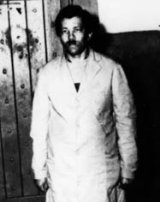
Walter Sisulu
(1912-2003)
|
Walter Sisulu's mother was a domestic
worker, his father a white civil
servant. Sisulu joined the ANC in
1940 and became Secretary
General of the ANC in 1949. He was
arrested seven times between
1953 and 1963. He was present at a
meeting of the Umkhonto High
Command when Operation Mayibuye was first
presented for
consideration. Sisulu was among
those captured in Rivonia in July
1963.
Defense attorney Joel Joffe described
Sisulu as "one of the most
impressive personalities among the
accused." Other
defendants
often turned to Sisulu for advice, as he
was respected for
his careful and deliberate
judgment.
|
Sisulu
was the first defense witness to be
questioned on the witness
stand. In his testimony, Sisulu
outlined the history of the ANC
and its military wing, Umkhonto we
Sizwe. He testified that
Operation Mayibuye was presented to the
High Command but never
adopted. He stated that he did not
agree with many aspects of the
proposed operation: "My view was
that conditions did not exist at
that time for Operation Mayibuye."
Defense attorney Joffe called
Sisulu's five days of cross-examination "a
triumph": "The whole court
had been impressed by this small man of
meager education but tremendous
sincerity, calm, conviction, and
certainty."
Sisulu was convicted on all four counts
and sentenced to life in
prison. He was released in 1989.
|
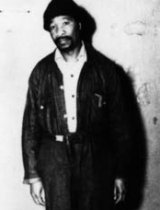
Govan Mbeki
(1910-2001)
|
Govan
Mbeki,
at 53, was grey-haired and the oldest of
the 11 Rivonia accused.
After graduating from Fort Hare University
in 1936, Mbeki began a life
of political activism. He served on
the editorial board of the
New Age, a liberation movement journal,
and was a leader of the ANC and
the South African Communist Party.
Defense attorney Joel Joffe wrote that
Mbeki had "the softest voice and
the quietest, calmest manner of any of the
accused," but beneath that
exterior was "a steel-hard
interior." In his cross-examination,
Mbeki admitted to having "a ruthless
determination" to emancipate black
South Africans."
|
At
the Rivonia
trial, Mbeki presented much of the defense
testimony relating to South
Africa's history of race-based repression
and the political goals of
the ANC. The prosecution presented
13 documents directly
implicating Mbeki, and his "guilt" was
never in serious question.
He was found guilty on all four charges
and sentences to life in prison.
Mbeki was released in 1988 after serving
25 years in prison.
Following his release, he was chosen as
Deputy President of the first
multi-racial South African Senate.
His son, Thabo Mbeki, was
elected president of South Africa.
Govan Mbeki died in 2001.
|
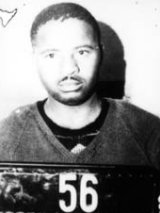
Elias
Motsoaledi
(1924-1994)
|
Born
in Nebo,
Sekhukuneland, Elias Motsoaledi moved at
age 17 to Johannesburg, where
he found work in a boot factory. He
joined a trade union movement
and soon was led into a life of political
activism. He joined the
ANC in 1948. After the organization
was banned, he became active
in Umkhonto we Sizwe which he joined
because, he said, there was no
other choice "but to suffer."
Defense attorney Joel Joffe described
Motsoaledi as "a short, vivacious
and charming personality." At the
time of the Rivonia trial, he
was 39 and the father of seven young
children.
|
At
the time of
the Rivonia raid, Motsoaledi was already
held in detention.
Prosecution witness Bruno Mtolo testified
that Motsoaledi showed him
how to make explosive material for
sabotage operations. Witness
English Mashiloane testified that
Motsoaledi supervised operations that
sent young recruits abroad for military
training. The defense
chose not to subject Motsoaledi to
questioning on the stand; instead,
he read a prepared statement in which he
said, "What I did, I did for
my people."
Motsoaledi was convicted on charges of
conspiracy and sabotage and
sentenced to life in prison. He was
released in 1989 and died
five years later.
|
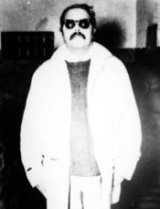
Ahmed
Kathrada
(1929- )
|
Ahmed Kathrada was born in 1929 to
immigrant
parents from India living in a small
village in the Western
Transvaal. Kathrada moved to
Johannesburg to receive an education
and became politically active by age 12
when he joined the Young
Communist League. He left school at
age 17 to become a full-time
political activist. When the African
and Indian Congresses
entered an era of close cooperation in the
1950s, Kathrada worked with
ANC leaders including Mandela and Sisulu.
Defense attorney Joel Joffe described
Kathrada as having "a sharp
tongue" and "an engaging
personality. He considered him more
"a
doer than a theorizer."
|
Joffe
described
the case against Kathrada as "extremely
weak." He was
arrested at Rivonia (disguised as a
Portuguese) where he had drafted a
couple of pamphlets and taped a broadcast
for ANC radio. There
was no evidence directly tying him to
Operation Mayibuye or sabotage.
Despite the weak case, Kathrada was
convicted on one of the four
charges against him and sentenced to life
in prison. He was
released in 1989, after spending 26 years
in prison. He was
elected as a member of the South African
parliament in 1994.
|
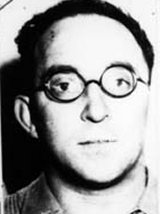
Denis Goldberg
(1933- )
|
Denis
Goldberg
was considered by South African
authorities in 1963 to be "the
most dangerous white man in the
country." Goldberg was born in
Cape Town, where he studied civil
engineering before joining the South
African Communist Party. In May
1963, Goldberg left Cape Town for
Johannesburg, intending to flee the
country. Instead, he was
asked by officials of Umkhonto we Sizwe to
use his technical knowledge
to explore the possibility of building
large numbers of grenades,
land mines, and other weapons that could
be used in a coming guerrilla
war. He was captured at Rivonia in
July 1963. Weeks later,
he made a failed attempt to escape from
Vereeniging Prison.
Defense attorney Joel Joffe described
Goldberg as an "easy-going" man
who provided a steady flow of puns, jokes,
and witticisms.
|
The
evidence
against Goldberg was overwhelming.
Prosecution witness Cyril
Davids testified that Goldberg ran a
training camp for guerrillas
(Goldberg maintained the camp was just
political.) More than
twenty other prosecution witnesses,
including manufacturers and
merchants, testified that Goldberg, using
a pseudonym, inquired
about the possibility of purchasing large
numbers of castings and other
parts that could be used in weapon
construction. With the massive
case against him, Goldberg offered to
plead guilty and take the blame
for other defendants. He took the
stand only against the advice
of his attorneys, who warned him that his
testify might backfire and
get him the death penalty.
Goldberg was convicted on all charges and
sentenced to life in
prison. After his release in 1985 he
moved to London. He
returned to South Africa in 2002 to become
a special adviser to the
Minister of Water Affairs and
Forestry.
|
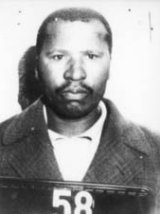
Andrew
Mlangeni
(1926- )
|
Andrew Mlangeni grew up at the ninth child
of fourteen in a Soweto
family. He worked as a caddy at a
golf course, as a bus driver
and as a factory worker before joining the
ANC in 1954. In
October 1961 he left Johannesburg and
received military training
outside the country. He joined
Umkhonto we Sizwe in February
1963, but was not a member of the National
High Command. He was
known in the movement as "Robot" for his
single-minded determination to
finish any task to which he was
assigned. Mlangeni was arrested
weeks before the Rivonia raid. While
in detention, he was
tortured with electrical shocks that left
visible burn scars.
|
Prosecution
witness
English Mashiloane testified that Mlangeni
arranged
transportation for young military recruits
and supervised their
training. In his closing argument,
Percy Yutar called Mlangeni
the "Minister of Transport" for Umkhonto
we Sizwe. In his
statement before the court, Mlangeni said
that he "found a political
home" in the ANC and that "what I did was
not for myself but for my
people."
Mlangeni was convicted on all four counts
and sentenced to life in
prison. He was released in
1989. He was elected as a member
of the South African parliament in
1994.
|
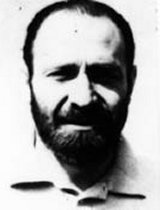
James Kantor
(1927-1975)
|
James
Kantor
was a South African lawyer. His law
partner and brother-in-law,
Harold Wolpe (who handled the affairs of
various political activists),
disappeared suddenly days after the
Rivonia raid. Wolpe and
Arthur Goldreich, owner of the Rivonia
estate, were arrested at the
South African border and taken to a
Pretoria jail. When Wolpe and
Goldreich managed a successful escape,
authorities turned their
attention to Kantor, who served
essentially as a proxy for Wolpe at the
trial. In the view of defense
lawyers, Kantor was "a hostage for
his brother-in-law." Kantor was
clearly an "odd man out" among
the eleven accused, and the evidence
against him, such as it was,
seemed unconnected to the other
defendants. During his period of
detention, Kantor suffered what appeared
to be a nervous breakdown and
his law practice deteriorated.
|
Before
the
Rivonia trial began, prosecutor Percy
Yutar insisted Kantor was
involved in sabotage and the recruitment
of men for military
training. (This assertion, it turned
out, was based on the
unsupported statement of a ANC supporter
to had been subjected to
torture.) At trial virtually no
evidence that incriminated Kantor
was presented. The prosecution
attempted to suggest that funds
from Kantor's firm were used for purchase
of the Rivonia farm and that
persons under communication bans met with
lawyers in his office, but
the witness who provided testimony on this
point largely absolved
Kantor on cross-examination. Kantor
was discharged from the case
by Justice de Wet in December 1963 without
even having to present
evidence on his own behalf.
Kantor fled the country after the
trial. He died of a heart
attack in 1975.
|
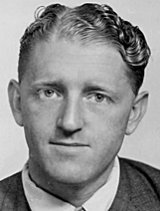
Lionel
(Rusty) Bernstein
(1920-2002)
|
Lionel
Bernstein
was the son of Jewish emigres.
Orphaned at age 8,
Bernstein was sent to an exclusive boy's
boarding school. Upon
graduating, he moved to Johannesburg were
he found work as an continued
his education and eventually became an
architect. After serving in the
South African army in WW II, Bernstein
supported a strike of African
miners in 1946. He wrote extensively
for various Communist Party
(which he had joined in 1939), ANC, and
liberation journals and
newspapers. In 1956, he was charged
with treason, but eventually
found not guilty. He was arrested at
Rivonia in July 1963 where
he had gone to plan remodeling for a
storeroom.
Defense attorney Joel Joffe described
Bernstein as "depressed,
listless, and nervous" after his 90-day
detention. He "spoke
little" and "seemed to sparkle only in his
writing."
|
Joel
Joffe
wrote there "was less evidence against
[Bernstein] than anyone
else." Joseph Mashifane, a Rivonia
servant and prosecution
witness, testified he saw Bernstein up on
the roof helping to erect a
radio antenna. Testifying at the
trial, Bernstein proved himself
to be an almost "ideal witness," in
Joffe's view. He gave "clear,
concise answers" in a "polite and
unruffled" manner and conceded
nothing. Cross-examination of
Bernstein was mishandled by the
prosecutor, who focused mainly on
Bernstein's Communist Party ties
while failed to establish elements of the
alleged crime.
According to Joffe, after cross, "the case
against him had disappeared."
Bernstein was found "not guilty" by
Justice de Wet. Writing in
1988, Bernstein said: "It is believed that
the judge decided in advance
to acquit one [of three defendants,
including himself, Kathrada, and
Mlaba, against whom the case was flimsy],
thus proving the fairness of
the trial." "Being white and
middle-class," Bernstein wrote,
probably won him "the lottery."
After the trial, Bernstein fled
South Africa, making his way to Zambia and
then to London, where he
worked as an architect. He
died in 2002.
|
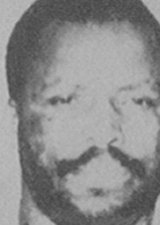
Raymond
Mhlaba
(1920-2005)
|
Raymond
Mhlaba
was born in the Fort Beaufort district and
took work in a Port
Elizabeth laundry after leaving
school. From trade union work he
gravitated to the Communist Party, which
he joined in 1943, and the
ANC, which he joined the following
year. He served as chair of
the Port Elizabeth ANC branch for six
years and, after the ANC's
banning in 1960, received military
training in China. He was
arrested at Rivonia in July 1963.
Defense attorney Joel Joffe described
Mhlaba as a large man with a
"stolid immovable determination" and a
trademark "great shrieking
laugh."
|
The
prosecution case against Mhlaba was
weak. A taxi driver testified
that Mhlaba was among a group of people
that he drove to an electricity
sub-station on the night it was
sabotaged. This evidence,
however, was contradicted by the
prosecutor's own apparent
acknowledgment later in the trial that
Mhlaba was outside the country
at the time of the attack on the
sub-station. Joffe believes the
taxi driver's testimony was perjury
calculated "to fill an obvious
weakness in the state's case." In
his testimony, Mhaba testified
that he was on a mission for the ANC at
the time of the sabotage, but
refused to answer a question about exactly
where he was and what he was
doing.
Despite the weak case against him, Mhlaba
was convicted and sentenced
to life in prison. He was released
in 1989. In 1994, Mhlaba
was selected as Premier of the Eastern
Cape and later served as High
Commissioner to Uganda and Rwanda.
In 2005, he died following a
diagnosis of liver cancer.
|
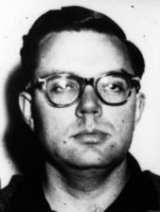
Bob Hepple
(1934- )
|
Alexander
(Bob)
Hepple was a lawyer and Communist Party
member. He served
as a member of the law faculty at the
University of Witwatersrand
before resigning to practice law
full-time. He was arrested at
Rivonia in July 1963.
While in detention, authorities approached
Hepple about turning state's
witness. Hepple seemingly agreed,
typed a confessional statement
for police and identified the hiding place
of Goldreich and
Wolpe. In return, Hepple was
released from detention on his
promise that he would not abscond.
Much to prosecutor Percy
Yutar's disgust, he did--"Such is the
reliance one can place on the
honor of a Communist!", Yutar later wrote.
|
At
the first
session of the trial in October 1963,
Percy Yutar announced that the
state was withdrawing charges against
Hepple and that he would be the
state's star witness in the upcoming
trial. Leaving the courtroom
that day, Hepple told his former fellow
defendants, "Good luck."
Hepple's escape took him to Kenya.
From the safety of Kenya,
Hepple told reporters that he never had
any intention to testify
against any of the accused, whose values
and aims he shared. He
later taught labor and comparative social
law in England until 2001,
and was knighted in 2004. He told an
interviewer in 2005 that he
considered himself to be
"tremendously lucky."
|
Nelson Mandela Trial Homepage
|