1. What is an indulgence?
An indulgence is the full or partial remission of temporal punishment
for sins after the sinner confesses and receives absolution.
Under Catholic teaching, every sin must be purified either here on
earth or after death in a state called purgatory.
|
2. How did the practice of dispensing
indulgences begin?
The first known use of plenary indulgences was in 1095 when Pope Urban
II remitted all penance of persons who participated in the crusades and
who confessed their sins. Later, the indulgences were also
offered to those who couldn't go on the Crusades but offered cash
contributions to the effort instead. In the early 1200s, the
Church began claiming that it had a "treasury" of indulgences
(consisting of the merits of Christ and the saints) that it could
dispense in ways that promoted the Church and its mission. In a
decretal issued in 1343, Pope Clement VI declared, "The merits of
Christ are a treasure of indulgences."
|
3. How were indulgences used in
Luther's time?
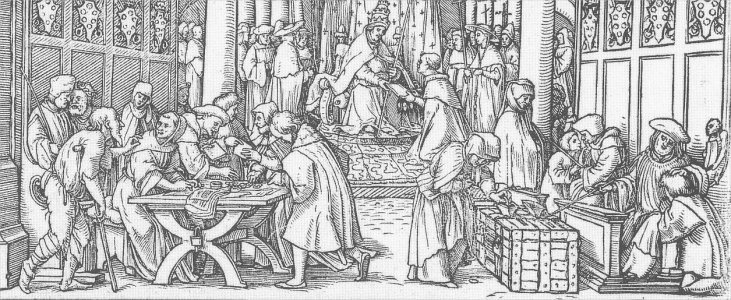
In Luther's time, the pope delegated the privilege of dispensing
indulgences. The Castle Church in Luther's Wittenberg, for
example, was delegated the rare privilege granting full remission of
all sins. Frederick the Wise, elector for the region of the Holy
Roman Empire that included Wittenberg, took pride in a large collection
of relics (over 19,000 holy bones and 5,000 other items*) of saints
that supposedly provided the basis for granting indulgences that could
reduce stays in purgatory by over 1.9 million years. These
treasures were made available to believers on All Saints Day, November
1. By viewing the relics and making the stipulated contribution,
the believer could reduce a stay and purgatory while providing much
needed financial support for Castle Church and the University of
Wittenberg.
Leo X, the pope in 1517, needed funds to complete the building of St.
Peter's Basilica in Rome. Leo entered into an arrangement that
essentially sold indulgence franchises that allowed the franchisee to
retain about half the funds raised by selling indulgences in return for
sending to Rome the other half for Leo's construction project. To
encourage indulgence sales, Albert of Brandenburg, one winner of the
privilege of selling indulgences, advertised that his indulgences
(issued by the pope) came with a complete remission of sins, allowing
escape from all of the pains
of purgatory. Moreover, Albert claimed, purchasers of indulgences
could use them to free a loved one already dead from the pains of
purgatory that he or she might presently be experiencing. The
going rate for an indulgence depended on one's station, and ranged from
25 gold florins for Kings and queens and archbishops down to three
florins for merchants and just one quarter florin for the poorest of
believers.
*The items in Frederick's collection included bones, teeth, hairs, and pieces of cloak and even a
girdle from various saints. They also included a piece of straw
and some strands of swaddling clothes from Christ's manger, a chunk of
gold brought by one of the three Wise Men, a strand from the beard of
Jesus, a twig from the burning bush of Moses, bread served at the Last
Supper, and seven shreds from a veil sprinkled with blood of Christ.
[Bainton, p. 53.] |
4. What sermon about indulgences
pushed Luther to act against indulgences?
In proclaiming the
special indulgence offered by Albert of Brandenburg, indulgence vendor
John Tetzel promoted it with a sermon that included a jingle of his own
creation: "As soon as the coin in the coffer rings, the soul from
purgatory springs." Tetzel made his way
through Germany, entering towns as part of a procession that included
local dignitaries, a cross bearing the papal arms, and the papal bull
of indulgence carried on a velvet cushion. In the marketplace of
each town, Tetzel would offer this sermon:
Listen now, God and
Peter call you. Consider the salvation of your souls and those of
your loved ones departed. You priest, you noble, you merchant,
you virgin, you matron, you youth, you old man, enter now into your
church, which is the Church of St. Peter. Visit the most holy
cross erected before you and ever imploring you. Have you
considered that you are lashed in a furious tempest amid the
temptations and dangers of the world, and that you do not know whether
you can reach the haven, not of your mortal body, but of your immortal
soul? Consider that those who are contrite and have confessed and
made contribution will receive complete remission of all their
sins. Listen to the voices of your dear dead relatives and
friends beseeching you and saying, "Pity us, pity us. We are in
dire torment from which you can redeem us for a pittance." Do you
not wish to? Open your ears. Hear the father saying to his
son, the mother to her daughter, "We bore you, nourished you, brought
you up, left you our fortunes, and you are so cruel and hard that now
you are not willing for so little to set us free. Will you let us
lie here in the flames? Will you delay the promised glory?"
Remember that you are able to release them, for as soon as the coin in the coffer rings, the soul from
purgatory springs. Will you not
then for a quarter of a florin receive these letters of indulgence
through which you are able to lead a divine and mortal soul into the
fatherland of paradise? [Bainton, pp. 60-61]
|
5. What were Luther's main objections
to Tetzel's sermon?
As Luther biographer Roland Bainton observed,
Tetzel's sermon "marked the apex of unbridled pretensions as to the
efficacy of indulgences." Although Pope Sixtus IV had offered
immediate release to souls in purgatory, Tetzel dispensed with the
previously imposed condition that the purchasers of the indulgences for
the dead demonstrate their own contrition. As Luther saw it, no
human can know whether the remission of sins for any individual is
complete, because complete remission comes only to those who show
worthy contrition and confession--and worthiness is known only to God.
|
6. How did Luther choose to make
known his criticisms of indulgences?
Luther summarized his objections in the form of ninety-five theses for
debate. The 95 Theses denounced the promise of springing souls
from purgatory on the basis of a monetary contribution alone to the
Church. Moreover, Luther challenged the right of a pope to grant
pardons on God's behalf. The power of pardon, Luther believed,
was God's alone. If, indeed, the pope had the power he claimed,
Luther asked why he didn't simply exercise it: "If the pope does have
the power to release anyone from purgatory, why in the name of love
does he not abolish purgatory by letting everyone out?" Luther's
complaints also went to the Church's justification for promoting
contributions. He complained about "the revenues of all
Christendom being sucked into this insatiable basilica" when there were
much greater needs, including "living temples" and local
churches.
|
7. What happened next?
The scandalous use of indulgences in the 1500s led directly to Martin
Luther's attacks on Catholic doctrine and, ultimately, the Protestant
Reformation which changed the cultural and political face of Europe.
|
Martin Luther Trial Homepage