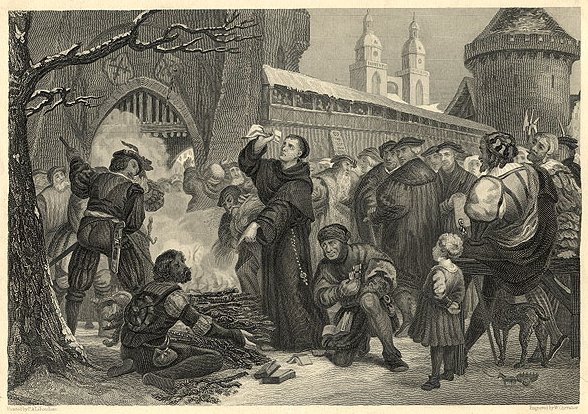
Luther burning the Pope's bull in front of the
east gate of Wittenberg in December 1520.
Exsurge Domine
(Condemning the Errors of Martin Luther)
Bull of Pope Leo X issued June 15, 1520
LUTHER'S REPLY: AGAINST THE EXECRABLE BULL OF THE
ANTICHRIST
Arise, O Lord, and judge your own cause. Remember your
reproaches to those who are filled with foolishness all through the
day. Listen to our prayers, for foxes have arisen seeking to destroy
the vineyard whose winepress you alone have trod. When you were about
to ascend to your Father, you committed the care, rule, and
administration of the vineyard, an image of the triumphant church, to
Peter, as the head and your vicar and his successors. The wild boar
from the forest seeks to destroy it and every wild beast feeds upon it.
Rise, Peter, and fulfill this pastoral office divinely
entrusted to you as mentioned above. Give heed to the cause of the holy
Roman Church, mother of all churches and teacher of the faith, whom you
by the order of God, have consecrated by your blood. Against the Roman
Church, you warned, lying teachers are rising, introducing ruinous
sects, and drawing upon themselves speedy doom. Their tongues are fire,
a restless evil, full of deadly poison. They have bitter zeal,
contention in their hearts, and boast and lie against the truth.
We beseech you also, Paul, to arise. It was you that
enlightened and illuminated the Church by your doctrine and by a
martyrdom like Peter's. For now a new Porphyry rises who, as the old
once wrongfully assailed the holy apostles, now assails the holy
pontiffs, our predecessors.
Rebuking them, in violation of your teaching, instead of
imploring them, he is not ashamed to assail them, to tear at them, and
when he despairs of his cause, to stoop to insults. He is like the
heretics "whose last defense," as Jerome says, "is to start spewing out
a serpent's venom with their tongue when they see that their causes are
about to be condemned, and spring to insults when they see they are
vanquished." For although you have said that there must be heresies to
test the faithful, still they must be destroyed at their very birth by
your intercession and help, so they do not grow or wax strong like your
wolves. Finally, let the whole church of the saints and the rest of the
universal church arise. Some, putting aside her true interpretation of
Sacred Scripture, are blinded in mind by the father of lies. Wise in
their own eyes, according to the ancient practice of heretics, they
interpret these same Scriptures otherwise than the Holy Spirit demands,
inspired only by their own sense of ambition, and for the sake of
popular acclaim, as the Apostle declares. In fact, they twist and
adulterate the Scriptures. As a result, according to Jerome, "It is no
longer the Gospel of Christ, but a man's, or what is worse, the
devil's."
Let all this holy Church of God, I say, arise, and with the
blessed apostles intercede with almighty God to purge the errors of His
sheep, to banish all heresies from the lands of the faithful, and be
pleased to maintain the peace and unity of His holy Church.
For we can scarcely express, from distress and grief of
mind, what has reached our ears for some time by the report of reliable
men and general rumor; alas, we have even seen with our eyes and read
the many diverse errors. Some of these have already been condemned by
councils and the constitutions of our predecessors, and expressly
contain even the heresy of the Greeks and Bohemians. Other errors are
either heretical, false, scandalous, or offensive to pious ears, as
seductive of simple minds, originating with false exponents of the
faith who in their proud curiosity yearn for the world's glory, and
contrary to the Apostle's teaching, wish to be wiser than they should
be. Their talkativeness, unsupported by the authority of the
Scriptures, as Jerome says, would not win credence unless they appeared
to support their perverse doctrine even with divine testimonies however
badly interpreted. From their sight fear of God has now passed.
These errors have, at the suggestion of the human race, been
revived and recently propagated among the more frivolous and the
illustrious German nation. We grieve the more that this happened there
because we and our predecessors have always held this nation in the
bosom of our affection. For after the empire had been transferred by
the Roman Church from the Greeks to these same Germans, our
predecessors and we always took the Church's advocates and defenders
from among them. Indeed it is certain that these Germans, truly germane
to the Catholic faith, have always been the bitterest opponents of
heresies, as witnessed by those commendable constitutions of the German
emperors in behalf of the Church's independence, freedom, and the
expulsion and extermination of all heretics from Germany. Those
constitutions formerly issued, and then confirmed by our predecessors,
were issued under the greatest penalties even of loss of lands and
dominions against anyone sheltering or not expelling them. If they were
observed today both we and they would obviously be free of this
disturbance. Witness to this is the condemnation and punishment in the
Council of Constance of the infidelity of the Hussites and Wyclifites
as well as Jerome of Prague. Witness to this is the blood of Germans
shed so often in wars against the Bohemians. A final witness is the
refutation, rejection, and condemnation no less learned than true and
holy of the above errors, or many of them, by the universities of
Cologne and Louvain, most devoted and religious cultivators of the
Lord's field. We could allege many other facts too, which we have
decided to omit, lest we appear to be composing a history.
In virtue of our pastoral office committed to us by the
divine favor we can under no circumstances tolerate or overlook any
longer the pernicious poison of the above errors without disgrace to
the Christian religion and injury to orthodox faith. Some of these
errors we have decided to include in the present document; their
substance is as follows:
1. It is a heretical opinion, but a common one, that the
sacraments of the New Law give pardoning grace to those who do not set
up an obstacle.
2. To deny that in a child after baptism sin remains is to
treat with contempt both Paul and Christ.
3. The inflammable sources of sin, even if there be no
actual sin, delay a soul departing from the body from entrance into
heaven.
4. To one on the point of death imperfect charity
necessarily brings with it great fear, which in itself alone is enough
to produce the punishment of purgatory, and impedes entrance into the
kingdom.
5. That there are three parts to penance: contrition,
confession, and satisfaction, has no foundation in Sacred Scripture nor
in the ancient sacred Christian doctors.
6. Contrition, which is acquired through discussion,
collection, and detestation of sins, by which one reflects upon his
years in the bitterness of his soul, by pondering over the gravity of
sins, their number, their baseness, the loss of eternal beatitude, and
the acquisition of eternal damnation, this contrition makes him a
hypocrite, indeed more a sinner.
7. It is a most truthful proverb and the doctrine concerning
the contritions given thus far is the more remarkable: "Not to do so in
the future is the highest penance; the best penance, a new life."
8. By no means may you presume to confess venial sins, nor
even all mortal sins, because it is impossible that you know all mortal
sins. Hence in the primitive Church only manifest mortal sins were
confessed.
9. As long as we wish to confess all sins without exception,
we are doing nothing else than to wish to leave nothing to God's mercy
for pardon.
10. Sins are not forgiven to anyone, unless when the priest
forgives them he believes they are forgiven; on the contrary the sin
would remain unless he believed it was forgiven; for indeed the
remission of sin and the granting of grace does not suffice, but it is
necessary also to believe that there has been forgiveness.
11. By no means can you have reassurance of being absolved
because of your contrition, but because of the word of Christ:
"Whatsoever you shall loose, etc." Hence, I say, trust confidently, if
you have obtained the absolution of the priest, and firmly believe
yourself to have been absolved, and you will truly be absolved,
whatever there may be of contrition.
12. If through an impossibility he who confessed was not
contrite, or the priest did not absolve seriously, but in a jocose
manner, if nevertheless he believes that he has been absolved, he is
most truly absolved.
13. In the sacrament of penance and the remission of sin the
pope or the bishop does no more than the lowest priest; indeed, where
there is no priest, any Christian, even if a woman or child, may
equally do as much.
14. No one ought to answer a priest that he is contrite, nor
should the priest inquire.
15. Great is the error of those who approach the sacrament
of the Eucharist relying on this, that they have confessed, that they
are not conscious of any mortal sin, that they have sent their prayers
on ahead and made preparations; all these eat and drink judgment to
themselves. But if they believe and trust that they will attain grace,
then this faith alone makes them pure and worthy.
16. It seems to have been decided that the Church in common
Council established that the laity should communicate under both
species; the Bohemians who communicate under both species are not
heretics, but schismatics.
17. The treasures of the Church, from which the pope grants
indulgences, are not the merits of Christ and of the saints.
18. Indulgences are pious frauds of the faithful, and
remissions of good works; and they are among the number of those things
which are allowed, and not of the number of those which are
advantageous.
19. Indulgences are of no avail to those who truly gain
them, for the remission of the penalty due to actual sin in the sight
of divine justice.
20. They are seduced who believe that indulgences are
salutary and useful for the fruit of the spirit.
21. Indulgences are necessary only for public crimes, and
are properly conceded only to the harsh and impatient.
22. For six kinds of men indulgences are neither necessary
nor useful; namely, for the dead and those about to die, the infirm,
those legitimately hindered, and those who have not committed crimes,
and those who have committed crimes, but not public ones, and those who
devote themselves to better things.
23. Excommunications are only external penalties and they do
not deprive man of the common spiritual prayers of the Church.
24. Christians must be taught to cherish excommunications
rather than to fear them.
25. The Roman Pontiff, the successor of Peter, is not the
vicar of Christ over all the churches of the entire world, instituted
by Christ Himself in blessed Peter.
26. The word of Christ to Peter: "Whatsoever you shall loose
on earth," etc., is extended merely to those things bound by Peter
himself.
27. It is certain that it is not in the power of the Church
or the pope to decide upon the articles of faith, and much less
concerning the laws for morals or for good works.
28. If the pope with a great part of the Church thought so
and so, he would not err; still it is not a sin or heresy to think the
contrary, especially in a matter not necessary for salvation, until one
alternative is condemned and another approved by a general Council.
29. A way has beeri made for us for weakening the authority
of councils, and for freely contradicting their actions, and judging
their decrees, and boldly confessing whatever seems true, whether it
has been approved or disapproved by any council whatsoever.
30. Some articles of John Hus, condemned in the Council of
Constance, are most Christian, wholly true and evangelical; these the
universal Church could not condemn.
31. In every good work the just man sins.
32. A good work done very well is a venial sin.
33. That heretics be burned is against the will of the
Spirit.
34. To go to war against the Turks is to resist God who
punishes our iniquities through them.
35. No one is certain that he is not always sinning
mortally, because of the most hidden vice of pride.
36. Free will after sin is a matter of title only; and as
long as one does what is in him, one sins mortally.
37. Purgatory cannot be proved from Sacred Scripture which
is in the canon.
38. The souls in purgatory are not sure of their salvation,
at least not all; nor is it proved by any arguments or by the
Scriptures that they are beyond the state of meriting or of increasing
in charity.
39. The souls in purgatory sin without intermission, as long
as they seek rest and abhor punishment.
40. The souls freed from purgatory by the suffrages of the
living are less happy than if they had made satisfactions by
themselves.
41. Ecclesiastical prelates and secular princes would not
act badly if they destroyed all of the money bags of beggary.
No one of sound mind is ignorant how destructive,
pernicious, scandalous, and seductive to pious and simple minds these
various errors are, how opposed they are to all charity and reverence
for the holy Roman Church who is the mother of all the faithful and
teacher of the faith; how destructive they are of the vigor of
ecclesiastical discipline, namely obedience. This virtue is the font
and origin of all virtues and without it anyone is readily convicted of
being unfaithful.
Therefore we, in this above enumeration, important as it is,
wish to proceed with great care as is proper, and to cut off the
advance of this plague and cancerous disease so it will not spread any
further in the Lord's field as harmful thornbushes. We have therefore
held a careful inquiry, scrutiny, discussion, strict examination, and
mature deliberation with each of the brothers, the eminent cardinals of
the holy Roman Church, as well as the priors and ministers general of
the religious orders, besides many other professors and masters skilled
in sacred theology and in civil and canon law. We have found that these
errors or theses are not Catholic, as mentioned above, and are not to
be taught, as such; but rather are against the doctrine and tradition
of the Catholic Church, and against the true interpretation of the
sacred Scriptures received from the Church. Now Augustine maintained
that her authority had to be accepted so completely that he stated he
would not have believed the Gospel unless the authority of the Catholic
Church had vouched for it. For, according to these errors, or any one
or several of them, it clearly follows that the Church which is guided
by the Holy Spirit is in error and has always erred. This is against
what Christ at his ascension promised to his disciples (as is read in
the holy Gospel of Matthew): "I will be with you to the consummation of
the world"; it is against the determinations of the holy Fathers, or
the express ordinances and canons of the councils and the supreme
pontiffs. Failure to comply with these canons, according to the
testimony of Cyprian, will be the fuel and cause of all heresy and
schism.
With the advice and consent of these our venerable brothers,
with mature deliberation on each and every one of the above theses, and
by the authority of almighty God, the blessed Apostles Peter and Paul,
and our own authority, we condemn, reprobate, and reject completely
each of these theses or errors as either heretical, scandalous, false,
offensive to pious ears or seductive of simple minds, and against
Catholic truth. By listing them, we decree and declare that all the
faithful of both sexes must regard them as condemned, reprobated, and
rejected . . . We restrain all in the virtue of holy obedience and
under the penalty of an automatic major excommunication....
Moreover, because the preceding errors and many others are
contained in the books or writings of Martin Luther, we likewise
condemn, reprobate, and reject completely the books and all the
writings and sermons of the said Martin, whether in Latin or any other
language, containing the said errors or any one of them; and we wish
them to be regarded as utterly condemned, reprobated, and rejected. We
forbid each and every one of the faithful of either sex, in virtue of
holy obedience and under the above penalties to be incurred
automatically, to read, assert, preach, praise, print, publish, or
defend them. They will incur these penalties if they presume to uphold
them in any way, personally or through another or others, directly or
indirectly, tacitly or explicitly, publicly or occultly, either in
their own homes or in other public or private places. Indeed
immediately after the publication of this letter these works, wherever
they may be, shall be sought out carefully by the ordinaries and others
[ecclesiastics and regulars], and under each and every one of the above
penalties shall be burned publicly and solemnly in the presence of the
clerics and people.
As far as Martin himself is concerned, O good God, what have
we overlooked or not done? What fatherly charity have we omitted that
we might call him back from such errors? For after we had cited him,
wishing to deal more kindly with him, we urged him through various
conferences with our legate and through our personal letters to abandon
these errors. We have even offered him safe conduct and the money
necessary for the journey urging him to come without fear or any
misgivings, which perfect charity should cast out, and to talk not
secretly but openly and face to face after the example of our Savior
and the Apostle Paul. If he had done this, we are certain he would have
changed in heart, and he would have recognized his errors. He would not
have found all these errors in the Roman Curia which he attacks so
viciously, ascribing to it more than he should because of the empty
rumors of wicked men. We would have shown him clearer than the light of
day that the Roman pontiffs, our predecessors, whom he injuriously
attacks beyond all decency, never erred in their canons or
constitutions which he tries to assail. For, according to the prophet,
neither is healing oil nor the doctor lacking in Galaad.
But he always refused to listen and, despising the previous
citation and each and every one of the above overtures, disdained to
come. To the present day he has been contumacious. With a hardened
spirit he has continued under censure over a year. What is worse,
adding evil to evil, and on learning of the citation, he broke forth in
a rash appeal to a future council. This to be sure was contrary to the
constitution of Pius II and Julius II our predecessors that all
appealing in this way are to be punished with the penalties of
heretics. In vain does he implore the help of a council, since he
openly admits that he does not believe in a council.
Therefore we can, without any further citation or delay,
proceed against him to his condemnation and damnation as one whose
faith is notoriously suspect and in fact a true heretic with the full
severity of each and all of the above penalties and censures. Yet, with
the advice of our brothers, imitating the mercy of almighty God who
does not wish the death of a sinner but rather that he be converted and
live, and forgetting all the injuries inflicted on us and the Apostolic
See, we have decided to use all the compassion we are capable of. It is
our hope, so far as in us lies, that he will experience a change of
heart by taking the road of mildness we have proposed, return, and turn
away from his errors. We will receive him kindly as the prodigal son
returning to the embrace of the Church.
Therefore let Martin himself and all those adhering to him,
and those who shelter and support him, through the merciful heart of
our God and the sprinkling of the blood of our Lord Jesus Christ by
which and through whom the redemption of the human race and the
upbuilding of holy mother Church was accomplished, know that from our
heart we exhort and beseech that he cease to disturb the peace, unity,
and truth of the Church for which the Savior prayed so earnestly to the
Father. Let him abstain from his pernicious errors that he may come
back to us. If they really will obey, and certify to us by legal
documents that they have obeyed, they will find in us the affection of
a father's love, the opening of the font of the effects of paternal
charity, and opening of the font of mercy and clemency.
We enjoin, however, on Martin that in the meantime he cease
from all preaching or the office of preacher.
[And even though the love of
righteousness and virtue did not take him away from sin and the hope of
forgiveness did not lead him to penance, perhaps the terror of the pain
of punishment may move him. Thus we beseech and remind this Martin, his
supporters and accomplices of his holy orders and the described
punishment. We ask him earnestly that he and his supporters, adherents
and accomplices desist within sixty days (which we wish to have divided
into three times twenty days, counting from the publication of this
bull at the places mentioned below) from preaching, both expounding
their views and denouncing others, from publishing books and pamphlets
concerning some or all of their errors. Furthermore, all writings which
contain some or all of his errors are to be burned. Furthermore, this
Martin is to recant perpetually such errors and views. He is to inform
us of such recantation through an open document, sealed by two
prelates, which we should receive within another sixty days. Or he
should personally, with safe conduct, inform us of his recantation by
coming to Rome. We would prefer this latter way in order that no doubt
remain of his sincere obedience.
If, however, this Martin, his
supporters, adherents and accomplices, much to our regret, should
stubbornly not comply with the mentioned stipulations within the
mentioned period, we shall, following the teaching of the holy Apostle
Paul, who teaches us to avoid a heretic after having admonished him for
a first and a second time, condemn this Martin, his supporters,
adherents and accomplices as barren vines which are not in Christ,
preaching an offensive doctrine contrary to the Christian faith and
offend the divine majesty, to the damage and shame of the entire
Christian Church, and diminish the keys of the Church as stubborn and
public heretics.]**
** Source for the italicized text: Hans
J. Hillerbrand (translator, editor), "The Reformation in its own Words"
(London: SCM Press Ltd., 1964), pp. 80-84.