×
Check-out the new Famous Trials website at www.famous-trials.com:
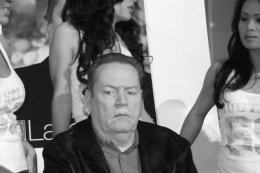 December 6, 1984 LARRY
FLYNT, the defendant, called in his own behalf, testified as follows: DIRECT
EXAMINATION * * * Q. Mr.
Flynt, do you recognize
Exhibit 4? A. Yes,
I do. Q. Can
you tell us when you receive [sic], if at
all, to the court? A. This
is a list of suggestions for ad parodies
that was submitted by a freelance art director in Los Angeles. Q. Now,
when was it that -- did that come into
your possession before today? A. Yes,
it did. I received it then and I've seen a
copy of it since then. Q. When
you say then, what date are you
referring to? A. July
of 1983. Q. Do
you recall the circumstances of your
receiving that document? A. Yes,
I do. Q. Can
you tell the jury the circumstances? A. Yes. We invite various people in the creative arts
area and
cartoonist, art
directors, you know, to submit ideas for ad parodies and cartoons and
we pay
for these ideas. And we get them from
people all over the country. Q. How
did that come to you? A. Well,
Mike Salisbury had been asked to submit
some ideas. He submitted a list to us
and we purchased approximately four (4) or five (5) of the ideas. We paid, I believe, five hundred dollars
($500.00) a piece for them. * * * Q. Now,
can you tell us, looking at Exhibit 4,
which of the items on there you recognize as
having been purchased from Mr. Salisbury by Hustler? A. The
Campari ad, the Coca-cola ad, the Kool
ad, the Malboro [sic] ad, the Trojans may have been one of those, I'm
not sure. Q. Now
the Campari ad is the one that you said
that you purchased is number six (6) on that list, is that right? A. Yes. * * * Q. Turning
to item number six (6) on there, can
you read for the jury what that item is? A. It
says Campari. "Jerry Falwell talks about
his first
times [sic]. Something like, I never
really expected to make it with Mom, but then after she showed all of
the other
guy [sic] in town such a good time, I figured, what the hell." Q. Now,
did you have any discussions with Mike
Salisbury about this list? A. About
the preparation of it? Q. Yes. A. No. Q. Was
the list given to you in this form? A. The
list was submitted to me with an
attachment of art work. Otherwise, he
attached the original Campari ad. I
believe a photograph of Jill St. John was on there and then he
suggested
getting a colored photograph of Reverend Falwell and putting it in
place of
theirs and then building the text around this idea. Q. Was
any of the words written in Number six (6)
written by anyone
at Hustler? A. No. Q. What
did Hustler Magazine do after they
purchased the items you've referred to on this list? Specifically, what
did
they do with item number six (6)? A. After
the ideas were purchased they were
discussed at an editorial meeting where both the art director and the
editor in
charge of the parodies could compare their work. An
art director does the illustration in
terms of laying out the physical design of the ad.
The editor writes all of the copy that
appears within -- the type that appears within the ad. * * * Q. Well,
let me ask you a question if there was
any discussion about what was intended to be conveyed by the ad parody
that you
hold in your hand? A. Well,
we wanted to poke fun at Campari for
their type advertisement because the innuendoes that they had in their
ads made
you sort of confused as to if the person was talking about their time
as far as
a sexual encounter or whether they were talking about their first time
as far
as drinking Campari. Of
course, another thing that you had to do is to have a person, you know,
that is
the complete opposite of what you would expect. If
someone such as me might
have been in there I don't know how people would have interpreted it. But if somebody like Reverend Falwell is in
there it is very obvious that he wouldn't do any of these things; that
they are
not true; that it's not to be taken seriously. But
where the irony and humor is found in this, while it
might not be
funny to certain people and they may not see the satire in there, they
have to
consider how different people around the country perceive Falwell to be
in
terms of his political activities, his beliefs, how he wants people to
perceive
him as, you know, he would like to be loved, have recognition,
acceptance by
the people. There's nothing wrong with
this, but when it happens, you know, ego comes into play.
The best example I can say is when somebody
asks me why Reverend Falwell, the only thing I can point out is why did
Walter
Mondale, during the debates in Louisville, "Do you want Reverend
Falwell
to be involved in selecting the next Supreme Court?" Now, that was
strictly to make a political point, but that means that he, more than
any other
evangelist is involved in the mainstream of politics.
And there is a great deal of people in this
country, especially the ones that
read Hustler Magazine, that feel that there should be a separation
between
church and state. So, when something like
this appears it will give people a chuckle. They
know this was not intended to defame the Reverend
Falwell, his
mother or any members of his family because no one could take it
serious. * * * Q. All
right. In terms of the idea of Reverend
Falwell giving an
interview to Hustler
Magazine, what do you think the believability of that is to the readers? A. Well,
all of our readers know that Reverend
Falwell has sued Penthouse Magazine for running a legitimate interview
with
him, so it's doubtful -- his -- because of his personal, you know,
beliefs and
convictions, Hustler and myself have been a target of him and the Moral
Majority,
you know, for the past ten (10) years. So
it's highly unlikely, you know, that he would -- that
there would be
any remote possibility that he would consider giving an interview to us. Q. All
right, now, looking at the items
specifically, can you tell us what specific items in there you think
are
totally unbelievable? A. Well,
you know it's a put-on when you read the
first one where it says, "My first time was in
an outhouse in Lynchburg, Virginia." I mean,
you start
off there. Q. Now,
read the interviewer's question. "Wasn't
it a little cramped?" A. Well,
you really don't know what that means
at that point. I mean, you know, you see
the ad, you know it's a put on but -- Q. Now,
Reverend Falwell responds, "Not
after I kicked the goat out." Now what to you was the believability to
that suggestion. A. Well,
you're talking about someone's first
time. It's kind of difficult for two (2)
people and a goat to fit in an outhouse. I'm
not trying to be funny. I
just, you know, don't really understand the point you're trying to make. Q. Well,
I'm asking you at this point to tell me
what about this ad parody makes it so clear to you that it was
something that
never could be believed. Now, let's go
down the items specifically, if you can, and tell us what about this ad
parody
makes this impression upon you? A. Well,
you know, as far as making it with his
mother, I mean, that's so outrageous, I mean, that no one can find that
believable. Q. What
else can you tell us? A. The
irreverence and the whole iconoclastic
appeal about your mom, "Isn't that a bit odd. I
don't think so. Looks
don't mean that
much to me in a woman." I mean, if this stuff was true it would be
extremely inflammatory and offensive, but the fact that you know it's
not true,
you know, I can't comprehend how anyone could take it serious. I mean, someone may not like it, but that's
not what we're here for today is whether somebody likes it or not, but
whether
it's in violation of the law. Q. Interviewer:
"Go on," reading at
the middle of the page. "Falwell:
Well, we were drunk off our God-fearing asses on Campari, Ginger Ale,
and Soda,
that's called the Fire and Brimstone, at the time." Now, what did you
think about the believability of that statement? A. I
think it's totally unbelievable. Q. Is
there anything in this ad parody that you
thought at the time would be believed? A. Not
anything. Q. Look
at the language at the bottom of the
left hand corner where it says, "Campari, like all liquor, was made to
mix
you up." Now, what did you think about the believability of that
statement? A. Well,
again, that is part of the parody on
the product itself, you know, the liqueur. I
mean, you're not going to believe that really, you know,
anymore than
you're going to believe the
material about Reverend Falwell. Q. Had
you seen liquor advertisements before
this advertisement parody was published. A. Pardon? Q. Had
you seen authentic liquor advertisements
before this ad parody was published? A. Yes. Q. Now,
had you ever seen a liquor advertisement
that told you that you -- that the liquor was made to mix you up? A. No. Q. Does
Hustler advertise liquor? A. No,
we don't. Q. Reading
on: "It's
a light, 48 proof, refreshing spirit, just mild enough to make you
drink too
much before you know you're schnockered." Now,
what was your opinion about the believability of that statement? A. Well,
no liquor company is really going to
use that kind of language, you know, to describe their product. Q. Reading
on: "For
your first time, fix it with orange juice or maybe some white wine. Then you won't remember anything the next
morning. Campari, the mixable that smarts." Tell
us what your opinion was about the believability of that statement? A. That's
-- I mean, that's not believable
because, you know, someone is saying, you know, drink our liquor and
you won't
remember anything the next morning. I
mean, again it becomes obvious. * * * Q. Now,
when the discussion concerned Campari,
was there anybody at that meeting who expressed the concern that a
reader might
take the ad parody to be a true statement of fact? A. No,
no one. But please understand how it works. Once an editorial decision is made, Xeroxed
copies of
whatever goes in
the magazine goes to the legal department. We
have, you know, three (3) in-house attorneys who look
this over and
if it doesn't have their approval on it, it don't go in the magazine. They're often making changes because the
editors, as well as myself, you know, do not have legal minds. Q. What
effect, if any, did you intend for the
ad parody to have on Jerry Falwell? A. We're
responding to our own readership; we
didn't intend for it to have any effect on him. And
the fact that he's you know, responded the way he has,
you know, is
just as, you know, unbelievable as the ad is. * * * Q. Publishing
the ad parody that is in front of
you, Exhibit 1, was there any intent on the part of Hustler to
hurt Mr.
Falwell? A. No. Q. Now,
the ad parody was published in March
1984. Is that correct? A. Possibly. I don't know. * * * Q. At
the time that ad parody was published, in
March of 1984, were you involved in a position to publish it? A. Ah,
yes. Because I recall working on this
issue. Q. Now,
when it was published, what was the
intent of Hustler, if any, to hurt Mr. Falwell? A. There
was no intent. |