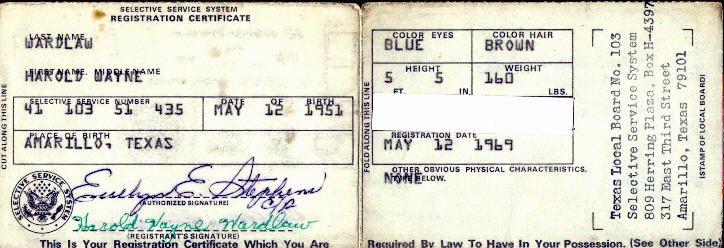
In 1968, the Court considered the argument of David Paul O'Brien that he had a First Amendment right to burn his draft card on the steps of a Boston courthouse as a form of protesting U.S. involvement in the Viet Nam War. The Court agreed that O'Brien was engaged in an expressive activity that triggered a First Amendment analysis. The Court noted, however, that O'Brien was punished for his "conduct" (the burning of the card) and not for what he was trying to say about the war. The Court offered in O'Brien a test for analyzing cases in which both speech and conduct elements are present: [A] government
regulation is sufficiently justified if it is within
the constitutional power of the Government; if it
furthers an important or substantial governmental
interest; if the governmental interest is unrelated to
the suppression of free expression; and if the
incidental restriction on alleged First Amendment
freedoms is no greater than is essential to the
furtherance of that interest.
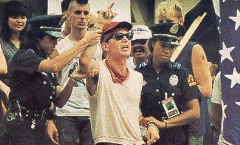 Gary Johnson being arrested after burning a flag. South Florida Free Beaches v Miami is an 11th Circuit decision. The court in that case considered the argument that enforcement of Miami's ordinance prohibiting public nudity abridged the First Amendment right of plaintiffs to "communicate their philosophy that the human body is wholesome." The court disagreed, suggesting that nudity had to be attached to some other expressive activity, such as dance or theater, to raise serious First Amendment issues. In Doe v Reed (2010), the Court considered whether the signing a state referendum petition is "speech" within the meaning of the First Amendment and, if it is, whether the state's disclosure of the names of petition signers violates their First Amendment rights. Eight members of the Court agreed that the signing of a referendum petition was "an expressive act" implicating the First Amendment. Justice Scalia disagreed, seeing the signing as a "legislative act" not within "the freedom of speech." On the question of whether the signers of petitions generally have a First Amendment right to keep their identities private, eight members said no, though they indicated that "unique circumstances" surrounding particular referendum might create a right to anonymity. Justice Thomas dissented. A good example of how what would once have been considered an economic regulation subject only to rational basis review, but what now receives closer scrutiny under the First Amendment, was a New York law that prohibited merchants from charging a surcharge to consumers who use credit cards. At first blush this seems like a law regulating conduct, specifically the setting of prices. But in Expressions Hair Design v Schneiderman (2017), the Court concluded that as applied to merchants like hairstylists (who might like to put up a sign such as "HAIRCUTS $20 (we charge a 3% extra for credit cards') the law restricts speech, not just conduct. A simple price regulations, such as "hairstylists must charge no more than $20 for haircuts," would be a conduct regulation and would not present First Amendment issues, Chief Justice Roberts said in his opinion for the Court. The Court sent the case back to the lower courts to determine whether the law might survive as a valid regulation of commercial speech.
|
Cases O'Brien v United States (1968) Texas v Johnson (1989) Buckley v Valeo (1976) South Florida Free Beaches v Miami (1984) Doe v Reed (2010) Expressions Hair Design v Schneiderman (2017) 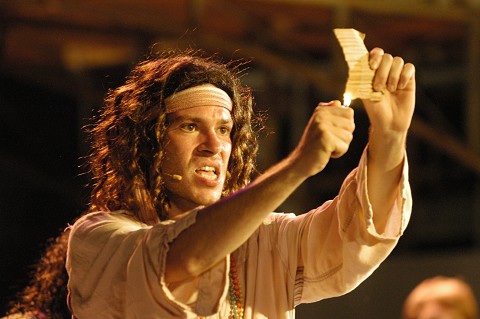 Scene of draft card burning from a production of "Hair." Photo by Rich Copley | LexGo.com. Questions 1. What are the essential
elements of "speech" for purposes of the First
Amendment? Is an intention to communicate
essential? Is it essential also that someone
actually understand the message?
Links:
Flag Burning and
Related Issues2. Is a speaker of Greek protected if no one in her audience understands a word of the language? Is it "speech" to send smoke signals when there is no one around to see the smoke? 3. Are all forms of art and music "speech" within the meaning of the First Amendment? 4. How should courts analyze First Amendment issues when the regulated activity includes both speech and non-speech ("conduct") elements? is the test developed by the Court in O'Brien a good one? Do you agree with its application in that case? 5. Doesn't speech always involve some elements of conduct, whether it is the moving of vocal cords, the placing of ink on paper, or the typing that sends a message into cyberspace? 6. What was Johnson trying to communicate by burning an American flag? Would he have a First Amendment argument if punished for burning a flag in his own backyard when no one was watching? 7. Do you agree with the Court in Buckley that campaign donations and campaign expenditures should be considered a form of "speech"? If government today could ban all campaign expenditures, what could our politics look like? 8. Was the court in South Florida Free Beaches too quick to reject the First Amendment argument? Is it plausible that the plaintiffs in that case were primarily trying to send a message to onlookers? Would nude plaintiffs have a better First Amendment argument if they started dancing or kept shouting, "Hey look, we're nude and proud!" 9. When you sign a petition are you engaged in "speech" within the meaning of the First Amendment? What do you think of Justice Scalia's characterization of petition signing as "a legislative act" not within the freedom of speech? Image of draft card (Viet Nam War era) O'Brien Test for Law Incidentally Regulating Speech |