|
This principle, it turns out, applies even to something so basic as human lives. Clearly, the Fourteenth Amendment prohibits the government itself from taking lives or liberty, except in a manner consistent with due process, and the Fourth Amendmend specifically prohibits the government from unreasonably seizing persons. When it comes, however, to a government duty to protect persons from bad private actors, the Court has been reluctant to find one--even when reasonable government actors could easily have saved lives or prevented serious bodily harm. The leading case concerning the government's duty (or lack thereof) to protect persons is DeShaney vs Winnebago Department of Social Service (1989). Joshua DeShaney was a young boy repeatedly beaten by an abusive father. After Joshua sustained serious injuries, hospital officials repeatedly warned the Department of Social Services about their suspicions that Joshua was being abused by his father. The warnings fell on deaf ears, and finally Joshua was so severely beaten as to fall into a coma and sustain permanent serious brain injuries. Joshua's mother sued the county, arguing that DSS officials had deprived Joshua of his liberty without due process of law by failing to intervene in a timely manner to protect him from his father. Writing for a 6 to 3 majority, Justice Rehnquist ruled that the state, absent "a special relationship" (such as might exist for persons in state institutions), had no affirmative constitutional duty to protect individuals. In a very strong dissent (that includes the two-word sentence "Poor Joshua!"), Justice Blackmun chastised the majority: Like the antebellum
judges who denied relief to fugitive slaves, the Court
today claims that its decision, however harsh, is
compelled by existing legal doctrine. On the contrary,
the question presented by this case is an open one,
and our Fourteenth Amendment precedents may be read
more broadly or narrowly depending upon how one
chooses to read them. Faced with the choice, I would
adopt a "sympathetic" reading, one which comports with
dictates of fundamental justice and recognizes that
compassion need not be exiled from the province of
judging.
Estate of
Sinthasomphone vs City of Milwaukee (1992)
is a federal district court decision involving
another tragic set of facts. On a night in
1991, Milwaukee police received a 911 call
informing them that a naked and badly beaten
young man (who turned out to be a 14-year-old
Laotian named Konerak Sinthasomphone) was at a
specific address and needed help. The
police responded to the call, as did the fire
department and paramedics. When the police
arrived, Jeffrey Dahmer, currently on probation
for sexual abuse of a male child, was trying to
reassert control over the boy while two private
citizens were trying to prevent him from doing
so. The police ordered the two citizens
and the fire department to leave, took control
of Sinthasomphone, and delivered the drugged and
beaten boy back to Dahmer's apartment.
Dahmer, it turned out, was a serial
killer. Sinthasomphone became one of his
seventeen victims, with his body dismembered and
stuffed into Dahmer's refrigerator.
Sinthasomphone's family and estate sued,
alleging Konerak's constitutional rights were
violated by Milwaukee police. The federal
district court ruled that the case could proceed
to trial, concluding that the alleged facts
suggest that it was the government's action in
preventing rescue, not just inaction, that was
the cause of his injuries and that Konerak's
brief period of police custody might have
created the "special relationship" that the
Supreme Court said was lacking in DeShaney. Castle Rock vs
Gonzales (2005) involved, as Justice
Scalia observed for the Court, yet another set
of "horrible facts." The Castle Rock
police repeatedly ignored increasingly frantic
calls from a mother begging them to investigate
what she suspected was the abduction of her
three children by her husband, who she was then
in the process of divorcing and who was
currently subject to a restraining order.
The police did nothing to investigate.
Finally, hours later, the husband showed up at
the police station and opened fire. Police
shot back, killing the man, and soon thereafter
discovered the three dead bodies of Jessica
Gonzales's young children in the back of his
pick-up truck. Jessica Gonzales sued
Castle Rock, alleging that the restraining order
created a claim of entitlement to protective
services under the Due Process Clause, a right
which the city violated by failing to follow up
on her calls. Voting 7 to 2, the Court
rejected her argument, holding that the
restraining order did not constitute a claim of
entitlement because it did not eliminate
discretion of government officials not to
enforce it. Dissenting Justices Stevens
and Ginsburg concluded that the failure of
Castle Rock police to respond did violate
Jessica's right to fair procedures, and thus
constituted a due process violation.
|
Cases DeShaney v Winnebago Dep't of Social Service (1989) Estate of Sinthasomphone v Milwaukee (1992) Castle Rock v Gonzales (2005) 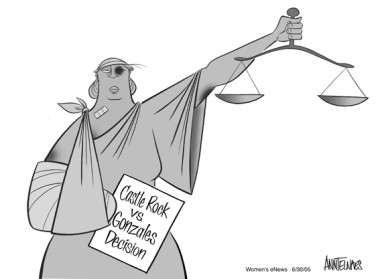 o oQuestions 1. Who has the better
argument in DeShaney,
the majority or the dissent?
2. Do you agree with Justice Blackmun in DeShaney, that when the Constitution is ambigous, it should be construed in such a way as to provide justice to the parties? 3. Do you think the Supreme Court would recognize that the brief period police held Konerak Sinthasomphone in custody, as they returned him to Dahmer's apartment, established a "special relationship" that would convince it to distinguish DeShaney? 4. Do you think the action/inaction distinction drawn in Estate of Sinthasomphone is a workable one? Is it possible to recharacterize most instances of "inaction" as "action" of another sort? 5. Do you think Sinthasomphone's constitutional rights were violated, assuming the facts were as alleged? 6. Note that Castle Rock, unlike DeShaney, is really a claimed procedural due process violation rather than a substantive due process violation. Gonzales claimed a "property right" that entitled her to a process that the police denied. Is this distinction between procedural and substantive due process clear to you? Does it make sense? 7. Did the Court in Castle Rock give proper deference to the determination of Colorado courts that state law in fact created an entitlement to police enforcement of the restraining order? Links  Jessica Gonzales with a photo of her three murdered children CBS News story on Gonzales v Castle Rock  Lynne Curry, The DeShaney Case (Univ. of Kansas Press) |