|
Introduction
The first state
marriage
law to be invalidated was Virginia's miscegenation law in Loving v
Virginia
(1967). Mildred Jeter, a black woman, and Richard Loving, a white
man, had been found guilty of violating Virginia's ban on interracial
marriages
and ordered to leave the state. The Court found Virginia's law to
violate the Equal Protection Clause because it invidiously classified
on
the basis of race, but it also indicated the law would violate the Due
Process Clause as an undue interference with 'the fundamental freedom"
of marriage.
In Zablocki
v Redhail
(1978), the Court struck down a Wisconsin law that required persons
under
obligations to pay support for the children of previous relationships
to
obtain permission of a court to marry. The statute required such
individuals to prove that they were in compliance with support orders
and
that marriage would not threaten the financial security of their
previous
offspring. The Court reasoned that marriage was "a fundamental
right"
triggering "rigorous scutiny" of Wisconsin's justifications under the
Equal
Protection Clause.
In Turner
v Safley
(1987), the Court refused to apply strict scutiny to a Missouri prison
regulation prohibiting inmates from marrying, absent a compelling
reason.
Instead, the Court found the regulation failed to meet even a lowered
standard
of "reasonableness" that it said it would apply in evaluating the
constitutionality
of prison regulations.
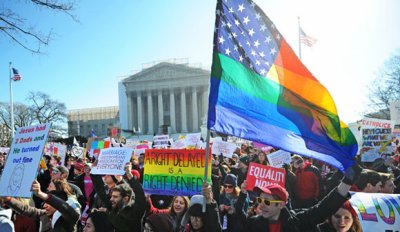
The supreme
courts of three states (Massachusetts, California, and Connecticut)
have, as of 2009, found bans on gay marriage to violate state
constitutional provisions. In November 2008, however, California
voters narrowly approved a proposition designed to overturn the
decision of that state's supreme court. The legality of the
voters' action is now an issue in the California courts.
Meanwhile, many states have, by legislation or voter initiative,
enacted "defense of marriage" laws to keep marriage an institution
exclusively for a man and a woman.
|
Massachusetts' Supreme Judicial Court Okays Gay
Marriage
The Supreme Judicial Court of
Massachusetts, on November
19, 2003, ruled that the state "failed to identify any constitutionally
adequate reason" to deny gay persons the right to marry and that the
state's
prohibition on same-sex marriage violated the state's
constitution.
The Court, in its fifty-page 4 to 3 ruling, gave the state legislature
180 days to "take such action as it may deem appropriate in light of
this
opinion." Because the case, Goodridge v Department of Public
Health,
was decided on state constitutional grounds, there is no federal issue
for appeal to the U. S. Supreme Court.
Because of the Full Faith and Credit
Clause of Article
IV of the U. S. Constitution**, same-sex marriages performed in
Massachusetts
would have to be honored in other states unless they have enacted a
so-called
"defense of marriage act," as most other states have, either by statute
or state constitutional amendment.
Following the Massachusetts decision,
some conservative members of Congress announced that
they would push for an amendment to the U. S. Constitution that would
prohibit
gay marriage. (It is unlikely that Congress has the statutory
power
under the Commerce Clause of the Constitution to overturn the decision
of Massachusetts.) Then-President Bush indicated that he
supported
such a constitutional amendment. Vice President Cheney,
interestingly, said that he disagreed with the President on this
issue, and would prefer that the matter be left to the states.
Gay marriage was a major issue in the
2004 election, and many observers credit it for giving Bush his narrow
win over Kerry. In key states such as Ohio, conservative voters
turned out in large numbers to support state constitutional bans on gay
marriage. In all eleven states where constititional bans on gay
marriage was on the ballot, it passed--in some states by nearly 3 to 1
margins. In 2006, anti-gay marriage amendments passed in
additional states, with Arizona being the lone state to reject such an
amendment.
**Article IV Section
1.
Full Faith and Credit shall
be given in each State to the public Acts, Records, and judicial
Proceedings of every other State. And the Congress may by general Laws
prescribe the Manner in which such Acts, Records and Proceedings shall
be proved, and the Effect thereof.

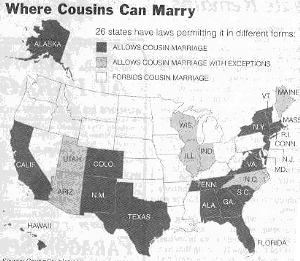
Source for map: National Public Radio
|
|
The First Proposed
Constitutional
Amendment on the Subject of Marriage (1912)
Congressional
Record, 62nd Cong.,
3rd sess., Dec. 11, 1912. Vol 49, p. 502
Mr.
RODDENBERY. ( ... ) The
resolution to which I make reference is one already introduced by me,
providing
for an amendment to the Constitution of the United States, with the
usual
resolving clause, and the article is as follows:
That
intermarriage between
negroes or persons of color and Caucasians or any other character of
persons
within the United States or any territory under their jurisdiction, is
forever prohibited; and the term "negro or person of color," as here
employed,
shall be held to mean any and all persons of African descent or having
any trace of African or negro blood.
Nothing will
contribute more
to the popular development and wise administration of a republican
government
than for the people in their legislatures to have an opportunity, by
the
adoption of this resolution, to provide that forever hereafter it shall
be contrary to the fundamental law of the Republic for a negro or a
part
negro or an African or a part African to intermarry with a white
person,
a Caucasian, or any person of like description. The object
of this resolution is to submit to the States a constitutional
amendment
for this purpose....
|
|
Cases
Loving
v Virginia (1967)
Zablocki
v Wisconsin (1978)
Turner
v Safley (1987)
Cases: Gay
Marriage
Lawrence v Texas (2003)
(intimate association)
Goodridge
v Dep't of Public Health (2003)

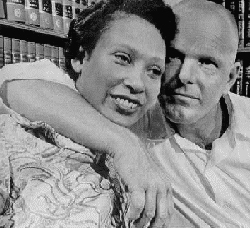
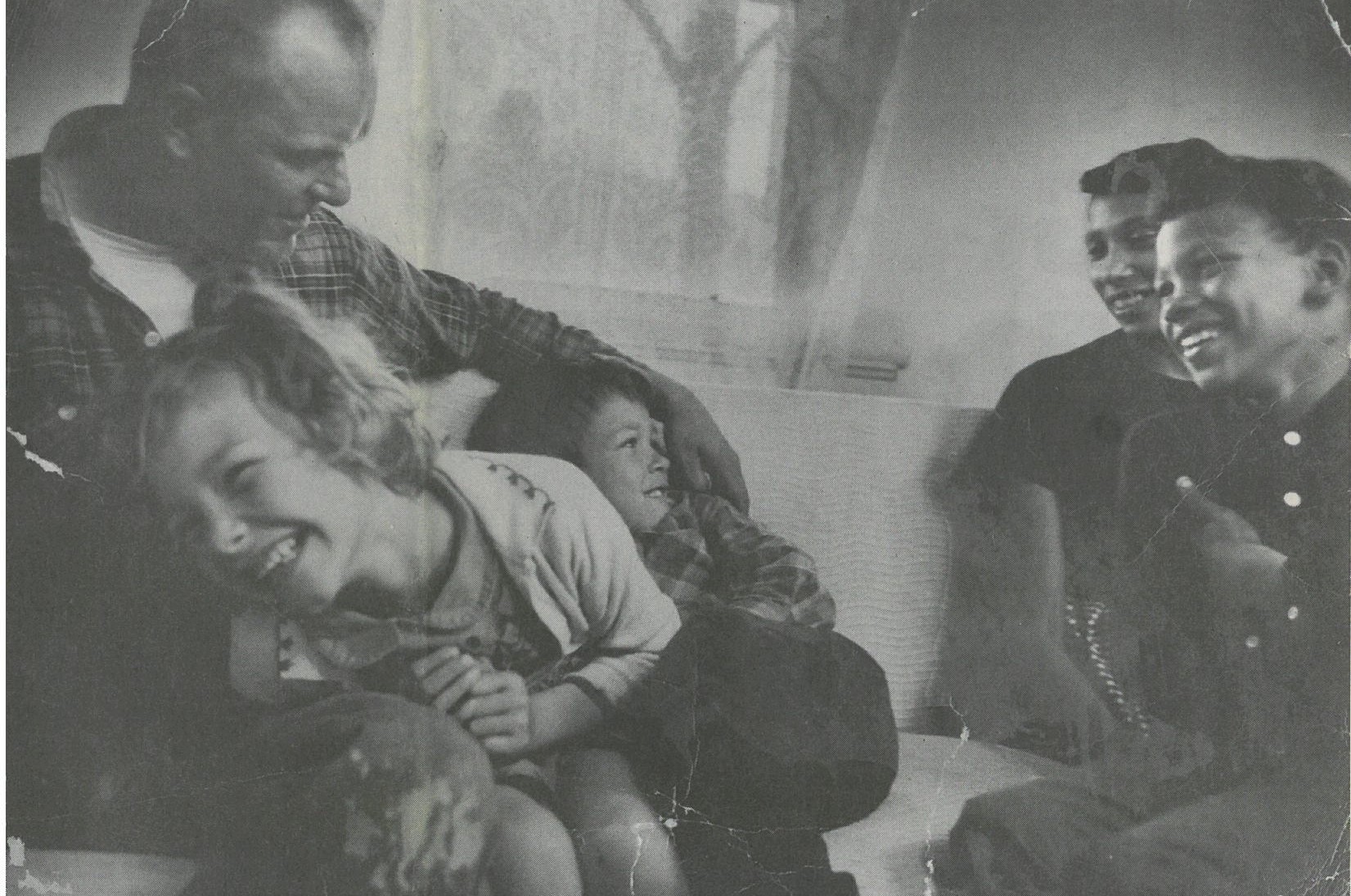
Mildred Jeter and Richard Loving

Julie Goodridge (left) and Hillary Goodridge
(right),
two of the plaintiffs who succesfully challenged Massachusett's ban on
same-sex marriages. (AP photo).
Questions
1. What do our
cases suggest
about the constitutionality of the following laws?: (1) a law
prohibiting
a mentally retarded adult from marrying, (2) a law prohibiting first
cousins
from marrying, (3) a law prohibiting a brother from marrying his
sister,
(4) a law prohibiting polygamy, (5) a law prohibiting persons of
certain incompatible blood types (predisposing offspring to defects or
disease) from marrying, and (6) a law prohibiting minors from marrying
without the consent of parents or guardians.
2. Do you
agree
that prison regulations concerning marriage should receive a lower
level
of scrutiny than should restrictions on marriage in other contexts?
3. Do you
agree
with the Massachusetts ruling concerning same-sex marriages? Do
you
think laws prohibiting same-sex marriages should be found to violate
the
Equal Protection Clause of the United States Constitution? Should
the Constitution be amended to prohibit same-sex marriages?
4. Does Lawrence
suggest that laws prohibiting homosexual marriage are
unconstitutional?
What legitimate interest does the state have, if any, in prohibiting
two
persons of the same sex from entering into a marriage relationship?
5. Justice Scalia
strongly criticized the majority's reliance, in Lawrence, on
European
decisions affording legal protection to homosexuals engaging in private
sexual conduct. To what extent to you see decisions and trends in
other parts of the world as being relevant to interpretation of our
Constitution?
6. Critics of same-sex
marriages argue that unless marriage is defined as the union of one man
and one woman we will soon have courts finding a constitutional right
to
polygamy or a right for a man or woman to marry a favorite pet.
What
lines might and should be drawn?
7. In 2002,
in In
Re Estate of Gardiner, the Kansas Supreme Court ruled that a
marriage
between a man and a transexual woman (a person born male, but operated
on prior to marriage) is invalid. As a result, the transexual
woman
was unable to claim her deceased spouse's $2.5 million estate that she
would have otherwise been entitled to. Do you think the Kansas
law
denying transexuals the benefits of marriage offends the U. S.
Constitution?

In 2002, scientists reported that first
cousins can
have children together without a great risk of birth defects or genetic
disease. Being cousins increases the risk of having a child with
a serious problem from a background rate of about 4% to a rate of about
6%.
Gay Marriage Update (2009)
Following the lead of
Massachusetts, two additional states found prohibitions on gay marriage
to violate state constitutions: California (May 2008) and Connecticut
(October 2008). In November 2008, however, California voters narrowly
voted to overturn the California Supreme Court decision legalizing gay
marriage. A lawsuit challenging the anti-gay marriage proposition
is pending in California courts.
The New York Times
report on the decision of the Connecticut Supreme Court included this
analysis:
“Like these once
prevalent views, our conventional understanding of
marriage must yield to a more contemporary appreciation of the rights
entitled to constitutional protection,” Justice Richard N. Palmer wrote
for the majority in a 4-to-3 decision that explored the nature of
homosexual identity, the history of societal views toward homosexuality
and the limits of gay political power compared with that of blacks and
women.
“Interpreting our state
constitutional provisions in
accordance with firmly established equal protection principles leads
inevitably to the conclusion that gay persons are entitled to marry the
otherwise qualified same-sex partner of their choice,” Justice Palmer
declared. “To decide otherwise would require us to apply one set of
constitutional principles to gay persons and another to all others.”
The ruling was
groundbreaking in various respects. In addition to establishing
Connecticut as the third state to sanction same-sex marriage,
it was the first state high court ruling to hold that civil union
statutes specifically violated the equal protection clause of a state
constitution.
|
|