|
In
1942, the Supreme Court sustained the conviction
of a Jehovah's witness who addressed a police
officer as a "God dammed racketeer" and "a damned
facist" (Chaplinksy v. New Hampshire).
The Court's opinion in the case stated that there
was a category of face-to-face epithets, or
"fighting words," that was wholly outside of the
protection of the First Amendment: those words
"which by their very utterance inflict injury" and
which "are no essential part of any exposition of
ideas."
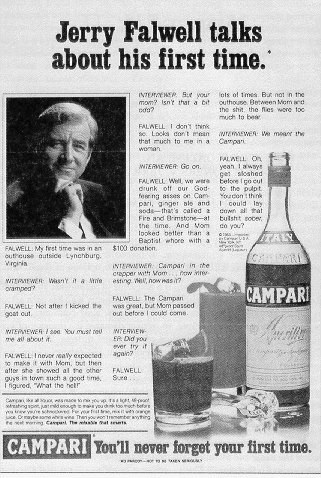
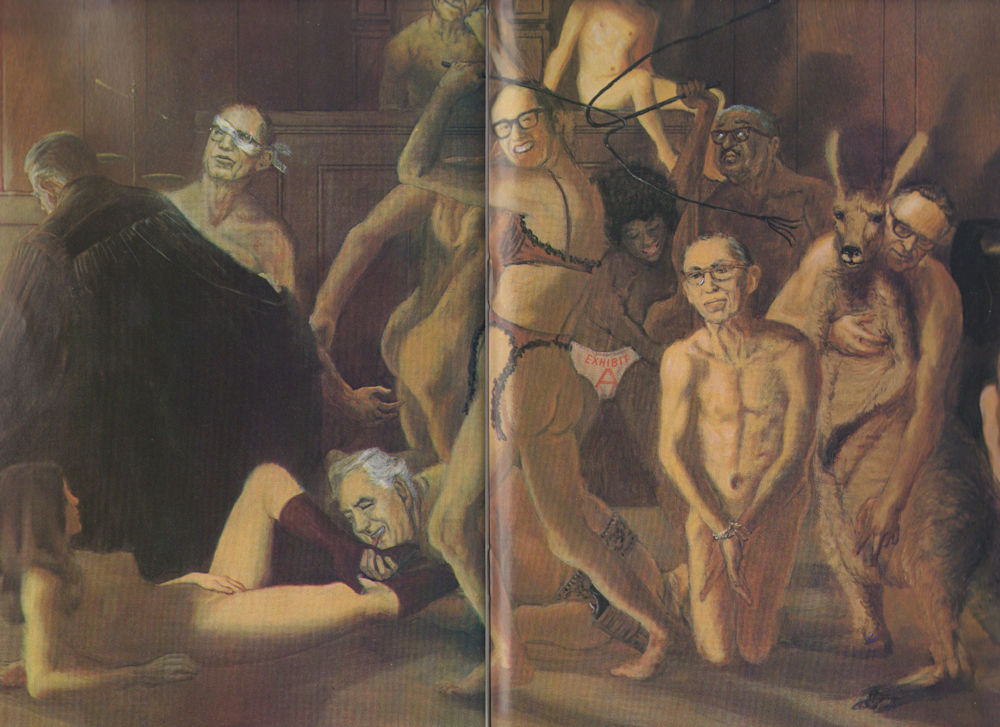
In 1988, the Supreme Court considered a jury award of damages against Hustler Magazine for publishing a malicious and untrue story about Rev. Jerry Falwell. The piece, labeled in small print "a parody," stated that Falwell's first sexual encounter was with his mother while drunk in an outhouse. A Virginia jury concluded that the Hustler piece constituted "intentional infliction of emotional distress" and awarded $150,000 to Falwell. The Supreme Court unanimously reversed the award, saying that it saw no principled basis for distinguishing the Hustler article from hard-hitting political cartoons and other speech clearly worthy of First Amendment protection. The Court distinguished the sort of character assassination practiced by Hustler from the face-to-face insult threatening an immediate breach of the peace that was in issue in Chaplinsky. American Booksellers v Hudnut (1986) involved a First Amendment challenge to an Indianapolis civil rights ordinance that made it a crime to distribute materials that depicted women as "sexual objects for domination, conquest, or use." The Sixth Circuit Court of Appeals invalidated the ordinance calling it "thought control." The Court ruled that the First Amendment gives government no power to establish "approved views" of various subgroups of the population. R. A. V. considered a challenge to a St. Paul ordinance punishing the placement of certain symbols that were "likely to arouse anger, alarm, or resentment on the basis of race, religion, or gender." Robert Victoria, a teenager, had been convicted of violating the ordinance after having been found to have burned a cross on the yard of a black family. The Court, in an an opinion by Justice Scalia, reversed R. A. V.'s conviction on the ground that the ordinance unconstitutionally criminalized some hurtful expression (specifically that aimed at racial and religious minorites) and not other hurtful expression (that aimed at other unprotected groups) based on the political preferences of legislators. Scalia makes clear that "fighting words" is not, as Chaplinsky had suggested, a category of speech that is wholly outside of First Amendment protection. A year after R. A. V., the Supreme Court unanimously upheld, in Wisconsin v. Mitchell, a statute that imposed stiffer sentences for racially-motivated assaults than for other types of assaults. The Court reasoned that the statute did not violate the First Amendment because it was aimed primarily at regulating conduct, not speech. In
Virginia v Black (2003), the Court divided
on the question of whether a state could prohibit
cross burning carried out with the intent to
intimidate. A majority of the Court
concluded that, because cross-burning has a
history as a "particularly virulent form of
intimidation," Virginia could prohibit that form
of expression while not prohibiting other types of
intimidating expression. Thus, the majority
found the cross-burning statute to fall within one
of R. A. V.'s exceptions to the general
rule that content-based prohibitions on speech
violate the First Amendment. Nonetheless,
the Court reversed the Virginia cross-burner's
conviction because of a jury instruction that
might produce convictions of cross-burners whose
motivation was ideological--and not an attempt to
arouse fear. Justice Thomas dissented,
arguing that cross-burning is conduct, not
expression, and therefore its suppression does not
raise serious First Amendment issues.
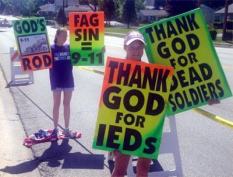
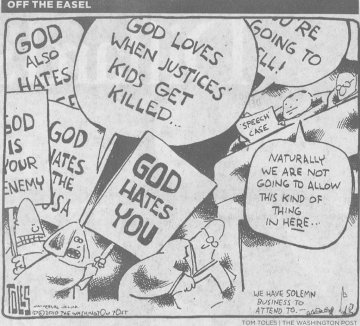
In
2011, in Snyder v Phelps, the Supreme
Court overturned a jury verdict against a
Kansas-based anti-gay church group that picketed
the funeral of a marine who died on duty in
Iraq. (The group believes that soldiers'
deaths are a form of punishment against America
for tolerating homosexuality). A Maryland
jury had found that the picketing and Internet
postings by the group targeted the soldier's
parents and constituted intentional infliction of
emotional distress.
Writing
for an 8 to 1 Court, Chief Justice Roberts noted
that the Westboro group's speech generally related
to a matter of public concern, that the group
complied with all city ordinances and police
department requests, and that the funeral itself
was not disrupted. Given these facts,
Roberts wrote, "We cannot react to [Snyder's] pain
by punishing the speaker. As a nation we
have chosen a different course--to protect even
hurtful speech on public issues to ensure that we
do not stifle public debate." Justice Alito
dissented, arguing that at least some of the
group's speech directly attacked the Snyder family
and therefore did not relate to a matter of public
concern.
|
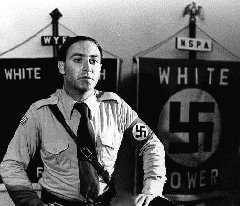
 Robert A. Victoria (above photo), a St.Paul teenager, was prosecuted for burning a cross in the yard of a black family. The
Cases
2. Are you surprised that the Court in Hustler is unanimous, and that the opinion is authored by Chief Justice Rehnquist? 3. The Indianapolis anti-pornography ordinance involved in American Booksellers was supported by an odd coalition of Fundamentalists and feminists. How does the ordinance differ from the typical anti-pornography law? 4. Under the Indianapolis ordinance, is there a variety of "good"--although sexually explicit--pornography that might be legally displayed and distributed? 5. Would the sale of Sports Illustrated's annual "swimsuit issue" (featuring many pages of women in skimpy swimsuits) be a violation of the Indianapolis ordinance? 6. Why should we (or shouldn't we) protect expression of the idea that women should be treated as sexual objests? 7. Should R. A. V. have been decided on the more limited "overbreadth" ground suggested by the concurring justices? 8. Some have called R. A. V. "the most important First Amendment decision in decades." Do you agree? 9. Does Scalia's opinion in R. A. V. suggest that he was writing to send a message to judges and administrators who might be reviewing or considering the adoption of "politically correct" university hate speech regulations? 10. After R. A. V., would a hate speech statute specifically protecting children or senior citizens be constitutional? 11. Why doesn't R. A. V. call into question Title VII actions based on, e.g., a male supervisor's relating a dirty joke or making a sexually suggestive remark to a female employee? 12. After Wisconsin v Mitchell, how should a court evaluate the constitutionality of a statute that sentences perpetrators of race-based assaults to 3 years, perpetrators of most types of assaults to 1 year, and perpetrators of assaults based on sexual orientation to 3 weeks? 13. How easy will it be to determine when a KKK cross-burning is a statement of group solidarity (protected by the First Amendment) rather than an unprotected attempt to arouse the fear of racial or religious minorities? 14. Could a state, consistent with the First Amendment, ban the flying of the Confederate flag if "done with the intent to intimidate"? The showing of a swastika when done "with an intent to intimidate"? What has to be shown before a potentially threatening form of symbolic expression can be targeted? 15. Do you think that the messages conveyed by the Westboro Baptist group in the Snyder case all addressed matters of public concern? 16. After Snyder, what options are open for states and communities that seek to protect families mourning loved ones at funerals from the harms inflicted by Westboro group? 17. The Court in Snyder stressed that the Westboro group complied with all ordinances and police requests. If they hadn't, would the Court have reached a different result in the case?
|