|
Supreme Court interpretation of the Free Exercise Clause has come full circle. From its narrow reading of the clause in 1878 in Reynolds, to its much broader reading of the clause in the Warren and Burger Court years, the Court returned to its narrow interpretation in the controversial 1990 case of Employment Division of Oregon v Smith. The story of this circular migration is an interesting one, and may provide lessons for other areas of constitutional interpretation. This page describes the first half of the story: the rise of the compelling state interest test for evaluating government actions that substantially burden religiously motivated conduct. The
Supreme Court's first encounter with a Free
Exercise Clause claim came when a Mormon
polygamist in the Utah Territory challenged his
conviction under a federal anti-polygamy
law. The Supreme Court rejected the
appellant's claim that his religious beliefs
necessitated, and therefore excused, his violation
of federal law. The Court read the Free
Exercise Clause as protecting religious beliefs,
not religious practices that run counter
to neutrally enforced criminal laws.
By the Warren Court years of the 1960s, the Court had adopted a much more expansive view of the Free Exercise Clause, reading it to compel governmental accomodation of religiously-motivated conduct in the absence of a compelling state interest and the use of means that least burdened religious practices. Applying this strict scutiny to laws that significantly burdened religious exercise, the Court found unconstitutional South Carolina's law denying unemployment benefits to a Seventh Day Adventist who turned down a job opportunity that included Saturday work (Sherbert). The
Burger Court continued to apply this test, using
it in 1972 to find unconstitutional (as applied to
Amish families) Wisconsin's law mandating
attendance in schools until age 17 (Yoder).
The Court found strong evidence for "the claim
that enforcement of the State's requirement of
compulsory formal education after the eighth grade
would gravely endanger if not destroy the free
exercise of respondents' religious beliefs." Douglas O.
Linder, The Story Behind Yoder v Wisconsin The
principle established in Yoder showed its
continuing vitality and was expanded in the 2025
case of Mahmoud v Taylor, which relied on
Yoder in holding that socially conservative
parents who had religious objections to their
children being exposed to public school
instruction that they claimed promoted or condoned
LGBTQ lifestyles must be allowed to have their
children opt out (penalty free) of such
instruction. State and lower federal courts, of course, applied strict scrutiny to enjoin a variety of criminal laws in the 1970s and 80s. For example, in 1979 in Frank v Alaska, the Alaska Supreme Court held that the state could not enforce its hunting laws against Athabascans who were religiously-motivated to hunt moose out of season--moose being a key ingredient in a religiously proper funeral potlatch. By the
mid-80s, the Supreme Court, while still using
heightened scutiny, began to take a more skeptical
view of Free Exercise claims. The close
division of the Court on these claims was revealed
in its 1985 affirmance (by an equally divided
Court, Justice Powell not participating) of an
Eighth Circuit decision enjoining Nebraska from
enforcing a state law requiring photo
identification on driver's licenses against a
Nebraska motorist who believed that such pictures
violated the Second Commandment's warning against
worshipping graven images (Jensen v
Quaring). The
next year, the tide began turning against Free
Exercise claimants as the story continues: The Free
Exercise Clause: Narrowing of the Test |
Congress shall make no law respecting an establishment of religion, or prohibiting the free exercise thereof. (Amendment 1)
Cases FEC Protection
Reaches its Apex 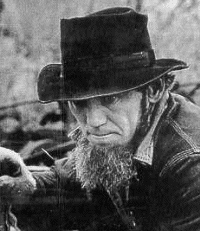 Jonas Yoder, who successfully challenged Wisconsin's compulsory education law (LIFE).
Questions 2. Is there any serious argument to be made that the people have an unlimited right to do anything that their religous beliefs compel them to do? If you were a member of a religion that believed the gods demanded that a virgin be thrown off a cliff every week, could you possibly argue that the Free Exercise Clause protects you against a charge of murder? 3. Should Sherbert be entitled to unemployment benefits if her religious beliefs required her to turn down any job that required her to work on Tuesdays and Thursdays? 4. Yoder holds that the Amish are exempt from state compulsory education laws because public education beyond a certain age threatens the religious values of the Amish. Does this case suggest that Christian Fundamentalists have a free exercise right to be exempted from, say, biology classes in which evolution is taught or requirements in a literature course that they read religiously-objectionable works? 5. Do the Frank and Jensen decisions suggest problems with the compelling state interest test? Do you think either or both of those cases were correctly decided? What about the argument that granting special treatment to those with a specific religious belief constitutes an establishment of religion? Links
|