×
Check-out the new Famous Trials website at www.famous-trials.com:

Section
34 of the Coroners
Act requires a coroner investigating a death to
make findings, where
possible. in relation to (a)
Identity of the deceased
person. I
propose to deal first with
the cause of death, which is generally referred
to, in the context of
the medical cause of death. The cause of death is
the real or actual
cause of death (not the terminal cause of death);
namely"... the
disease injury of complication, not the mode of
dying.” “(See Ex P
Minister of Justice, Re Malcolm. Re Ingles (1965)
NSWR 1598, at 1604
(McClemens J). Since
the first inquest
before Mr. Barritt SM, it was thought that the
quantity of blood on the
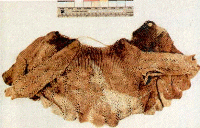
jumpsuit and singlet indicated that Azaria
Chamberlain had died. During
the criminal trial, experts offered opinions as to
the cause and manner
of Azaria's death based on the distribution and
apparent flow pattern
of the blood staining upon the clothing. Further
opinion evidence in
that regard was given before the Royal Commission.
It was
common ground between
the experts that most of the blood staining on the
jump suit originated
from the outside of the fabric that most of the
blood staining to the
back of the collar was consistent with Azaria's
body having been supine
for a period while her blood was shed and that the
blood stains on the
left shoulder were consistent with her torso being
in an upright
position while her blood flowed. As noted by the
Commissioner (at 187
of his Report) nit was therefore accepted that
most of the blood
staining originated from injury to the neck or
head of the baby, with
the blood flowing down the outside of the collar
and neck area and
soaking through to the singlet beneath.” After
examining all the
evidence relating to the cause of the blood
staining on the clothing
and the location of the injuries' on Azaria's body
Commissioner Morling
said (at 189) that he was unable to conclude
whether the blood staining
on Azaria's clothing originated from injury to her
head, neck or both. The
Commissioner was also
unable to conclude with certainty whether or not
the bleeding which
caused the blooding staining occurred before or
after Azaria's death
(at 190). Commissioner Morling went on to say (at
190-191): In this
situation the evidence does not indicate what the
cause of death was or
how the baby died". However.
it must be borne in
mind that the Marling inquiry was not intent on
discovering the cause
of death as such. Therefore. I now turn to
consider the evidence
bearing upon the cause of death in light of the
civil standard of
proof. The
evidence in relation to
the bloodstained jumpsuit is equivocal in terms of
establishing the
cause of death: (1)
Although the bleeding
that caused the bloodstaining was due to an injury
of some kind, it is
not possible to determine the site of the injury,
i.e. whether the
injury was sustained to the head, neck or both
areas. Nor can the means
by which any such injury was inflicted be
ascertained. (2) It
is not possible on
the evidence to determine whether the injury,
which produced the
bleeding, which in turn resulted in the blood
stained clothing,
occurred before or after Azaria's death. In other
words it is not
possible to conclude that Azaria in fact died from
the injury (whatever
that might have been), which caused the bleeding
which in turn,
produced the bloodstains on the clothing. It will
be recalled that Mr.
Galvin CM concluded that the cause of death was
"extensive wounding to
the child's neck." Although that Conclusion may
have been open on the
evidence which was then before the Coroner, a
diversity of opinions as
to the cause and manner of Azaria's death based on
the distribution and
apparent flow pattern of the blood staining on the
clothing was
presented both at the trial and at the Royal
Commission. It was that
further evidence, which was not before Mr. Galvin
CM, which led the
Royal Commissioner, and indeed also leads this
inquiry, to being unable
to conclude whether the blood staining on Azaria's
clothing originated
from an injury to her head, neck or both. That
very same body of
evidence also leads this inquiry to being unable
to conclude on the
balance of probabilities that that injury
(whatever it might have been)
caused death. The
blood staining on the
clothing formed, of course, only one small part of
a great volume of
evidence adduced with a view to establishing the
cause and manner of
Azaria's death. However, the bloodstained clothing
probably provided
the strongest evidence indicating what the cause
of death was and how
the baby died. There is no other evidence, or
sufficiently cogent
evidence, either viewed alone, or taken in
conjunction with the
evidence relating to the bloodstained clothing,
which is capable of
reasonably satisfying me as to the cause of
Azaria's death. Finally.
it should be noted
that the absence of a body, and the consequential
absence of a
post-mortem examination and the results thereof,
means that potentially
vital evidence as to the cause and manner of death
is not available to
the coroner. One need go no further than the
recent statements made by
David Ranson in his article "The Coroner and the
Rights of the
Terminally III Act 1995 (NT)" (Journal of Law and
Medicine at Vol 3
November 1995 at 169) as to the importance of a
post-mortem
examination: "In carrying out their investigations
into deaths,
coroners rely heavily upon the medical information
provided by
pathologists and in particular on the results of
autopsy examinations.
Indeed, the forensic autopsy is the mainstay of
the information
provided to a coroner for the purposes of
investigating a death and
determining the cause of death...the coronial
system relies on
autopsies to provided the best evidence of the
cause, mode and
circumstances of death." (at 173). As
stated above, the
standard of proof in a coroner’s court is the
civil standard i.e. the
balance of probabilities. On the basis that that
standard requires a
belief amounting to reasonable satisfaction, the
cause of death of
Azaria Chamberlain is indeterminable, and must
remain undetermined.
Azaria Chamberlain died of cause or causes
unknown. Even if
one were to apply
the standard purely as a matter of objective
probability (which it is
submitted is not the appropriate approach), the
appropriate finding as
to the cause of death must remain an open finding.
Although
Section 34 of the
Coroner Act, unlike Section 37 (1) of the former
Act, does not
expressly require a coroner to ascertain the
manner of death,
subsection (v) of Section 34 {i.e. "any relevant
circumstances
concerning the death"} has a very wide ambit, and
certainly includes
the manner of death. There
have ever been only
two theories as to the manner in which Azaria
Chamberlain died. The
first is that Mrs. Chamberlain murdered her
daughter. The second is
that Azaria had been taken by a dingo. In terms
of a coroner's
verdict or findings, the first theory, if
substantiated to the
reasonable satisfaction of a coroner, would
translate into a finding of
death by violent means due to human intervention
viz that Azaria
Chamberlain died at the hands of Alice Lynne
Chamberlain (without there
being any ascription of criminal responsibility);
the second theory, if
substantiated, would result in a finding of
accident or accidental
death. "Accident"
in this context
has been described as an unforeseen misfortune or
mishap causing injury
or harm which bears a casual' connection with the
death {See Waller,
"Coronial Law and Practice in New South Wales" at
23; and David
McCann's article "Range of Findings open to the
Coroner" in "The
Aftermath of Death" (Editor High Selby at 16.).
Jervis (9th ed at 86)
refers to "accident as meaning on "unlooked - for
mishap or an untoward
event which was not expected or designed." Although
the Royal
Commission of Inquiry into Chamberlain Convictions
had to consider the
two competing theories, its line of inquiry must
be kept in context.
The purpose of the Royal Commission was to enquire
into and report on
the correctness of the Chamberlain convictions. In
reaching the conclusion
that there was a reasonable doubt as to the
Chamberlain's guilt,
Commissioner Morling concluded that the hypothesis
that Mrs.
Chamberlain murdered Azaria had not been proved
beyond reasonable doubt. Although
the Commissioner
was of the opinion that the evidence afforded
considerable support for
the dingo hypothesis, His Honor did not examine
the evidence to see
whether it had been proved that a dingo took the
baby. To do so would,
in \the words of Commissioner Morling, involve
"... (a) Fundamental
error of reversing the onus of proof and requiring
Mrs. Chamberlain to
prove her innocence (at 339 of the Report). In the
circumstances His
Honor went no further than to say: "It is
impossible in the above
summary to capture the whole effect of the
voluminous evidence given on
the matters which bear upon the dingo hypothesis
but, taken in its
entirety, it falls far short of proving that
Azaria was not taken by a
dingo. U(at 338 of the Report). In
reaching the conclusion
that there was a reasonable doubt as to the
Chamberlain's guilt;
Commissioner Morling found it unnecessary to
consider the possibility
of human intervention (other than by the
Chamberlains) in the time
between Azaria's disappearance and the finding of
her clothes. However,
he said that it was not impossible to imagine
circumstances in which
such intervention could' have occurred. He said:
"It was not
inconceivable that an owner of a domestic dog
intervened to cover up
its involvement in the tragedy or that some
tourist, acting
irrationally, interfered with the clothes before
they were later
discovered by others. (at 340 of the Report).
Although there was not
the slightest evidence to support either of those
hypotheses,
Commissioner Marling considered that the
possibility of human
intervention (other then by the Chamberlains) was
another factor, which
must be taken into account in considering whether
the evidence
established the Chamberlain's guilt beyond
reasonable doubt. However,
it must not be
forgotten that Commissioner Morling was not
commissioned to inquire
into and determine the cause and manner of death
of Azaria Chamberlain
for the purposes of the Coroners Act, in respect
of which a different
standard of proof, viz, the civil standard
applies. Against that
background it would be open to the present
inquiry, applying a civil
standard of proof, to record a coroners finding of
death by violent
means due to human intervention (without ascribing
criminal
responsibility to any person), despite the fact
that the convictions
against the Chamberlains were quashed. Such an
outcome would not be
illogical given the different objectives pursued
by\ the criminal
process and the coronial one, and the divergent
standards of proof.
However, for the reasons, which follow, even
applying the civil
standard of proof, the evidence does not
reasonably support a coroner's
finding of death by violent means due to human
intervention. In R v
Wolverhampton
Coroner: ex parte McCurbin (1990) 1 WLR 719 at 727
Woolf LJ conceded
that although there was a "technical distinction"
between the standard
of proof in criminal proceedings and that in
coronial proceedings, when
a coroner had to consider a finding of unlawful
killing, the gravity of
the crime was so high the result would be the
same. Whichever standard
was applied. I do not agree that the distinction
is purely technical,
and it does not necessarily follow that in so far
as a coroners finding
of unlawful killing is concerned, the matter is so
serious that the
result would be the same, whatever standard of
proof was applied. The
standard of proof in a
Coroner's Court in Australia is the civil standard
as governed by the
Briginshaw principle. According to that principle
the seriousness of an
allegation, the inherent unlikelihood of an
occurrence of a given
description, or the gravity of the consequences
flowing from a
particular finding "are considerations which must
affect the answer to
the' question whether the issue has been proved to
the reasonable
satisfaction of the tribunal "(1938 60 CLR 336 at
361 - 362). It
follows that clear, cogent or strict proof is
necessary where criminal
conduct is alleged in civil proceedings, for
example a coronial
inquest. It is however, wrong to read such a
statement as being
directed to the standard of proof, and as
indicating the need for an
elevated standard of proof in cases where criminal
conduct is alleged.
Rather, as The Honorable Mr. Justice D H Hodgson
says in his article.”
The Scales of Justice: Probability and Proof in
Legal Fact – Finding
(supra at 739-740), the circumstances that
criminal conduct is alleged
is a factor relevant to what material concerning
the particular
circumstances is to be considered adequate, so
that the court can then
reasonably act on the balance of probabilities.
This approach does not
ignore the mathematical probability of a
particular event having
occurred. It simply requires the fact- finder to
not only look at the
probabilities based on the available evidence of a
particular event
having occurred, but to determine whether the
nature and quality of the
evidence, is sufficient to reasonably satisfy the
fact - finder that
the particular event occurred. After
examining all the
evidence I am unable to be satisfied on the
balance of probabilities
that Azaria Chamberlain died at the hands of Alice
Lynne Chamberlain.
It automatically follows that I am also unable to
be satisfied on the
balance of probabilities that Michael Leigh
Chamberlain had any
involvement in the death. I have
reached those
conclusions after having regard to the
considerations referred to in
Briginshaw and Briginshaw (supra). I do not
consider that the evidence
is sufficiently clear or cogent, or that material
facts have been
strictly proved to such an extent, as to lead me
to be reasonably
satisfied that Azaria died at the hands of her
mother. In reaching that
conclusion I have had regard to the whole of the
evidence, that is to
say, all the evidence pointing to the involvement
of the Chamberlains,
and all the evidence given on the matters, which
bear upon the dingo
hypothesis. In relation to the involvement of the
Chamberlains in the
death of Azaria Chamberlain, I have reached the
same conclusion as
Commissioner Morling: the only difference is that
the Commissioner was
applying the criminal standard of proof whereas I
have applied the
civil standard of proof on the balance of
probabilities. I would
add that if one were
to reject the "belief' approach to the civil
standard of proof, and
apply to the evidence in the present case the
"objective probability"
approach, which merely requires a probability
greater than 50 percent
of the event in question having occurred, the same
result would obtain:
I would still be unable to conclude that Azaria
died at the hands of
Alice Lynne Chamberlain. Unlike
the Marling Inquiry,
the present inquiry, which is charged with the
duty of ascertaining the
cause and manner of Azaria's death, must go on to
consider alternate
findings. It was not part of Commissioner
Morling's commission to
determine whether the dingo hypothesis had been
proved. Applying
once again the
"belief' approach to the civil standard of proof
to the evidence, I am
unable to be reasonably satisfied that Azaria
Chamberlain died
accidentally as a result of being taken by a dingo
from her tent at the
camp site at Ayers Rock. I have
approached the matter
in the following way: (1) One
of the factors
referred to in Briginshaw and Briginshaw (supra)
as affecting the
answer to the question whether the fact (or facts)
sought to be proved
has been established to the reasonable
satisfaction of the fact-finder
is "the inherent unlikelihood of an occurrence of
a given description"
having taken place. At page
310 of his Report,
Commissioner Morling stated: "The defense asserted
that Azaria had been
taken by a dingo, an event for which there was no
known precedent. It
was therefore a novel case". Of course, one does
not expect that human
beings; in particular young babies, will
ordinarily be taken and killed
by a dingo. First, that circumstance is a factor,
which may itself be
relevant to the question of probabilities.
Secondly, it is a factor, to
use the words of The Honorable Mr. Justice Hodgson
(supra at 739-740),
"relevant to what material concerning the
particular circumstances is
to be considered adequate so that the court can
then reasonably act on
the balance of probabilities. (2) In
light of the factors
referred to above. I have closely examined all the
evidence given on
matters, which bear upon the dingo hypothesis, and
which was before the
Royal Commission. That evidence is conveniently
summarized in the
Morling Report at pages 328-340. (3)
Although a finding that
Azaria died at the hands of her mother has been
discounted at an
earlier stage, the evidence supporting that
hypothesis cannot be
ignored when considering a finding of accidental
death. That body of
evidence, as much as the evidence which supports
the dingo hypothesis,
is relevant to whether or not I can be reasonably
satisfied that Azaria
Chamberlain died accidentally as a result of being
taken by a dingo. (4)
Although I agree with
Commissioner Morling that the evidence affords
considerable support for
the view that a dingo may have taken Azaria, the
evidence is not
sufficiently clear, cogent or exact to reasonably
support such a
finding on the balance of probabilities. When I
have come to consider
the possible findings in this case I have
purposely not taken into
account further alternate hypotheses involving
human intervention
(other than by the Chamberlains) or accidental
death due to causes
other than the one put forward. The reason for
that is that there is
not the slightest evidence supporting any such
hypotheses. Although
Commissioner Morling took the view (as did some of
the judges in the
High Court) that the possibility of human
intervention (other than by
the Chamberlains) may be a matter relevant to the
creation of a
reasonable doubt concerning the Chamberlain's
guilt, I do not believe
it would be proper in the context of a coronial
inquest, which is after
all concerned with ascertaining the cause and
manner of death, to
consider hypotheses which are not open on the
evidence. If, however, I
have erred in the approach, which I have taken,
and I should have
considered further hypotheses not raised on the
evidence, their
consideration would have, if anything, diminished
the cogency of the
evidence supporting the two dominant hypotheses,
and not altered the
conclusions, I have reached. Given
that I am unable to be
reasonably satisfied on the evidence that Azaria
died at the hands of
Alice Lynne Chamberlain or alternatively that
Azaria died accidentally
as a result of being taken by a dingo, the only
finding that can be
recorded is an open finding. (See Jervis 11th ed
at 253 in relation to
an open finding). An open
finding is
unavoidable as I am unable, after applying the
requisite standard of
proof and its inherent degrees of reasonable
satisfaction, to choose
between the two main competing hypotheses
concerning the death of
Azaria Chamberlain (the choice between the two
being a mere matter of
conjecture), and to prefer one hypothesis over the
other (See Holloway
v McFeeters 1956 94CLR 470). An open finding is
tantamount to a
statement that on all of the evidence the cause
and manner of Azaria's
death cannot be determined, and must remain
unknown. Before
returning an open
finding, I have heeded the warning that an open
verdict should only be
returned in the last resort where there is
insufficient evidence to
enable a coroner to reach one of the other
positive verdicts. I have
also considered the
submission made by Mr. Tipple to the effect that
"in the circumstances
that have occurred, the return of an "open
finding" would be
inappropriate because it would do less than
justice to the findings of
the Marling Report and would lead to speculation
that the death was due
to causes other than "accidental causes".(See page
5 of the written
submissions). Mr. Tipple also submitted that B...
now that the
innocence of the Chamberlains has been
authoritatively restored and
proclaimed, it would lead to great mischief if
their right to the
status of innocence was undermined by the formal
recording of an "open
finding" in relation to the death." (Ibid). With due
respect, these
submissions are based on a number of fundamental
misconceptions
concerning the scope of the Marling Report, the
relationship of the
presumption of\incidence to the coronial process,
and the nature and
function of the coronial process. As
stated above, the purpose
of the Royal Commission was to enquire into the
correctness of the
Chamberlain convictions, and to report
accordingly. The Marling Report
concluded as follows (at 342): “It
follows from what I have
written that there are serious doubts and
questions as to the
Chamberlain's guilt and as to the evidence in the
trial leading to
their conviction. In my opinion, if the evidence
before the Commission
had been given at the trial, the trial judge would
have been obliged to
direct the jury to acquit the Chamberlains on the
ground that the
evidence could not justify their conviction. In Re
Conviction of
Chamberlain (1988) 93 FLR 239 the Court of
Criminal Appeal of the
Northern Territory, having found in the light of
fresh evidence that
there had been a miscarriage of justice in former
criminal'
proceedings, quashed the convictions against Mr.
and Mrs. Chamberlain.
The quashing of the Chamberlain convictions must
be kept in proper
perspective. It is
not the purpose of a
criminal trial to establish the innocence of the
accused: rather its
purpose is to establish the person's guilt, the
standard of proof being
beyond reasonable doubt. Consistent with this
purpose, a criminal trial
begins with the assumption that the accused is not
guilty. That is
reflected in the presumption of innocence, which
underlies our system
of criminal law: a person is presumed innocent
until proven guilty. It is
often said that the
presumption of innocence requires that the facts
necessary to establish
criminal liability must be proved beyond
reasonable doubt. However,
that is. a misconception. In II Evidence: Its
History and Policies"
(Butterworths 1990) Julius Stone (at 215) says: “The
rule requiring proof
beyond a reasonable doubt in criminal cases has
really nothing to do
With the law of presumptions, nor, indeed with the
proof of any
particular fact involved in a criminal trail. It
is a special standard
of sufficiency of persuasion on all the evidence
which must be
satisfied before there can be conviction in
criminal cases. It does not
come into operation until the process of
submitting the evidence is at
an end. The law of presumptions, on the other
hand, is concerned with
the process of submitting evidence. The
presumption of innocence will
prevail or be destroyed in exactly the same way as
any other
presumption. In criminal cases, however, there
will come into
operation, before guilt can be found, the
additional requirement of
persuasion beyond reasonable doubt on all the
evidence." The
quashing of the
Chamberlain convictions by the Court of Criminal
Appeal of the Northern
Territory entitled Mr. and Mrs. Chamberlain to the
presumption of
innocence "with which the law clothes all persons
unless and until
their guilt has been proved beyond reasonable
doubt" (See the judgment
of Asche CJ at 241). At the trial the presumption
of innocence had been
destroyed by reason of the prosecution having
adduced evidence and
proved the Chamberlain's guilt beyond reasonable
doubt. However, the
existence of a grave doubt as to the guilt of the
Chamberlains in light
of fresh evidence demanded. the quashing of the
convictions. The
quashing' of the convictions signified the
continuation (or if you like
the prevailing) of the presumption of innocence;
because as Nader J
rightly observed (at 254): "in the absence of a
conviction, innocence
is presumed." After the quashing of the
convictions the Chamberlains
were exactly in the same position as an accused
found not guilty, in
which case the presumption of innocence continues.
As it is not the
function of a criminal trial to establish the
innocence of an accused
person, but to ask and answer the question whether
the accused is
guilty of the crime charged beyond all reasonable
doubt, the continuing
presumption of innocence in favor of the
Chamberlains means that in the
eyes of the criminal law Mr. and Mrs. Chamberlain
are innocent. It is in
this sense that Mr.
Tipple's statements that "the innocence of the
Chamberlains has been
authoritatively restored and proclaimed, and
they have a right to
the status of innocence should be understood. In order
for Mr. Tipple's
submissions as to the deleterious effect of an
open finding to succeed
it would have to be shown (a) that an open finding
would do less then
justice to the Morling Report and (b) that such a
finding would
undermine the Chamberlain's status of innocence
and thereby occasion
great mischief. The
first point to be made
is that the laws of the Northern Territory do not
preclude civil
proceedings being brought against a person,
previously acquitted in
criminal proceedings, for compensation, arising
out of the same set of
facts advanced earlier with a view to establishing
criminal guilt. Such
proceedings may be brought either at common law or
pursuant to statute,
for example, the Crimes (Victims Assistance Act)
Act. Consequent upon
the quashing of their convictions, Mr. and Mrs.
Chamberlain enjoy the
same status as an acquitted person. But the
continuing presumption of
innocence in favor of Mr. and Mrs. Chamberlain
does not theoretically
bar the institution of civil proceedings based on
the same set of
facts, which led to their ultimate acquittal
(though in practical
terms, the particular circumstances of the case do
not lend themselves
to such subsequent litigation). Where a
person who is
acquitted of criminal charges (either at first
instance or at a later
time) is proceeded against in subsequent civil
proceedings on the same
set of facts, that person is presumed innocent in
relation to any
allegations of criminal conduct until the contrary
is proved on the
balance of probabilities according to the
principles enunciated in
Briginshaw v Briginshaw (supra; see, in.
particular, the following part
of Dixon J's judgment at pp 362-4: "When in a
civil proceeding, a
question arises whether a crime has been
committed, the standard of
persuasion is, according to better opinion, the
same as upon other
civil issues… But, consistently with this opinion,
weight is given to
the presumption of innocence and exactness of
proof is expected"). It
follows that the presumption of innocence, rather
than being undermined
by subsequent civil proceedings, continues, that
is to say until the
contrary is proved according to the civil
standard. What
must be kept firmly in
mind is that in the above context criminal and
civil courts perform
different functions, and in discharging their
respective tasks apply
different standards of proof, and even where an
allegation of criminal
conduct is alleged in civil proceedings the
presumption of innocence
applies, and the defendant in the civil suit is
presumed innocent until
the allegation is proved. If the
law raises no
objection to subsequent civil proceedings for
compensation in cases
where the person sued has been earlier acquitted
of criminal charges,
then subsequent coronial proceedings are equally
unobjectionable,
particularly in light of the purposes of a
coronial inquest, which are
indeed limited. Unlike in the case of subsequent
civil proceedings for
compensation arising out of the commission of an
offence, which
inevitably require the fact finder to decide
whether or not the
defendant was "guilty" of the offence, it is not
the function of a
coroner to determine any question of criminal or
civil liability, to
apportion guilt or attribute blame (R v H M
Coroner for North
Humberside and Scunthorpe: Ex parte Jamieson
(1994) 3 WLR 82). The
essential task of a coroners court is to ascertain
cause' and manner of
death. Married to those aspects is the unique
consequence of coronial
proceedings that the findings of a coroner are not
conclusive and
binding on any other court (Sewell, "Law of
Coroner" (1843) p20); nor
do a coroner's findings affect rights or
liabilities (See Jacobs JA in
Ex parte Flock. re Featherstone (1967) 86 WN (Pt
2) (NSW) 349 at 353).
"An inquiry before a coroner is merely in the
nature of a preliminary
investigation. It is not of any force" (Bird v
Keep (1918) 2 KB 692). Even a
positive finding in
the present case that Azaria Chamberlain died at
the hands of Alice
Lynne Chamberlain, provided such a finding was
open on the evidence,
would not violate the integrity of the Morling
Report; nor would it
create mischief by undermining the Chamberlain's
status of innocence.
First, the coroner's function is entirely
different to that bestowed
upon the Marling Inquiry, and a court exercising
criminal,
jurisdiction. A coroner's court is not concerned
with the determination
of criminal liability. Secondly, where a coroners
finding of unlawful
homicide or a finding of death by violent means
due to human
intervention is under consideration the
presumption of innocence
applies until the contrary is proved to the
requisite 'standard of
proof. However, even where the presumption of
innocence is displaced in
coronial proceedings, that is not inconsistent
with the continuation of
the presumption of innocence arising out of an
acquittal in criminal
proceedings, given the limited function of
coronial proceedings.
Thirdly, the criminal standard of proof does not
apply to coronial
proceedings; the applicable standard of proof is
the civil standard on
the balance of probabilities. Finally, the
findings of a coroner do not
affect rights or liabilities, and are of no
binding force. However,
we are dealing here
with an open finding. An open finding would have
even less capacity
(substantially less) to undermine or otherwise
have a deleterious
effect on the Chamberlain's status of innocence.
An open finding is
still the product of proceedings, which are
limited in nature and
function. Further, an open finding does not
disturb the presumption of
innocence with which all inquests must begin when
considering unlawful
homicide or death by violent means due to human
intervention as a
possible finding. Ah open finding leaves the
presumption completely
intact. Thus
far, Mr. Tipple's
submissions as to the deleterious effect of an
open finding on the
Chamberlain's status of innocence cannot be
sustained. However, Mr.
Tipple also submits that an open finding would
lead to speculation that
the death was due to causes other than accidental
causes, and
presumably create mischief. I now deal with that
submission. An open
finding will, by its
very nature, lead to speculation that Azaria's
death was due to
non-accidental causes. However, undoubtedly such
speculation existed
within the community even after-the findings of
the Morling Report and
the subsequent quashing of the Chamberlain
convictions. Such
speculation continues to this very day. Regardless
of the outcome of
the present inquest, whether it were to result in
a . positive finding
(one implicating either Mrs. Chamberlain or the
dingo}, or an open
finding, speculation over the cause and manner of
Azaria's death would
remain. What is important, however, is that any
such speculation,
inevitable as it is, can never disturb the
unassailable fact that as a
matter of public record the "law of the land holds
Mr. and Mrs.
Chamberlain to be innocent. " I
foresee that many members
of the community may disagree with the conclusion
I have reached., Two
factors may go a long way towards explaining that
lack of unanimity.
The first is the fact that I have had the
advantage of having all the
evidence before me. The second is that the mental
processes leading up
to my decision have been confined and structured
by a set of legal
principles governing the standard of proof in
coronial cases. Pursuant
to the provisions
of Section 34 of the Coroners Act I make the
following findings: (1) The
name of the deceased
was Azaria Chantel Loren Chamberlain, the daughter
of Michael Leigh
Chamberlain and Alice Lynne Chamberlain. (2)
Azaria Chantel Loren
Chamberlain, a female Caucasian, was born at Mount
Isa Queensland on
11th June 1980. Her usual place of residence was 3
Abel Smith Parade,
Sunset, Mount Isa, Queensland. (3)
Azaria Chantel Loren
Chamberlain died at Ayers Rock on 17th day of
August 1980. (4) As
to the cause of her
death and the manner in which she died the
evidence adduced does not
enable me to say. I therefore return an open
finding and record the
cause and manner of death as unknown. Dated
this 13th day of
December 1995. Mr. John
Lowndes |