×
Check-out the new Famous Trials website at www.famous-trials.com:
 Mark Aldrich |
 Thomas C. Sharp |
| In
October 1844, a Hancock County grand
jury indicted nine men for the murders of Joseph and
Hyrum Smith.
Four men fled the county and were never arrested: John
Wills, William
Voras, and two men with unknown first names, Gallaher
and Allen.
A witness to the murders, Jeremiah Willey, said that
Wills, Gallaher,
and Voras were among the men that broke into the Smiths'
room and that
Gallaher shot Joseph Smith in the back as he ran to the
window. Wills,
Gallaher, and Voras all received wounds when they were
shot through the
cell door by Joseph Smith. The following biographical sketches of the five defendants in the Carthage Conspiracy trial of 1845 are drawn largely from Carthage Conspiracy: The Trial of the Accused Assassins of Joseph Smith, by Dallin H. Oaks and Marvin S. Hill (University of Illinois Press, 1979). |
| Levi
Williams Colonel and commanding officer of the 59th Regiment of the Illinois Militia Age at indictment: 34 Levi Williams and
his wife
moved from New York to Green Plains, Illinois, in the
early 1830s,
where the couple raised their five children.
Williams farmed,
worked as a cooper, and served as a part-time Baptist
minister.
He rose through the ranks of the Illinois militia and
assumed the
position of commanding officer of the 59th Regiment in
1840.
Williams used his position in the militia to make life
difficult for
Mormons. In December 1843, he led a mob that
kidnapped a
Mormon and his son at gunpoint, bound them in chains,
and carried them
across the river to Missouri, where they were briefly
held on charges
of horse theft. On June 19, 1844, Williams
ordered the tar and
feathering of a militia officer who refused a request
of a constable to
join a posse that was traveling to Nauvoo to attempt
to arrest Joseph
Smith. Williams reportedly said after Smith's
murder, that Mormon
domination of Hancock County meant "the old settlers
had no chance, and
that [murder] was the only way to get rid of
them." At the 1845
trial, the prosecution presented no evidence that
Williams actually
fired a bullet at the Smiths, but two witnesses
testified that Williams
asked for militia volunteers to go to Carthage, where
the Smiths were
imprisoned. Williams, according to witnesses,
was among the 100
or so men present at the jail when the Smiths were
murdered.
According to the account of William Daniels, Williams
gave the order to
charge the jail: "Col. Williams shouted out, 'Rush
in!—there’s no
danger
boys—all is
right!'”
|
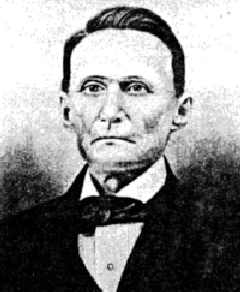
| Mark Aldrich Land developer and Commander of the Warsaw Independent Battalion (a two-company battalion attached to the 59th Regiment) Age at indictment: 42 Mark Aldrich, the
oldest of the
Carthage defendants, was a founder of Warsaw, a Whig
Party member of
the Illinois State Legislature, and--after the
Carthage trial--the
first American mayor of Tuscon, Arizona.
Aldrich moved to Hancock
County from New York in 1832 and quickly established
himself as one of
the early developers in the area. Aldrich and
Smith became
involved in
a land dispute in 1841-42 after 204 English
immigrant Mormons moved on
to rented land just south of Warsaw owned by
Aldrich. When
Aldrich
raised the rent and imposed certain restrictions
objectionable to
Smith, the Mormons left for Nauvoo, a move that
forced Aldrich to file
for bankruptcy in March 1842. Anti-Mormon antipathy
in Warsaw also
was a factor in the decision to leave Aldrich's
property. It is
believed that the land controversy turned Aldrich
into an outspoken
opponent of the the presence of Mormons in Hancock
County.
Witnesses
at the 1845 trial placed Aldrich at a railroad
shanty where volunteers
were recruited to march to the Carthage jail.
There he reportedly
spoke in favor of ridding Hancock County of the
Smiths, and then set
off with the mob. The jury acquitted Aldrich
along with the other
defendants.
|
| Jacob C. Davis State senator and commander of the Warsaw Cadets Age at indictment: 31 After attending William
and Mary College
in Virginia, Davis moved to Warsaw in 1838, where he
studied law and
served as Hancock County circuit clerk before being
elected (with
Mormon support) to the Illinois Senate in
1842. In 1844, Davis
sought the Democratic nomination for a seat in
Congress, but failed to
win Mormon backing for his bid and thus lost the
race. It is
believed that the failure of the Mormons to support
his campaign for
Congress might have led to Davis becoming an
outspoken opponent of the
presence of the Latter Day Saints in Hancock
County. According to
prosecution witness William Daniels, Davis agreed
with other
conspirators the night before the murders that the
Smiths should be
killed. When asked by Thomas Sharp to join the
march to the
Carthage jail, however, Davis refused and (according
to Daniels) was
called a "damned coward." At the 1845 trial,
Prosecutor Lamborn
effectively dropped charges against Davis.
Lamborn told the jury,
"I have no doubt in my own mind, not a particle,
that Davis cooperated
in the murder, but there is no legal evidence to
convict him."
|
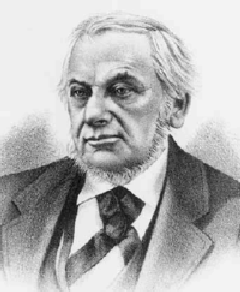
| Thomas C. Sharp Publisher of the Warsaw Signal, a leading anti-Mormon newspaper Age at indictment: 31 "Old Tom Sharp," as he
was called by
Mormons, was the most prominent of the five
defendants. Sharp's
anti-Mormon views, published in his Warsaw
Signal newspaper, helped turn much of
Hancock County's
non-Mormon population against the Smiths.
After graduating from
Dickinson College in Pennsylvania and studying law,
Sharp moved to
Warsaw in 1840. After a year or so of largely
unsuccessful law
practice, Sharp turned to editorializing against
Mormon power in
Hancock County. After the destruction of the
Nauvoo Expositor,
Sharp called for revenge: "War and extermination is
inevitable!...We
have no time for comment, every man will make his
own. Let it be
made with powder and ball!!!" Evidence at the
trial showed Sharp
spoke at the railroad shanty in favor of an attack
on the jail and made
no effort "to inform the Carthage Greys that a mob
was coming."
Witness William Daniels testified that Sharp's
speech "pointed to the
necessity of killing the Smiths to get rid of the
Mormons." After the murders, Sharp defended them in
the Warsaw Signal
calling
them an "execution" supported by "some of our most
respectable
citizens."Sharp
fled to
Missouri after a reward was posted for his arrest,
but surrendered to
Illinois authorities on October 1, 1844.
Following his acquittal
at the Carthage trial, Sharp served as mayor of
Warsaw, Hancock County
judge, and as a school principal.
|
| William N. Grover Captain of the Warsaw Rifle Company Age at indictment: 26 William
Grover, married but childless, practiced law in
Warsaw. He was
elected justice of the peace in 1843. In his
summation for the
prosecution, Josiah Lamborn conceded that the state
had failed to
produce sufficient evidence to convict Grover.
Lamborn told the
jury: "Nor is there evidence to convict Captain
Grover, although I
verily believe he was at the jail with a gun."
Lamborn's concession was
surprising in view of the fact that testimony
indicated Grover was
among the mob that marched to the Carthage jail and
that Grover had
later bragged that he had killed Joseph Smith.
After his
acquittal, Grover moved to Missouri and, in 1863,
was appointed U. S.
Attorney for the Eastern District of Missouri.
|