|
Contempt
of
Court Opinion
UNITED
STATES )
)
vs.
)
Before
Wilkerson, J.
)
C
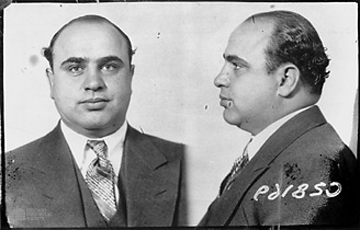
A P O N E
)
Friday,
February 27th, 1931
10
o’clock A. M.
OPINION
THE COURT:
This
respondent was served on the 27th of February, 1929, with a
subpoena
from this Court requiring him to appear before the grand jury on the 12th
day of March, 1929, at 10 o’clock A. M.
On the 11th of March he
entered his appearance in this court, submitted himself to the
jurisdiction of
the court, and made an application to the court to postpone his
appearance in
response to the subpoena until the April term of the court, or until
such other
time as his appearance might be directed by the order of the court.
In connection with the petition and
made a part of the petition by express reference there was submitted to
the
court an affidavit executed in Florida and sent by the respondent to
Chicago. The affidavit was that of a
doctor named Phillips.
The affidavit stated that he was
acquainted with the respondent, that he had been attending him ever
since the
13th of January; that the respondent was then under his
professional
treatment. That since January 13, 1929,
the respondent had been suffering from bronchopneumonia pleurisy with
effusions
of fluid into the chest cavity, and for six weeks was confined to his
bed at
his home on said Palm Island, and had been out of his bed only for ten
days
last past, that he had not fully recovered from the disease and that in
the
professional opinion of the affiant his physical condition was such
that it
would be dangerous for him to leave the mild climate of Southern
Florida and go
to Chicago, and that to do so would imperil the safety of the
respondent; that
there would be very grave risk of relapse which might result in his
death from
the recurrence of pneumonia; that the doctor advised against requiring
the
respondent to go from Florida to Chicago, and that it would be
inconsistent
with the personal safety of the respondent to go to Chicago; that the
opinion
expressed by his was concurred in by three professional consultants of
the City
of Miami, Dr. Goudy, Dr. Maxwell, and Dr. Pierson, all of whom may be
reached
by addressing them at 120 Shoreland Arcade in the City of Miami.
Now as to this affidavit the fact is
that it was executed in the office of a lawyer; that it was taken from
the
lawyer’s office and sworn to before the United States Commissioner and
turned
over to the respondent. It appeared
first in the court accompanied by a letter which concededly was written
by the
respondent and in which there was a reference to his desire to obtain a
stay of
time for his appearance before the Grand Jury. The
doctor said he did not pay very close attention
to the affidavit
when it was dictated by the lawyer. There
is no contention, however, by the respondent
here that he did not
understand the allegations of the affidavit. He
was not undertaken to assert any lack of
familiarity with the
statements in the affidavit. On the
contrary, he adopted it and sent it to Chicago to the attorneys to be
used for
the purpose indicated.
Aside from the opinion of the doctor
as to what was the matter with the respondent, there were certain
averments of
facts in the affidavit which could not have escaped the attention of
any one
who had given even a slight consideration to the language of the
affidavit.
There is a positive statement of
fact that the respondent had been confined to his bed at his home for a
period
of six weeks after the 13th of January, and there is the
positive
and direct statement that he had been out of bed only for ten days last
past.
Now the testimony offered by the
respondent consisted of the evidence of Drs. Phillips and Owens and of
the two
nurses.
Dr. Phillips’ testimony, of course,
must be considered in the light of the telegram which he sent to Dr.
Owens in
which he characterized the sickness of the respondent as not serious in
its
character. He has given an explanation
for that, but without saying anything further concerning the testimony
of Dr.
Phillips, I think clearly that we must decide the question of fact as
to the
respondent’s illness in January upon the testimony of Dr. Owens and the
two
nurses.
Dr. Owens reached Miami sometime
between the 15th and 20th of January and found
him, he says,
seriously ill from the disease mentioned. He
remained there a few days, and when he left,
shortly after the 20th
of January, so far as temperature and pulse were concerned, the
condition of
the patient was about normal.
One of the nurses when to the home
on the 5th of January and remained a little less than three
weeks. The night nurse who was called in
by Dr. Phillips went there on the 13th or about the 13th
and remained seven or eight days. I
think she said seven to ten days. At any
rate, the nurses had gone by the last week of January, and the evidence
establishes beyond all reasonability of doubt in this case that during
the
month of February the respondent was not confined to his bed.
The evidence shows during that
period frequent attendance at the race track; it shows a trip in an
airplane;
it shows a boat trip, and taking all of the evidence, it is perfectly
clear
that at least after the 2nd of February it could not be
truthfully
stated that the respondent was confined to his bed, and that the
statement on
the date when the affidavit was made, namely the 5th of
March, 1929,
the respondent had been out of bed of only ten days last past was
glaringly
false.
Now the result of the whole thing
was that there was a short extension of the time within which this
respondent
was to appear before the Grand Jury.
But I think that we miss the point
in this case when we lay stress upon what happened when counsel for the
defendant and Dr. Anderson appeared before this branch of the Court, or
when we
lay stress upon the inconvenience, if any, to which the United States
was
subjected by the failure of the respondent to come here on the 12th,
or if we lay stress upon the statement of the respondent in his
application for
a continuance that he was willing to come here whenever the Court
directed him
to come, or the statement which it is said was in the letter that he
did not
wish to be in contempt of court, -I say we miss the point in this case
when we
lay stress upon that.
The point in this case as I see it,
is this: There has been a system established for the administration of
justice. The Court is a part of that
machinery which is erected for the administration of justice.
Now the Court deals with litigants,
with witnesses, with jurors in only one way, and that is through the
process of
Court, and when the process of Court issues it is to be respected, it
is to be
obeyed, it is not to be trifled with, it is not to be flaunted; and
with
respect to the process of the court the duty rests upon litigants and
upon
witnesses and upon jurors to deal honestly and fairly and frankly with
the
court; and when an attempt is made to interfere with the function of
the
process of the Court, when an appeal is made to the Court to relieve a
party
from obedience to the process of the Court, the Court is entitled to
the
fullest, fairest and most complete disclosure of all the facts. In no other way may the Courts operate.
Now here we have an application
addressed to this Court with respect to the execution of the process of
the
Court in which it is represented to the Court that the respondent had
just been
out of bed for ten days, when it must have been a matter of general
knowledge
in the community in which he was staying that he was not sick in bed at
all.
Now the point in this case is the
effect of conduct of that kind upon the administration of justice, and
the
situation is not changed by the [unreadable] which the Court took with
reference
to this document. The situation would be
the same if the Court had acted in granting the continuance for some
reason
entirely different from the one stated in the affidavit.
The point to the case is that
instead of obeying the process of the Court, the respondent, to be
relieved
from obedience to the process of the Court, sent this affidavit which
contained
these false statements.
Upon the record as it stands there
is nothing for the Court to do except to adjudge the respondent guilty
of
contempt of Court as charged in the information, and as punishment for
the
contempt the respondent will be committed to the County Jail of Cook
County
for the period of six months.
The United States may prepare the order.
MR. EPSTEIN: If you Honor please, I
wish to enter a motion in arrest of judgment.
THE COURT: Yes.
MR.
EPSTEIN: And in support of my
motion for arrest of judgment I wish to assign the argument that there
is no
proof that the defendant had any knowledge of the false representations
that
were made, as I made before in my argument, and I wish to urge in
support of
the motion in arrest of judgment that there has never been any service
personally of the rule to show cause in this case; and I might say all
the
other point that were heretofore argued and presented and contained in
the
motions heretofore made.
THE COURT: The motion will be
overruled.
MR. EPSTEIN: May I have an exception
to the overruling of the motion in arrest?
THE COURT: Yes.
MR. EPSTEIN: Now if your Honor please, will your
Honor
make any findings of
fact in connection with the –
THE COURT: Well I have
directed the United States
Attorney to prepare an order.
MR. EPSTEIN: Your
Honor, the verdict was that –
THE
COURT: He will put in this order
the facts found. I have found no that the
charge of the information –
MR. EPSTEIN: That he was guilty of
the charges contained in the information.
THE
COURT: Oh, that may be embodied in the
formal offer
which the United States submits.
MR.
EPSTEIN: Will your Honor – until
the presentation of that order I suppose there is no real final order
in the
case.
THE COURT: What is the
bond of the respondent?
MR. EPSTEIN: $5,000 and he has
voluntarily appeared, as your Honor knows.
THE COURT: I think that is a
sufficient bond.
MR. EPSTEIN: As the
matter stands on the –
THE
COURT: You may present the formal order
for entry
next morning at 10:00 o’clock.
MR. EPSTEIN: At that time will your
Honor allow us an order –
THE
COURT: There will be no order this morning. I have announced my decision in the case and
formal order will be presented here Monday morning at 10:00 o’clock by
the
United States Attorney for entry. In the
meantime the respondent may be at liberty on the bond which he has
already
given in this case, if that is satisfactory to the respondent.
MR.
EPSTEIN: And at that time, if
you Honor please, or shall we make a motion now, praying an appeal?
Will your
Honor allow an appeal?
THE
COURT: I will allow an appeal. You can present your petition when you have
it ready, petition and assignment of errors and bond on the appeal will
be the
same as the bond here, $5,000.
MR. EPSTEIN: And supersedeas?
THE
COURT: I think that bond is sufficient
on appeal.
MR.
GROSSMAN: Yes.
THE
COURT: Yes, supersedeas, bond $5,000.
MR.
EPSTEIN: Will your Honor allow
supersedeas?
THE
COURT:
On $5,000 bond.
MR.
EPSTEIN: On $5,000 bail.
THE
COURT: I may, however, limit the operation
of the
supersedeas. I think that you should
prepare on this hearing a bill of exceptions within twenty days. I think that would be ample time for you to
do that, so that you can get the record up and get it docketed before
the Court
of Appeals. I should like to limit the
time
of operation of the supersedeas so that the case may be considered
before the
Court adjourns in July. I do not think
that is any hardship upon counsel.
MR.
EPSTEIN: Well, it will be a hardship –
THE
COURT: Sometimes in matter of this kind a
great deal
of force of the Court’s acts, if they are correct, is lost in delay,
and I
think it is important that the questions which are involved should be
finally
disposed of at as early a date as possible. I
am disposed to do everything to facilitate your
getting your appeal
and your bill of exceptions.
MR.
EPSTEIN: Well, as to that I don’t know. For twenty days right now to me happens to be
–
THE
COURT: Thirty days.
MR.
EPSTEIN: -- a time when I am
going to be very busily engaged, but I have able assistants and counsel
and
colleagues and cogitators with me.
THE
COURT: Did you both have reporters in
this case?
MR.
WAUGH:
Yes, your Honor.
THE
COURT: The record in this case is short
and somebody
can take it and abstract it and make a statement of the evidence in a
day, I
should think.
MR.
WAUGH: Of course it has to be written up
first. We have not had it written up
yet.
MR.
EPSTEIN: We have not had it written up
as we went along.
THE
COURT: Those questions may be disposed
of on Monday.
MR.
WAUGH: All right.
(Thereupon
an adjournment was taken
to Monday, March 2, 1931, at 10:00 o’clock A. M.)
|