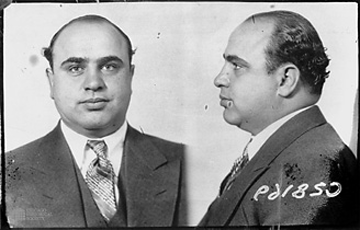
|
Appellate
Decision Reviewing Verdict
Circuit
Court of Appeals, Seventh
Circuit.
CAPONE
v.
UNITED STATES.
No.
4672.
Feb.
27,
1932.
Rehearing Denied March 23, 1932.
56
F.2d 927
Appeal
from
the District Court of the United States for the
Eastern Division of the
Northern District of Illinois; James H. Wilkerson, Judge.
Alphonse
Capone was convicted of willfully attempting to evade and
defeat income tax for 1925, 1926, and 1927, and of failing to file
returns for
1928 and 1929, and he appeals.
Affirmed.
Allegation in indictment concerning attempt to evade
and defeat
income tax held sufficient as against demurrer. Revenue Act 1926,
§
1114(b), 26
U.S.C.A. § 145; U.S.C.A.Const. Amends. 5, 6.
This
appeal is from a conviction on three counts which charge
felonies of willfully attempting to evade and defeat income tax for the
respective years 1925, 1926 and 1927, in violation of section 1114(b)FN1of the Revenue Act of 1926, 44 Stat. 116
(26 USCA §
1266); and on two counts which charge misdemeanors of failing to file
returns
for the respective years 1928 and 1929, in violation of section 146(a)FN2 of the Revenue Act of 1928, 45 Stat.
835 (26 USCA
§ 2146(a).
FN1. ‘*
* * any person who willfully attempts in any manner to evade or defeat
any tax
imposed by this title or the payment thereof, shall * * * be guilty of
a
felony. * * *’
FN2. ‘Any
person required under this title to pay any tax, or required by law or
regulations made under authority thereof to make a return * * * for the
purposes of the computation, assessment, or collection of any tax
imposed by
this title, who willfully fails to pay such tax, make such return * * *
at the
time or times required by law or regulations, shall, in addition to
other
penalties provided by law, be guilty of a misdemeanor. * * *’
There
were two indictments, and they were consolidated and tried
at the same time. The first contained but one count and charged a
felony under
section 1114(b), supra; the second indictment contained twenty-two
counts, of
which counts 13 and 18 charged misdemeanors under section
146(a),
supra, and the other counts charged felonies under section
1114(b), supra. Appellant was found guilty of the felonies charged in
counts 1,
5, and 9, and of misdemeanors charged in counts 13 and 18 of the second
indictment. As to all other counts of that indictment, and also as to
the
charge in the first indictment, appellant was found not guilty.
Appellant's
demurrer to each count of each indictment was
overruled; and, after verdict, he filed a motion in arrest of judgment,
which
was also overruled. With the exception of the year involved and the
amounts of
income and tax referred to, the felony counts are identical. This is
also true
as to the counts charging misdemeanors, and, with the exception of
jurisdictional facts, the substance of one count of each class is set
forth in
the margin. FN3
FN3. ‘Count
1. * * * Alphonse Capone * * * hereinafter in this indictment sometimes
called
the defendant, on, to wit, the 15th day of March, 1926, * * *
unlawfully and
fraudulently did then and there willfully attempt to evade and defeat
an income
tax in the sum of, to wit, $55,365.25, imposed by an Act of Congress
approved
February 26, 1926, * * * known as the Revenue Act of 1926, upon his net
income
had and derived during the calendar year ended December 31, 1925, that
is to
say, his gross income had and derived during said calendar year less
the
deductions allowed under Title II (Income Tax) of said Act of Congress;
that
said willful and fraudulent attempt to evade and defeat said income tax
was by
the means and in the manner following, that is to say:‘That the said
Alphonse
Capone, * * * during the calendar year 1925 was an individual who was
married
and living with his wife and who on December 31, 1925, had one
dependent, and
whose annual accounting period was on the basis of the calendar year
and not on
the basis of a fiscal year, and whose legal residence and principal
place of
business during said calendar year and until and including March 15,
1926, were
within the Eastern Division of the Northern District of Illinois and
within the
said First Internal Revenue Collection District of Illinois, and who
had and
derived during the calendar year ended December 31, 1925, a gross
income for
said calendar year of over $5,000.00, to wit, $257,286.98, and who was
after
the 31st day of December, 1925, and on or before the 15th day of March,
1926,
required by the Act of Congress aforesaid to make to the Collector of
Internal
Revenue for the Internal Revenue Collection District aforesaid, under
oath, a
return stating specifically the items of his gross income and the
deductions
and credits allowed under Title II of the Act of Congress aforesaid for
the
purposes of computation, assessment and collection of any tax imposed
by Title
II of said Act of Congress.‘That the said defendant was further
required by the
Act of Congress aforesaid to pay to the Collector of Internal Revenue
for the
Internal Revenue Collection District aforesaid for the calendar year
ended
December 31, 1925, an income tax upon his net income * * * by reason of
the
fact, which the said grand jurors charge on their oath to be a fact,
that said
defendant had and derived and received during said calendar year a
gross income
of to wit, $257,286.98, from which said gross income he, the said
defendant,
was entitled to deductions for said calendar year 1925 in the sum of,
to wit,
$1.00, and no more, and had and derived and received a net income
during said
calendar year 1925 of, to wit, $257,286.98, upon which said net income
for the
calendar year last aforesaid there became due on March 15, 1926, to the
United
States of America, after the allowance of all credits, a tax of, to
wit,
$55,365.25, of which said tax at least one-fourth should have been paid
then
and there by the said defendant to the Collector of Internal Revenue
aforesaid.‘That the said defendant, * * * on, to wit, March 15, 1926,
well
knowing all the premises, unlawfully and fraudulently did then and
there
willfully attempt to evade and defeat the income tax aforesaid upon his
said
net income for the calendar year 1925; * * *’‘Count 13. * * * That on,
to wit,
the 15th day of March, 1929, * * * the said Alphonse Capone * * *
unlawfully
did willfully and knowingly fail to make a return of income required by
an Act
of Congress approved May 29, 1928, * * * which said Act of Congress is
known as
the Revenue Act of 1928, that is to say, a return stating specifically
the
items of his gross income had and derived during the calendar year 1928
and the
deductions and credits allowed under Title I (Income Tax) of said Act
of
Congress: that said willful failure to make the return aforesaid was
under the
circumstances following, that is to say:‘That said defendant during the
calendar year 1928 was an individual who was married and living with
his wife
and who on December 31, 1928, had one dependent, and whose annual
accounting
period was on the basis of the calendar year and not on the basis of a
fiscal
year, and whose legal residence and principal place of business during
said
calendar year and until and including March 15, 1929, were within the
Eastern
Division of the Northern District of Illinois and within said First
Internal
Revenue Collection District of Illinois, and who had and derived during
the
calendar year ended December 31, 1928, a gross income for said calendar
year of
over $5,000.00, to wit, $140,536.93, and who was after the close of the
calendar year 1928 and on or before the 15th day of March, 1929,
required by
the Act of Congress aforesaid to make to the Collector of Internal
Revenue for
the Internal Revenue Collection District aforesaid, under oath, a
return
stating specifically the items of his gross income and the deductions
and
credits allowed under Title I of the Act of Congress aforesaid for the
purposes
of computation, assessment and collection of any tax imposed by said
Title I of
said Act of Congress; that the said defendant, having between the close
of the
calendar year 1928 and the 15th day of March, 1929, failed to make the
return
aforesaid, unlawfully did, on said 15th day of March, 1929, within the
judicial
division and district aforesaid, and within the collection district
aforesaid,
and within the jurisdiction of this court, then and there willfully
fail to
make the return aforesaid stating specifically the items of his gross
income
and the deductions and credits allowed under Title I of the said Act of
Congress, or any return whatsoever, to the Collector of Internal
Revenue for
the Internal Revenue Collection District aforesaid as required by the
Act of
Congress aforesaid or to any other proper officer of the United States.
* * *’
Michael
J. Ahern and Albert
Fink, both of Chicago,
Ill., for
appellant.
George E. Q. Johnson, U. S. Atty., Jacob I. Grossman, Samuel G.
Clawson, and
Dwight H. Green, Asst. U. S. Attys., all of Chicago, Ill., and William
J.
Froelich, Sp. Asst. to Atty. Gen.
Before
ALSCHULER, EVANS, and SPARKS,
Circuit Judges.
SPARKS,
Circuit Judge (after stating the facts as above).
The
errors relied upon in this appeal are that the court erred in
overruling the demurrer to each count of the indictment upon which
appellant
was found guilty, and in overruling his motion in arrest of judgment as
to each
of said counts.
It
is first contended by appellant that the demurrer and motion in
arrest should each have been sustained as to the felony counts,
because, as he
insists, those counts charge the alleged offense in the generic terms
of the
statute, without specification of particulars; that is to say, he
contends
that, in order to render the felony counts impervious to either the
demurrer or
the motion in arrest, the particular attempts to evade and defeat the
tax upon
which the government relied for a conviction should have been pleaded
with
particularity.
The
rights of appellant which give rise to the questions herein
raised are derived from Articles
V and
VI of the Amendments to the Constitution of the United States,
and in so far as they are applicable read as follows:
‘Article
V.
* * * nor shall any person be subject for the same offence to be
twice put in jeopardy of life or limb. * * *’
‘Article
VI. In all criminal prosecutions, the accused shall enjoy
the right * * * to be informed of the nature and cause of the
accusation. * *
*’
One
of the reasons for the adoption of the clause referred to in
Article VI was to furnish a means of preventing a violation of the
right
guaranteed by the clause
referred to in Article
V.
In
interpreting these constitutional provisions, courts have quite
generally held
that where the offense is purely statutory, having no relation to the
common
law, it is, as a general rule, sufficient in the indictment to charge
the
defendant with acts coming fully within the statutory description in
the
substantial words of the statute, without any further expansion of the
matter;
but it is also true that the accused must be apprised by the
indictment, with
reasonable certainty, of the nature of the accusation against him, to
the end
that he may prepare his defense and plead the judgment as a bar to any
subsequent prosecution for the same offense. United
States v. Simmons, 96 U. S. 360, 24 L. Ed. 819.
The
cases are legion in which indictments have been attacked by
the same methods and for the same reason as are now under discussion.
In many
such cases the indictments have been held bad and in many they have
been held
good as tested by the constitutional provisions above referred to,
depending in
each case upon the particular facts then before the court. The facts in
each
case, of course, were different, but in each case the question
presented was
the same: Were the facts pleaded with such particularity as to apprise
the
accused of the nature of the crime with such certainty as to enable him
to
prepare his defense and to plead the judgment as a bar to any
subsequent
prosecution for the same offense? In some instances it was held that
the
indictments were sufficient which merely described the crime in the
language of
the statute, because the language of the statute described the crime
with such
particularity as to guarantee the constitutional rights above referred
to. In
other cases it was held that the indictments were bad which merely
followed the
language of the statute, not because of any hard and fast rule to that
effect,
but because the language of the particular statute then before the
court did
not describe the crime with sufficient particularity as to accord the
defendant
his constitutional rights above referred to.
Appellant
relies largely upon the principles laid down in United
States v. Cruikshank, 92 U. S. 542, 557, 23 L. Ed. 588. The
indictment in that case contained sixteen counts, the first eight of
which
charged defendants with having banded together with the unlawful and
felonious
intent to injure, oppress, threaten, and intimidate two colored
citizens of the
United States, and with the further intent of thus hindering and
preventing
said colored citizens in their respective free exercise and enjoyment
of their
rights and privileges accorded them under the Federal Constitution. The
next
eight counts are a repetition of the first eight, except that, instead
of the
words ‘banded together,’ the words ‘combined, conspired, and
confederated together’
are used. The court held that all counts except 5, 8, 13, and 18
referred to
rights which were guaranteed, not by the Federal Constitution, but by
the
Constitution of Louisiana, and for that reason no federal crime was
charged in
any of said counts. Counts 5, 8, 13, and 18 charged, in substance, that
the
intent was to hinder and prevent the two colored citizens in the free
exercise
and enjoyment of ‘every, each, all and singular’ of the rights granted
them by
the Federal Constitution. There was no specification of any particular
right,
but the language was broad enough to cover all. The court said:
‘According to
the view we take of these counts, the question is not whether it is
enough, in
general, to describe a statutory offence in the language of the
statute, but
whether the offence has here been described at all. * * * It is an
elementary
principle of criminal pleading, that where the definition of an
offence, * * *
includes generic terms, it is not sufficient that the indictment shall
charge
the offence in the same generic terms as in the definition; but it must
state
the species,-it must descend to particulars.’
As
illustrative of this statement, the court further said: ‘It is
a crime to steal goods and chattels; but an indictment would be bad
that did
not specify with some degree of certainty the articles stolen. This,
because
the accused must be advised of the essential particulars of the charge
against
him, and the court must be able to decide whether the property taken
was such
as was the subject of larceny. So, too, it is in some States a crime
for two or
more persons to conspire to cheat and defraud another out of his
property; but
* * * an indictment for such an offence must contain allegations
setting forth
the means proposed to be used to accomplish the purpose. This, because,
to make
such a purpose criminal, the conspiracy must be to cheat and defraud in
a mode
made criminal by statute; and as all cheating and defrauding has not
been made
criminal, it is necessary for the indictment to state the means
proposed, in
order that the court may see that they are in fact illegal. * * * So
here, the
crime is made to consist in the unlawful combination with an intentto prevent the
enjoyment of any
right granted or secured by the Constitution, etc. All rights are not
so
granted or secured. Whether one is so or not is a question of law, to
be
decided by the court, not the prosecutor.’
In
other words, the court held that the right about to be violated
should be particularized in order that the court might say, as a matter
of law,
whether such right was guaranteed by the Constitution.
It
will be observed in that case that the court was dealing with a
certain right which was threatened with violation, which right,
although not
specifically designated, was alleged to be guaranteed by the Federal
Constitution to certain citizens named. The controversy in that case
related
only to the particularization of that right and not to the specific
acts of
defendants by which it was alleged that defendants had attempted to
interfere
with that right. Indeed, no complaint was made as to those allegations,
although they were made in the most general terms.
In
the instant case the right
alleged to be violated is that of the government to collect an income
tax from
appellant. Under the ruling of the Cruikshank Case, it was therefore
necessary
that the indictment should state facts from which the court, as a
matter of
law, could say that there was an income tax due from appellant to the
government, for all income is not taxable. The indictment is not
deficient in
this respect, for it states the total amount of appellant's income for
the year
in controversy; it sets forth the credit to which appellant is
entitled; it
describes his civil condition as that of a married man with one
dependent; and
informs him as to the exact amount of the tax due. From these
allegations,
therefore, the court could say that the tax was due and owing, and the
error
which rendered the Cruikshank indictment invalid was thus eliminated in
the
instant indictment.
But
it is contended by appellant
that the indictment should have specified the means by which he
attempted to
evade or defeat the payment of the tax. Neither the Cruikshank Case nor
any
other case which we have been able to find supports this contention. In
the
Cruikshank Case it was stated that all rights are not guaranteed by the
Federal
Constitution, and that therefore, as a matter of law, a charge of
conspiracy to
defeat a citizen's constitutional right must show that the right
threatened is
one conferred by the Constitution. In other words, if a certain right
is
excepted in the definition of the crime, facts must be pleaded to avoid
the
exception.
But
in the instant case there
are no exceptions, for the statute says that every attempt to evade or
defeat
the payment of income tax is a violation of law. What was a question of
law in
the Cruikshank Case, by reason of existing exceptions, is in the
instant case a
question of fact for the jury because of the absence of exceptions.
We
are convinced that the
allegation in relation to appellant's attempt to evade and defeat the
payment
of the tax in the instant case is sufficient, and that the objection
thereto is
one of form rather than of substance. The form used is indeed quite
general,
and this fact would have abundantly justified appellant in asking the
court to
require the district attorney to furnish a bill of particulars as to
the
specific attempts to evade and defeat, and we cannot presume that the
request
would have been refused (Rosen
v. United States, 161 U. S. 29, 16 S. Ct. 434, 480, 40
L. Ed. 606); but
appellant made no such request, and he now has no reason
to complain. The validity of the counts charging felonies is abundantly
supported by the following cases: United
States v. Gooding, 12 Wheat. (25 U.
S.) 460, 6 L. Ed. 693; United
States v. Simmons, 96 U. S. 364, 24 L. Ed. 819; Dunbar
v. United States, 156 U. S. 185, 15 S. Ct. 325, 39 L. Ed. 390; Connors
v. United States, 158 U. S. 408, 15 S. Ct. 951, 39 L. Ed. 1033; Durland v. United States, 161 U. S. 306, 16 S. Ct. 508,
40 L. Ed.
709; Ledbetter
v. United States, 170 U. S. 606, 18 S. Ct. 774, 42 L. Ed. 1162; Pounds
v. United States, 171 U. S. 35, 18 S. Ct. 729, 43 L. Ed. 62; Armour Packing Co. v. United States, 209 U. S. 56, 28
L. Ed. 428, 52
L. Ed. 681;Bartell
v. United States, 227 U. S. 427, 33 S. Ct. 383, 57 L. Ed. 583; Lamar
v. United States, 241 U. S. 103, 36 S. Ct. 535, 60 L. Ed. 912; Konda v. United States (C. C. A.) 166 F. 91, 22
L. R. A. (N. S.) 304;Hardesty
v. United States (C. C. A.) 168 F. 25; Enders
v. United States (C. C. A.) 187 F. 754; May
v. United States (C. C. A.) 199 F. 42; Marhoefer v. United States (C. C. A.) 241 F. 48; Case
v. United States (C. C. A.) 6 F.(2d) 530; Graffi v. United States (C. C. A.) 22 F.(2d) 593.
In
a certain class of cases cited by appellant, where the act
charged is a crime only under certain conditions, it was held that
those
conditions must be alleged to exist in order to render the indictment
valid.
Thus in Batchelor v. United States, 156 U. S. 426, 15 S. Ct.
446, 39 L.
Ed. 478, an indictment was held bad which charged
misapplication of
bank funds, but did not charge that the misapplication was unlawful;
in United
States v. Kelsey (D. C.) 42 F. 882, defendant
was charged with
suppressing election ballots, but it was not alleged that he knowingly
did so;
in Kellerman v. United States (C. C. A.) 295 F. 796, defendant
was charged with bribery of a United States officer, but the indictment
did not
allege that the person bribed was a United States officer; in Boykin
v. United States (C. C. A.) 11 F.(2d) 484, defendant
was charged
with attempting to bribe a prohibition agent with intent to influence
him as to
matters and proceedings then pending, but it was not alleged that such
matters
related to the agent's duties as prohibition officer; in Aroniss v. United States (C. C. A.) 13 F.(2d) 620,defendant
was charged with maintaining a common nuisance at a certain place where
intoxicating liquors were kept, and the court held that the facts
constituting
the nuisance must be alleged, because is some instances intoxicating
liquor may
be lawfully kept. Like rulings were made in United
States v. Carol, 105 U. S. 611, 26 L. Ed. 1135; Grimsley v. United States (C. C. A.) 50 F.(2d) 509; United
States v. Berger (D. C.) 9 F.(2d) 167; Fontana
v. United States (C. C. A.) 262 F. 283; Pettibone v. United States, 148 U. S. 197, 13 S. Ct.
542, 37 L.
Ed. 419. In the case last referred to it is said that, when
the
criminality of a conspiracy consists in an unlawful agreement to
compass or
promote some criminal or illegal purpose, that purpose must be fully
and
clearly stated; while, if the criminality of the offense consists in
the
agreement to accomplish by criminal or unlawful means a purpose not in
itself
criminal or unlawful, the means must be set out.
In
other cases cited by appellant the indictments were held bad on
account of indefiniteness as to allegations of material facts under
circumstances which would have rendered it very difficult indeed for
the
defendant to have prepared his defense, or to have been protected
against a
second jeopardy for the same offense. In United States v. Simmons,
supra,
defendant was charged with having caused and procured a still to be
used at a
certain place for distilling. The court held that it was necessary to
name the
person or persons who were so procured by the defendant or to allege
that the
name or names were unknown, but that it was not necessary to set forth
the
special means employed. In United
States v. Hess, 124 U. S. 483, 8 S. Ct. 571, 31 L. Ed. 516, defendant
was charged with devising a scheme to defraud divers unknown persons
(which
scheme was not described) with intention to effect such schemes by
inciting
such unknown persons to communicate with him by and through the United
States
post office. In Batchelor v. United States, supra,
defendant was charged with
misapplying certain sums, each misapplication constituting a separate
crime.
There were many misapplications referred to generally, but neither the
amounts
nor the means employed were specified, and it was quite apparent that
neither
constitutional right was protected. In McKenna
v. United States (C. C. A.) 127 F. 88,defendant
was charged with
conspiracy to injure certain named persons in the free exercise and
enjoyment
of a right, not naming the right. In Larkin
v. United States (C. C. A.) 107 F. 697, a
charge was made of
fraudulently using the United States mails to defraud definite
individuals-not
the public nor a class-and their names were not given, and the
indictment was
held bad for that reason. In Jarl
v. United States (C. C. A.) 19 F.(2d) 891, the
charge was for
transportation and sale of intoxicating liquor, and the allegations
were so
indefinite as to place, means of transportation, the person to whom the
sale
was made, and the kind of liquor in controversy, as to furnish no
protection to
defendant's constitutional rights. In United States v. Kelsey,
supra, the
indictment was held bad because of the absence of allegations which the
statute
required. In Ledbetter
v. United States, supra, Armour Packing Co. v. United States, supra,
and United
States v. Gooding, 12 Wheat. (25 U.
S.) 460, 6 L. Ed. 693, the
crimes were charged in the language of
the statute, and the indictments were held sufficient. The Armour Case
charged
the accepting of rebates prohibited by the Elkins Act (49 USCA
§§ 41-43),
although the details of the device by which the rebates were received
were not
set out. In Anderson
v. United States (C. C. A.) 260 F. 557, the
indictment charged a
conspiracy to steal goods, not describing them, which were moving in
interstate
commerce; and in Collins
v. United States (C. C. A.) 253 F. 609, the
charge was for making and
conveying false reports with intent to interfere with military and
naval
operations, and the reports were not described or set forth. In Miller
v. United States (C. C. A.) 136 F. 581, defendant
was charged with
knowingly and willfully procuring the presentation to the Commissioner
of
Pensions of a false and fraudulent writing, and it was not alleged whom
defendant had procured to present it, nor was it alleged that such
person's
name was unknown. In Pierre v. United States (C. C. A.) 275 F. 352, it
was
charged that defendant made threats to take the life of the President
of the
United States, but did not allege that they were made in the presence
of any
person. In Boykin v. United States, supra, defendant was charged with
bribery
of a prohibition officer; and, besides other defects above referred to,
the
court said that the crime charged involved both an act and intent, and
that the
indictment was not sufficiently specific, although the government knew
which
act it would rely upon, but defendant did not know, and was not
sufficiently
apprised with relation thereto.
In
all the cases relied upon
by appellant which we have specifically referred to, as well as other
cases
which he has cited, it is quite apparent that the defendant's
constitutional
rights were not sufficiently protected by the allegations of the
indictment;
but we find no such conditions existing with relation to the indictment
now
before us. It is not to be denied that appellant should be fully
protected
against a second or subsequent jeopardy for any offense involved in the
instant
indictment, and we think he is so protected. When the government,
without
particularization, chooses to make a general charge of means employed
to effect
a certain criminal purpose at a given time, whether under such
conditions a
defendant may successfully claim protection against a subsequent
jeopardy for
such offense effected at such time by any means which might have been
given in
evidence at the former trial, we are not called upon to decide. It is
quite
obvious, however, that he cannot be placed in jeopardy a second time
for such
offense which was effectuated by any means relied upon at the first
trial and
which were given in evidence. To accomplish such protection, the entire
record
of the former trial, as well as parol evidence, if necessary for that
purpose,
is admissible in the second trial. Dunbar v. United States,
supra.
While
it is true that
appellant tested the sufficiency of each count of the indictment by
demurrer,
yet, if his criticism with relation to the sufficiency of the
allegations be
correct, we think that he was neither surprised nor harmed by the
court's
ruling in respect thereto. We base this conclusion upon the following
facts
which appear of record:
The
indictment was returned June 5, 1931, and after counsel
appeared for appellant he pleaded guilty on June 16. The cause was
first
continued until June 30, and again to July 30, on which last date the
court
informed appellant that he would be subjected to all proper questions,
whereupon, on motion of his counsel and by consent of the court,
appellant
withdrew his plea of guilty and entered a plea of not guilty, and the
cause was
continued to September 8, and on September 10 it was set for trial on
October
6.
On
September 25 appellant's counsel asked leave to amend the
record in order that appellant might file a plea in abatement and
demurrer.
After some discussion relative to the nearness of the trial date, the
court
said it would give appellant an opportunity on September 29 to argue
before
trial any point contended by appellant to be fatal to the case. Upon
inquiry as
to the points to be raised, counsel replied that he had some points
that had
not been presented in the O'Brien Case (which had previously been tried
by that
court and was then pending on appeal in this court, and has since been
affirmed, 51
F.(2d) 193, and
certiorari denied November 30, 1931, 52
S. Ct. 129, 76 L. Ed. 569), and
some that had been presented, but
which, in his opinion, had not been properly argued in that case; and
that if a
certain count was upheld in the O'Brien Case that decision would
control only
as to the particular attack made on the count in that case. The trial
court
said that if counsel had anything new it would hear him. At that time
counsel
for appellant sought an order stopping any further examination of
witnesses
before the grand jury then sitting. The court refused, stating that as
a result
of the argument on demurrer the court might find the indictment
invalid, and it
might be necessary for the district attorney to obtain another
indictment. The
court did not then permit amendment of the record or withdrawal of the
plea of
not guilty, but continued the motion to amend to September 29, so that
by that
time counsel would know whether he intended to file a plea in abatement.
On
September 29 counsel moved to withdraw the plea of not guilty
for the purpose of filing a demurrer. The court overruled the motion to
correct
the record, but granted motion to withdraw the plea of not guilty, and
permitted the quite lengthy demurrer to be filed. The court then
announced that
the demurrer would then be heard, but counsel for appellant stated he
did not
desire to make any argument on it-that he understood the court would
not care
to hear any point based on anything that had already been decided by
the
Circuit Court of Appeals; that some of the principal points of the
demurrer
challengedthe correctness of the
ruling of
the Circuit Court of Appeals; and that almost every other point the
occurred to
counsel seemed to be either directly or inferentially overruled by that
court;
and, as he did not think he had any point in the demurrer which would
appeal to
the court, argument would be a waste of time. The court then said that,
upon
counsel's statement that the points had been ruled upon by the Circuit
Court of
Appeals substantially in favor of the United States, the demurrer
would
be overruled. Counsel for appellant remarked that there were some new
points
that had not been ruled on, but he did not think they would appeal to
the
court, and did not care to argue them then. The court asked if they
were
kindred points to the ones already passed on, and counsel could not say
definitely, but stated there was another question which he might argue
later as
to the unconstitutionality of the statute, although he had not quite
satisfied
himself on that yet and was working on it and did not care to argue it
then.
The court said that question could be raised at any time, and counsel
said that
was all regarding the demurrer at that time. The court then overruled
the
demurrer and the plea of not guilty was re-entered.
It
does not appear that during the proceedings in the trial
appellant made any contention that he had been either surprised or
prejudiced
by the evidence introduced under the alleged too-general allegations of
the
indictment, or that his rights relating thereto were being injured in
any
manner.
Title
28, U. S. C. § 391, 28 USCA § 391 (Judicial Code, § 269,
as
amended), contains the following clause: ‘On the hearing of any appeal,
certiorari, writ of error, or motion for a new trial, in any case,
civil or
criminal, the court shall give judgment after an examination of the
entire
record before the court, without regard to technical errors, defects,
or
exceptions which do not affect the substantial rights of the parties.’
We
are convinced that the counts complained of are not defective
as contended by appellant; but, if it be conceded that appellant's
contentions
are correct, said alleged defects are to be considered as technical and
as not
affecting the substantial rights of appellant, and by reason of the
statute
last cited his contentions are without merit. Connors v. United States, supra; Lamar v. United States,
supra.
Appellant
contends that his demurrer to counts 13 and 18 and his
motion in arrest of judgment as to said counts should each have been
sustained
separately and severally, because, as he says, neither of said counts
alleges
that appellant did not make any return whatever, but each alleges that
he did
not make a return ‘stating specifically the items of his gross income
and the
deductions and credits allowed.’ The language quoted is contained in
each of
said counts, and follows explicitly the language of the statute. The
penal
clause of the statute provides that any person who is required to make
a
return, and who willfully fails to make just such a return as is
described in
the above quotation, is guilty of a misdemeanor. There is no merit in
this
contention, for, even if his theory were correct, he is in error in the
statement of the facts, for each of said counts alleges that he made no
return
whatever.
Appellant
further insists that counts 13 and 18 are each insufficient because it
is not
alleged directly and positively in either count that no return was
made, but
only that no return was made to a proper officer. On the contrary, each
of said
counts directly and positively avers that no return whatever was made
to the
proper collector of internal revenue, or any other proper officer of
the United States.
The fact that the collector of internal revenue is the only proper
officer
authorized by the statute to receive and file the return fully warrants
us in
considering as surplusage the words ‘or to any other proper officer of
the
United States.’ There was no error in overruling appellant's demurrer
and
motion in arrest of judgment as to counts 13 and 18. Rosen v. United
States,
supra; Dunbar v. United States, supra; Evans
v. United States, 153 U. S. 584, 14 S. Ct. 934, 38 L. Ed. 830; Collins
v. United States (C. C. A.) 20 F.(2d) 574.
Each
count of the indictment
upon which appellant was convicted being sufficient to repeal the
demurrer,
they are also sufficient to withstand the motion in arrest.
Judgment
affirmed.
|