×
Check-out the new Famous Trials website at www.famous-trials.com:
|
NOTES OF JUSTICES CONCERNING THEIR CONFERENCE DISCUSSIONS IN THE CASE OF BROWN et al. v BOARD OF EDUCATION OF TOPEKA 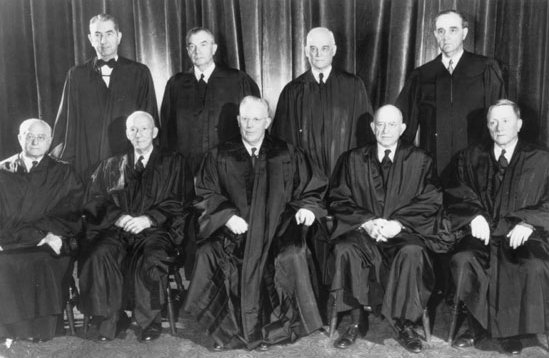 Supreme Court (12/14/1953 photo) (top row, L to R: Clark, Jackson, Burton, Minton; front row, L to R: Frankfurter, Black, Warren, Reed, Douglas)
Conference of
December 12,
1953 [From the notes of Burton and Douglas]
CHIEF
JUSTICE WARREN:
The previous plan was to discuss these cases informally in view of
their
importance, and that no vote be taken at this time. I favor that idea
of
delay-there is great value in unanimity and uniformity, even if we have
some
differences. We are now
down to the point of deciding the issues. Ben Franklin at the
constitutional convention.
I do not yet know what we should do. I am for pooling all of the humble
wisdom
of the Court and having, perhaps, many discussions. We should decide it
this
term. I have read as much as time allows, and I was much interested in
the oral
arguments. The case was well argued, and the federal government was
very frank
in its brief and orally, I can't escape the feeling that the Court has
finally
arrived at the place where we must determine whether
segregation is
allowable in public schools. The thing
that concerns me is whether we are called upon to overrule our older
cases and
lines of reasoning. The more I read and hear and think, the more I come
to
conclude that the basis of the principle of segregation and separate
but equal
rests upon the basic premise that the Negro race is inferior. That is
the only
way to sustain Plessy. I don't
see how it can he sustained on any other theory. If we are to sustain
segregation,
we must do it on that basis. If oral argument proved anything, the
arguments of
Negro counsel proved that they are not inferior. I don't see how we can
continue in this day and age to set one group apart from the rest and
say that
they are not entitled to exactly the same treatment as all
others. To do
so is contrary to Thirteenth, Fourteenth, and Fifteenth Amendments.
Those
amendments were intended to make those who were once slaves equal with
all
others. That view will perhaps cause trouble, but personally I can't
see how
today we can justify segregation based solely on race and so forth. I recognize
that the time element is important in the Deep South, We must act, but
we
should do it in a tolerant way. It would he unfortunate if we had to
take
precipitous action that could inflame the issue more than necessary.
The conditions
in the extreme South should be carefully considered by the Court.
Kansas and
Delaware are not much different from California---500,000 Negroes,
100,000 Japs,
100,000 Chinese. But not so in the Deep South. It will take all the
wisdom of
the Court to do this with a minimum of commotion and strife. How we do
it is
important. At present, my instincts and tentative feelings would lead
me to say
that in these cases we should abolish, in a tolerant way, the practice
of segregation
in public schools.
REED: I
can
understand Warren's attitudes. I am trying to approach this question
without
past prejudices. I want to work this out in the best way.
I am not sure whether I will sit in the South
Carolina or Virginia cases, but I may. If writing on clean slate, I
probably would
say that they should have segregation. It is an unfortunate thing. Each
of us can
accept it personally, but this is not the problem. I also recognize
that this
is a dynamic Constitution, and what was current in Plessy might
not be
current now. The power of the states is an issue. I would leave states
with
complete power in the Briggs case, etc. Some states have put
it into law
and some have abolished it in their own way. But here, it is
an issue
of the Fourteenth Amendment. Equal protection has not been
satisfactory. The
result has been less facilities, etc. for Negroes. Equal opportunity
has not
been enforced. I can't say that there has been a denial of equal
protection as
it looks, although in fact it has not been equal (District of
Columbia-not
under that.) Children may be forced to separate without a violation of
the
equal protection clause, It is not a denial of liberty to say that
people must
separate to go to school. Segregation
is not done on a theory of racial inferiority, but on racial
differences, It protects
people against the mixing of races, The argument was not made here that
the Negro
is an inferior race. Of course there is no “inferior race” although
they may be
handicapped by a lack of opportunity, but
on equal protection, they demonstrably have equal protection. It is a
police
power that has been exercised. Its purpose has been to maintain a
policy
status. Growth is toward the ending of segregation. BURTON:
Reed
refers to an editorial in the Atlanta Journal Constitution. If
segregation
is bad, it is because of a denial of due process. You have to go to due
process.
There is not much deference. It is a question of reasonable
classification.
That brings forth the historical question. There has been a
contemporary
interpretation of the problem since the Fourteenth Amendment. Look at
the
administrative construction at the time of the adoption of the
Fourteenth
Amendment, and at the contemporaneous approval of segregation. People
were
familiar with it at first hand. The practice has been constantly the
other way,
and has long sanctioned segregation. The existence of early school
segregation
statutes was contemporaneous with the Fourteenth Amendment. Congress
never could pass the integrated schools laws. Integration was never
written in,
and separated schools existed-and equal services. Long Gum [sic] said
that it was valid to have separate schooling. Congress has had the
power
to end segregation in the District of Columbia. The President has had
the power
to end segregation in the armed forces. Those
efforts failed, so they come to the courts and ask this Court to say it
was or
has become unconstitutional. They left aside the immediate aspects, and
so wait
to see what this Court does. This is not a political question, but we
should
not move to change the law. If there is to be a change, Congress should
do it.
FRANKFURTER:
One has to curb one's tongue when dealing with such problems. I would
put no
time limit on when the decision should come down. The awful thing about
the Insular
Cases was not too many opinions (two hundred pages), it is that
they looked
in too many directions. This is among my chief concerns. These cases
raise this
question because the "due process" clause puts on this Court a burden
that no court should have. Other nations
have not put a due process clause into their constitutions,
including
Austria, Ireland or India. We cannot escape the statesmanship issue,
but this
is not our job. We are kind of a trustee of due process.
As a pure matter of history, in 1867 the
Fourteenth Amendment did not have as its purpose to abolish
segregation.
The due process and equal protection clauses certainly did not abolish
segregation
when the Fourteenth Amendment was adopted. The most that the history
shows is
that the matter was inconclusive. A host of legislation passed by
Congress
presupposes that segregation is valid. A host of legislation and
history in Congress
and in this Court indicates that Plessy is right. What did the
leaders intend? You can't imprint all views on it. District of Columbia
legislation and also federal legislation was based on the assumption
of
segregated school" as in the national school lunch acts and
so forth, as late as 1950. We must not be self-righteous and "God
Almighty"
when writing this. (Goldberg says that the question "is
settled"·-we
should not say that.) History speaks clearly, and the question
arises-does history determine this question? In 1922, the
Court said that free speech was not protected by the Fourteenth
Amendment, and
last Term we said the opposite. Holmes said that the Fourteenth
Amendment did not
make all states alike. Joseph McKenna said well, "time works
changes." Principles must be capable of another application than this
version,
and that gives it best. Psychological changes, and that is what this is
about.
DOUGLAS: On the four state cases, I
would join
Earl Warren's conclusion and his reasons. History does shed a mixed
light on
it. In this day and age, race and color can't now be
salient.
Don't try to anticipate too much. We should recognize that adjustments
will have
to arise. The Court this Term is deciding its principles. It is a
simple
problem. Race and color cannot be a constitutional standard for
segregating the
schools. In the District of Columbia case there is a different problem
(and
Hugo Black is probably of the same view.) That complaint is for
a
declaratory judgment on the basis that segregation in the District of
Columbia
is mandatory. But I have doubts that it is mandatory. I
would
send the District of Columbia case back to the court of appeals to
determine whether
the statutory system in the District of Columbia is mandatory or
permissive. I would
let them have further time on that.
JACKSON: Cardozo
said that much of constitutional interpretation is
partly statutory
construction and partly politics. This is a political
question. To me
personally, this is not a problem. But it is difficult to make this
other than
a political decision. Lincoln was not quoted in the NAACP's argument-he
was
extremely limited in his objectives. It is pure hypocrisy to say that
there was strong feeling on this issue at that time. There is
not much
legislative
history. We don't have custom or precedents against segregation in
education. Education at the time of the Fourteenth Amendment was not an
issue. The precedents and custom are for segregation. I don't know how
to
justify the abolition of segregation as a judicial act. If we have
to decide this question, then representative government has failed. We
would have
to give advice to the lower courts. Some would put all boards of
education in
jail, and others would not give Negroes any relief. The problem is to
make a
judicial basis for a congenial political conclusion. I don't think it
wise to
just throw the abolition of segregation into the hopper, and leave the
rest to
another fight. We must go way beyond what the government has wanted.
The resistance
will be immeasurably increased by a flat and immediate doctrine, As a
political
decision, I can go along with it-but with a protest that it is politics.
BURTON: We
have no choice in this matter but to act. I hope that we act this Term.
We can
work it out on a judicial basis. The problem is a judicial
one. On the
four state cases, I go on equal protection. Prior to the Fourteenth
Amendment,
states could do what they liked. Now they cannot. The Fourteenth
Amendment
problems have been a gradual development. There is a trend away from
separation
of the races in restaurants, the armed forces, and so forth.
The
Fourteenth Amendment is nationwide, and calls for uniform practices.
You can't
draw a line between types of schools-the same principle that is
applicable
to graduate school is equally applicable to primary school. At the time
of the Fourteenth
Amendment life was separate; now it is inadequate preparation for life
today. As to the
District of Columbia, we must rest on due process. And due process is
equal
protection, for that is what the rest of the country requires. On the
congressional
statutes, the District of Columbia never made segregation mandatory,
but only
permissive. CLARK:
I am
closer to this than anyone except for Hugo. I have lived with it. We
can't handle
this by a brief policy statement. There is a danger of violence if this
is not
well handled. In some communities it runs up to 60 percent colored in
Mississippi, and Alabama is much the same. They can get their temper
from Byrnes.
He made a strong statement that he would just abolish the public
schools. Violence will follow in the South. This is a very serious
problem. If segregation is unconstitutional
it must be handled very
carefully, or we will cause more harm than good. I think that colored
students
in those get as good an education as the whites. Much progress has been
made in
voting there, to school boards, and so forth. On relief,
various conditions will require different handling. The option must to
dictate that
clearly. There must be no fiat, or look like a fiat that has to be done
promptly. It should not only have something in it, but it should be
done in
such a way that will permit different handling to different places. On the
merits, I was surprised at the legislative history. I had always
thought it obvious
that one of the purposes of Fourteenth Amendment was to abolish
segregation.
But the history shows differently, and we can't use that. It is also
almost
unanswerable that the same Congress and the same legislators that
passed the
Fourteenth Amendment also recognized separate school I can't well say
that
Congress has ignored it. They did not do it because southern
congressmen could
not do anything in the District of Columbia that would integrate the
District
of Columbia. People couldn't vote to integrate here and then return
home to the
South. There was no disclosure of the vote.
JACKSON:
There is no great loyalty to public schools in
the South. There will be
trouble when you send white children to colored schools and locations.
MINTON:
Segregation
is on its way out in Indiana. You can have a choice of schools. We did
have
segregated schools, hut not now. The population now is
10 percent Negroes.
CLARK:
In
Texas, several counties are predominantly Mexican, There is trouble
with Mexicans
and whites, and in the last few years they have been segregated in San
Antonio and
along the border. I don't like the system of segregation and will vote
to
abolish it, as I said before. Even though we can't rely on the
legislative
history. But the remedy must be carefully worked out, and some
variations
permitted to fit the trial courts.
MINTON: I
don't discount the seriousness of this decision. There may be trouble
in the
offing, but I doubt it. Look at developments in the army with respect
to segregation.
The only justification for segregation is the inferiority of the Negro.
So many
things have broken down these barriers. Slavery went out with the Civil
War.
Then came the Fourteenth Amendment, which was intended to wipe out the
badges
of slavery and inferiority. The Slaughterhouse and Strouder
cases
say so-they establish a bundle of equal rights. The Fourteenth
Amendment
says equal rights, not separate but equal.
Separate is a
lawyer's addition to the language that came in by this Court. Our early
cases
indicated that these badges should be wiped out. Plessy v. Ferguson
henceforth
said separate and equal, and that laid down the new view. But Henderson
and McLaurin greatly weakened Plessy. In
those cases, we
struck down segregation. Plessy v. Ferguson is a weak
reed today.
In the state cases, I would go on equal protection. I can't imagine a
valid
distinction based on color. I would go further in the District
of
Columbia and would apply due process. You can't
classify on the basis of color. It is also a freedom of choice, or
liberty. On
segregation today, it is a different world today than in the 18605 when
they
were just out of slavery. In the District of Columbia, the law amounts
to a
mandatory practice, whether or not it is mandatory in form. As to possible
remedies, I am inclined to let the district courts have their heads in
this
matt.er, and not merely see our opinion.
|