×
Check-out the new Famous Trials website at www.famous-trials.com:
|
NOTES OF JUSTICES CONCERNING THEIR CONFERENCE DISCUSSIONS IN THE CASE OF BROWN et al. v BOARD OF EDUCATION OF TOPEKA 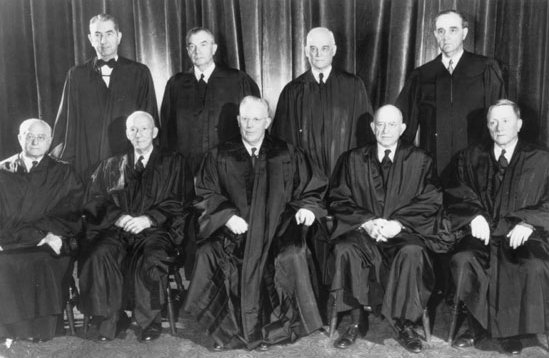 Supreme Court (12/14/1953 photo) (top row, L to R: Clark, Jackson, Burton, Minton; front row, L to R: Frankfurter, Black, Warren, Reed, Douglas)
Conference of
December 13,
1952 CHIEF
JUSTICE VINSON: I am not
sure what we should do today. It is 3:30 P.M. #413
Bollingv. Sharpe (District
of Columbia): There is a body of law in back of us on separate but
equal. The District of Columbia statutes-1862 and later-were enacted
close to the dates of
the Civil War Amendments. The same men were in Congress then who passed
the Civil War Amendments. However you construe it, Congress did
not pass a statute determining the issue and ordering no segregation.
It is
hard to get away from that
contemporary interpretation of the Civil War Amendments. Congress
evidently did not want to pass
this. Sumner's bill against segregation failed, and therefore the
District of Columbia has
had segregated schools for ninety years. Harlan's dissent in Plessy
is careful not to refer to schools. That has
significance, because
Harlan was strong on other items and later wrote the Cumming case
for this Court. I
don't
see in the District of Columbia case how we can get away from this
Court's long and continued
acceptance of these patterns of Congress ever since the Civil War
Amendments. As to having
mixed school classes, I think that Congress has the power to act for
the District of Columbia
and for the states. It may act in the District either directly through
the Board of
Education, or bypassing a few statutes. I don't think much of the idea
that it is for Congress and not for us to act.39 If they do
not act, this leaves us with it. It would be better if
Congress would act. Congress may act for the District of Columbia, but
probably will not act
for the states. (They will probably be content in the District of
Columbia to leave it to the board of education.) In the absence of
congressional
action, we have the commerce clause cases and these cases. . #101
Briggs
v. Elliott (South
Carolina): The facilities are equal here. It took some time to make
them
equal. Thurgood Marshall says that it will be necessary to state a time
for it to be made
effective. The abolition of the separate school system in the South
raises serious
practical problems. In Sipuel and McLaurin we said
that the right
was personal and that they
should get in right now, but it is difficult when there are large
numbers. The situation is very serious and very emotional. We can't
close our eyes
to the seriousness of the problem
in various parts of the country, although the problems are hotter in
some parts of
the country than in others. We face the complete abolition of the
public school system in
the South. It may be easy to say that the result is of no consequence
to but I think us, that it is. It is said that
we
should not consider this, but I can’t throw it all off. We can't avoid
taking it into consideration. Boldness is essential,
but wisdom is indispensable. #448
Gebhart v. Belton (Delaware) and Davis v. School
Board (Virginia): The schools here are not equal at the moment,
but they are moving toward it.
I am inclined toward giving
these states the time to make their facilities equal. #101
Briggs
v. Elliott (South
Carolina) and #8 Brown v. Board of Education (Kansas): The history of the
South Carolina case shows what time can do. Where you have a large
percentage of colored
people, it is hard to say that they cannot be equal. The Kansas Judge
said that it is detrimental to Negroes to be segregated. Virginia was
to the contrary. In Virginia, the
finding was that the court could not say that the proof on that side
was preponderant,
and that commingling would bring on humiliation and so forth. Affirm? BLACK:
To
start off, I am not at all sure that Congress is barred by the same
limitations
as the states. Congress can legislate where the states cannot, for
states are
bound by the Fourteenth Amendment. I see an anomalous result of
permitting
segregation in the District of Columbia and not elsewhere under the
equal protection
clause. (All parties seem to have felt that they were all the same.) First, we
must decide: is segregation a per se violation of the Fourteenth
Amendment? Marshall
understates and the others overstate the effect. of such a ruling." It
would
be serious and dramatic. There will be serious incidents and some
violence if
the Court holds segregation unlawful. States would probably take
evasive
measures while purporting to obey. South Carolina might abolish its
public
school system. One of the worst features is that the courts will be on
the
battle front. It will be law by injunction and contempt, and I don't
believe in
law by injunction. If we had
decided this case right after passage of the Civil War Amendments, I
believe that
we would have held originally that the way to enforce this was through
Congress. Now, however, the courts have taken jurisdiction. I can1t
draw a
rational distinction between this case and other cases under the
Fourteenth
Amendment as respects a self-executing agreement. If we can declare
confiscation
or other laws unconstitutional) then we can do the same with
segregation. I am driven
to the segregation issue with the knowledge that it will mean trouble.
I am
compelled to say for myself that I can't escape the view that the
reason fur
segregation is the belief that Negroes are inferior. I do not need
books to say
that. I am also
compelled to say for myself that the Civil War Amendments have as their
basic
purpose the abolition of such castes, and to protect the Negro against
discrimination on account of color. And that is what is behind the
opposition
now. Southerners always say that segregation is meant to prevent the
mixture of
the races. This is the idea behind the southern view that the mixture
of races
is thought to be very dangerous and weakens the white race. If I have to
meet it, I can't go contrary to the truth that the purpose of these
laws is to discriminate
on account of color. The Civil War Amendments were intended to stop
that. I
have to say that segregation of itself violates the
Constitution, unless
the long line of decisions and state decisions prevents such a ruling.
I don't think
that Congress went as far as they thought the Civil War Amendments
went. They
didn't go all the way that was intended in the old cases. I have to
vote
that way, to end segregation. And if a majority votes the other
way-to
segregate and to preserve equal and separate-then there should be
leeway for
changes, if equal and separate is going to be the rule, then wide
latitude
should be given to findings in the state courts. I reverse.
REED:
I
approach this problem from a different view than Black. There are some
who want
to hold Negroes down and deprive them of educational equipment. I know
that some
desire to keep the Negro as a laborer. The race came out of slavery a
short
time ago. The state
legislatures have informed views on this matter. Negroes have not
thoroughly assimilated.
There has been some amalgamation of the races, as shown by the counsel
who
appeared here. States are authorized to make up their own minds on this
question. We must try
our best to give Negroes benefits. We must start with the idea that
there is a
large and reasonable body of opinion in various states that separation
of the
races is for the benefit of both. Then there is the determination of
when the
changes are to be made. There has
been great, steady progress in the South in the advancement of the
interests of
the Negroes. States should be left to work out the problem for
themselves. It is
the right of the states to improve Negroes' status. Think of the
advancements. transportation, voting, FEPC, and so
forth. Segregation
is gradually disappearing. This applies to both North and South. It is
optional
in Kansas, Kentucky, and other states. We don't have the same problems
in
Kentucky as in the South. The facilities are not equal in Kentucky, but
they are
better than they are in the South. I agree that
the meaning of the Constitution is not fixed. What was due
process in 1860
may not be due process today-and that is going forward. To say that
today, we would
have to reverse what we have said before, and say that segregation is no
longer permissible. Why not let
it go on? When will
there be changes? If the body of people think that it is
unconstitutional. I cannot
say that the time has come when we can say that seventeen
states are
denying equal protection or due process. We must allow time,
Segregation in the
border states will disappear in fifteen or twenty years. Ten years in
Virginia,
perhaps. Ten years would make it really equal. Every year helps. In the
Deep
South, separate but equal schools must be allowed. I uphold segregation
as
constitutional. FRANKFURTER:
I am very glad that Vinson started with the District of Columbia case.
The
District of Columbia raises very different questions than the state
cases. It
just shows the different efforts of people.
I do not agree with Hugo Black that
the states are more limited than Congress. We need an
effective way to deal with this, and we should set all of these cases
down for
reargument on specific issues. This is not a delaying tactic-this
is not an unjustifiable delay. It is important when we
decide.
Brandeis said that the most important thing of this Court is what we do
not do! The District
of Columbia is the nation’s capital. I am prepared to vote today that
segregation
in the District of Columbia violates the due process clause. I
have
never had close living relation to Negroes, but I have had much to do
with
their problems. I was once assistant counsel to the NAACP. I also
belong to the
Jewish minority. I am familiar with the experiences of colored people
here,
especially Coleman, one of my old law clerks. It is intolerable that
this government should permit segregation in D.C. life. But I
deprecate the
use of needless force in changing this-it is important for the
government that will be responsible to enforce it. Still, it is very
important
that the District of Columbia case be set down for reargument after the
new
administration comes in. It is a gain in law administration if it
comes
not as a pronouncement of coercive law; but with the help of
the new
administration that has promised to change the law here in the
District. The due
process clause brings in special points, and I would set
the case down
for special consideration, for shaping decrees and for the District of
Columbia
to address themselves to the decree. Set down very specific questions,
such as
the manner in which it would be carried out and so forth. We should
hold all of
the cases. The social gains of having them accomplished with
executive
sanction would be enormous. As to the
states, these
are equity suits. They involve imagination in shaping decrees. I would
ask
counsel on reargument to address themselves to the problems of
enforcement. I
favor reargument in the state as well as the District cases. We can't
treat
these cases as sociological questions. Few things
are more dangerous than the familiar. How does Black know what the
framers of
the Civil War Amendments meant? I have read all of its history, and I
can't say
that it meant to abolish segregation. You cannot say from the
legislative
history that they meant to abolish segregation; there are many views.
You
cannot fairly say, yes these fellows meant to abolish
segregation,"
or vice versa. The proponents used evasive words so as not to stir the
issue. I
don't see anything in the United States Code or in the equal protection
clause
on the basis on which such a decision could be made. That leads me to
say that
must look only on physical things. It is arbitrary to say that
"equal rights" means physical things. If Kansas were here alone, I
would just reverse on the findings of the trial court and say that they
applied
the wrong legal principle. I would ask counsel that, assuming this
wording of law,
can they say that this Court has long misread the Constitution? What
justifies us in saying that what was equal in 1868 is not
equal under
law? Equal protection does not mean what was equal, but
what is
equal? I would ask counsel to demonstrate what it is that justifies
their saying
that what has gone on before is all wrong. I conclude
nothing going to the merits. I can't say that it is unconstitutional to
treat a
Negro differently than a white, but I would put all of these cases down
for
reargument. 'The further
maturing process would be highly desirable. The cases should be set
down for
reargument, say, 1st March. DOUGLAS: Segregation is a very simple constitutional question for me. No classification on the basis of race can be made. I can't avoid the same conclusion that Hugo has reached in the state cases, that states can't classify by color for education. The Fourteenth Amendment prohibits racial classifications, and so does the due process clause of the Fifth Amendment. Segregation is unconstitutional, whether by the states or Congress. A Negro can't be put by the state in one room because he's black and another student put in the other room because he's white. The answer is simple, though the application of it may present great difficulties. Can't play the factor of time. It will take a long time to work it out. I would not mind setting down the D.C. case for reargument in March, but not the others. Not rush pronouncements.
JACKSON:
If
we are going to take turns, it is better not to take a vote now. I
would
start with these cases as a lawyer would. I find nothing in the text
that
says this is unconstitutional Nothing in the opinions of the
courts say
that it is unconstitutional. Nothing in the history of the Fourteenth
Amendment
says that it is unconstitutional. There is nothing in the acts of
Congress
either way. On the basis of precedents, I would have to say that it is
constitutional.
Marshall's brief starts and ends with sociology, not legal issues. I
don't know
the effect of segregation, or the reason for it.
You can't cure
this situation by putting children together. I was never
really conscious of racial problems until I came to the District of
Columbia. We
had segregation in Jamestown, New York in the 1860s and 1890s. White
lawyers (Catholics
and Jews) would not let Negroes use books in the library (ordered
library out
of the courthouse). I won't be a
party to immediate unconstitutionality-to say that it is
unconstitutional to
practice segregation tomorrow. It will be bad for the Negroes to be put
into
white schools. But segregation is nearing an end. (If two or three
deaths on the
Court-this will come-it is no way out.) We should perhaps give them
time to get
rid of it, and I would go along on that basis. l would not object to
such a
holding with a reasonable time element. These are equitable remedies
that can
be shaped to the needs. If we can work it out so we can say segregation
"bad"--under approval of the Constitution and with the support of
Congress -- and that it must be done in a certain period. I
would
suggest that the District of Columbia case can be reargued, and that
the Senate
and House Judiciary Committees be asked to file briefs and argue. If
stirred up
to a point, they may abolish it.
BURTON:
They
have the right to come to us. We have the Constitution. I agree that
this should
be done in as easy a way as possible. Sipuel and Sweatt crossed
the threshold of these cases, and we must he guided by them. We must
not depart
from these cases. Education is more than buildings and faculties. It is
a habit
of mind. With the Fourteenth Amendment, states
do not have the choice--segregation violates
equal protection. The total effect is that separate education is not
sufficient
for today's problems. It is not reasonable to educate people separately
for a
joint life. The Fifth Amendment also
bars segregation. But we can use time. I would give plenty of time in
this
decree. I would go the full length to upset segregation. I reverse. I
will
support reargument in the District of Columbia case.
CLARK: I
favor
reargument in the D.C. case. The result must be the same in all of these cases. I will probably affirm in
Delaware. In
Texas, the problem is as acute as anywhere. The Mexican problem is more
serious.
Far more retarded. A Mexican boy of
fifteen is in a class with a Negro girl of twelve. Some Negro girls get
in
trouble. If we delay action (is Bob's idea) it will help. Our opinion
should
give the lower courts the opportunity to withhold relief in light of
troubles.
I would be inclined to go along with that. Otherwise, I would say that
we have
led states on to believe that separate but equal is O.K., and we should
let
them work it out.
MINTON:
The
hour is late. We are confronted with a body of law that lays down
separate and
equal. We have chipped and chiseled it away with Sweatt and MeLaurin.
Classification by race does not add up. It is not
reasonable. It is
invidious and it can't be maintained. Congress, in the District of
Columbia, has authorized segregation-but it's not legal. Confrontation
with the
states is not final. There will be trouble, but this race grew up in
trouble.
The Negro is oppressed and has been to bondage for years after slavery
was
abolished. Segregation is per se unconstitutional. I am
ready to vote
now. [The Justices ordered all five cases to be
reargued. Attorneys were asked to address the historical question
of whether the 14th Amendment was intended to end segregation, as well
as the question of whether the courts have the authority to end
segregation.] |