×
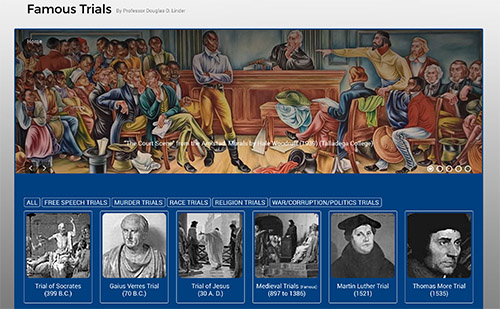
Check-out the new Famous Trials website at www.famous-trials.com:
|
United States Dictrict Court District of Kansas
Wilbur B. Brookover, having been first duly
sworn, assumed
the stand and testified as follows.
Direct examination by Mr. Greenberg: Q. Mr. Brookover, will you
please state your full name? A. Wilbur B. Brookover. Q. What is your occupation? A. I am a social
psychologist by profession. The position I
now hold is professor of social science, sociology, at Michigan State
College. Q. What degrees do you
hold, Mr. Brookover? A. I hold an A.B. Degree
from Manchester College, a Master
of Arts Degree and a Doctor of Philosophy Degree in sociology and
psychology
from the University of Wisconsin. Q. Are you a member of any
learned societies, Doctor? A. I am a member of the
American Sociological Society,
Society for Applied Psychology, Society for Applied Anthropology,
Society for
the Psychological study of Social Issues, the High Valley Sociological
Society,
Michigan Academy of Sciences, the American Association for the
Advancement of
Science. Q. What is your field of
special interest, Dr. Brookover? A. I am particularly
concerned in my teaching and research
in the field of social psychology with particular reference to the
human
relations in the school society, or the school as a social institution
and the
relations between minority groups and majority groups in society. Q. Are you the author of
any books or publications? A. I am the author of
several articles on various topics
concerned with social relations between teachers and pupils and other
aspects
of social factor in education. I am also the author of articles
concerned with
relation of these social factors to teaching - to pupil achievement. I
have
published articles on the impact of social stratification on education,
one
that is in press at the present time to appear in the Journal of
Educational
Theory. I am also the author of articles concerning social factors in
relation
to citizenship education, an article to appear in the 1951 yearbook of
the
National Council of Social Studies, now in press. I have in preparation
a booko
to be published by the American Book Company that will be titled “The
Sociology
of Education.” I am a joint author of a book now in preparation; it’s a
monograph which will report research which - committee of which I was
chairman
conducted on Minority groups in Maple County, which is a Midwestern
community. Other than what you have
stated, have you devoted any
special study to the problem of the effect of racial segregation on the
individual? A. Well, the monograph
which I just mentioned grows out of a
rather extended project still in process on the analysis of minority
group
relations of minority group relations in Midwestern society. I have
inaugurated
at the present time, designed a study to analyze the dynamics of
prejudices
against youth. Mr. Goodell: I didn’t get
that. The witness: The dynamics
of prejudices among youth in a
Midwestern school community. Q. Now, Dr. Brookover, I
am going to ask you a hypothetical
question which I would like to have your answer on the basis of your
learning.
Assume that in the City of Topeka there is maintained a racially
segregated
school system. Would you say that a negro child who attends the
racially
segregated school receives the same
benefits as he would receive from attending a racial integrated school? A. No, I would not. Q. On what do you base
your opinion? A. Well, I would say,
first of all, that I would want to
emphasize the nature of the educational process in this respect;
Education is a
process of telling youth to behave in those ways that society thinks is
essential. In our society it has long been held that this is a
necessary
function, to prepare democratic citizens. Now, the child acquires these
essential behavior patterns in association with other people. In other
words,
they are not fixed; they are not inherent in the behavior of the child,
but
they are acquired in a social situation. Now, in order to acquire the
types of
behavior that any society might expect and learn how to behave in
various
situations, the child must be provided with the opportunity to interact
with
and understand what kinds of behavior are desired, expected, in all
kinds of
situations. This is achieved only if the child has presented to him
clearly
defined models. Q. What do you mean by
models, Professor? A. Examples, illustrations
of behavior; persons behaving in
the ways that are - that the child is expected to behave and also
consistent
example of this sort. In other words, of an example, one kind of model,
and
another time he is expected to behave if at one time he is presented
with one
kind of an example, one kind of model, and another time he is presented
with
another kind of a model, and there is constant confusion. Now that, I
think,
leads us immediately to the situation with regard to segregated
schools. In
American society we consistently present the to the child a model of
democratic
equality of opportunity. We teach him the principals of equality; we
teach him
what kind of ideas we have in American society and set this model
behavior
before him and expect him to internalize, to take on, this model, to
believe
it, to understand it. At the same time, in a segregated school
situation he is
presented a contradictory or inharmonious model. He is presented a
school
situation in which it is obvious that he is a subordinate, inferior
kind of
citizen. He is not presented a model of equality and equal opportunity
and
basis of operating in terms of his own individual rights and
privileges. Now,
this conflict of models always creates confusion, insecurity, and
difficulty
for the child who cannot internalize a clearly defined and a clearly
accepted
definition of his role, so he is faced with situations which he doesn’t
- he
has two or three, at least two in this situation, definitions of how he
is
expected to behave. This frustration that results - may result in
delinquent
behavior or otherwise criminal or socially abnormal behavior. Now the
negro
child is constantly presented with this dual definition of his role as
a
citizen and the segregated schools perpetuates this conflict in
expectancies,
condemns the negro child to an ineffective role as a citizen and member
of
society. Q. Dr. Brookover, this
opinion and the reasons you have just
given, they are supported by scientific authority? A. Yes, there is extensive
work been done by psychologists,
social psychologists, on the whole theory of role-taking and the
question of
eternization of patterns of expectancy, such people as George Herbert
Meade,
Charles Horton Cooley and numerous other people have done extensive
work,
extensive research in the process of personality development and
learning a
situation through social interaction. Mr. Greenberg: That is
all. Cross Examination, By Mr. Goodell: Q. Doctor, I will just ask
you one question: Have you ever
heard of all these people, all negroes: Mary MacLeod Bethune of
Sumpter, South
Carolina, who is president of the college there, Bethune-Cookman
College,
Daytona Beach, Florida. A. I have heard of someone
by the name of Bethune. I am not
sure that I know. Q. Richard Wright,
Greenwood, Mississippi, and Jackson,
Mississippi, author of Native Son, negro. A. I have. Q. Charles Johnson of
Bristol, Virginia. A. Charles Johnson, that I
know. Q. Sociologist and
President of Fisk University. A. I think that is in
Tennessee. Q. Perhaps so. Walter
White of Atlanta, Georgia, Executive
Secretary of National Association for the Advancement of Colored
People. A. I have heard of him;
don’t know him. Q. George Washington
Carver, Neosho, Missouri, residence. A. I have heard of him. Q. Langston Hughes, poet
and author, I believe from Kansas. A. I have heard of him;
don’t know him. Q. W.E.B. DuBois who was
and author, I believe connected
with Fisk University at Nashville. A. I know a DuBois who is
an anthropologist. I don’t know if
this is the one. Q. Mordecai Johnson, Paris
Tennessee, president of Howard
University, Washington, D.C., a negro university. A. I know the name; I
don’t know him at all. Q. William Grant Still, a
composer of Little Rock, Arkansas.
A. Don’t know him. Q. Negro. A. Phillip
Randolph, Florida, president of the
sleeping - strike that. Charles Wesley of Baltimore, Maryland,
president of the
University in Ohio; I don’t have the town. A. I don’t know him. Q. Frederick Patterson,
President of the Tuskegee Institute,
Washington, D.C. A. I don’t know him. Q. Some of these men you
know. Assuming they were all
educated - got their preliminary education in segregated schools, a
large part
of them in the south, would you - did you consider that in arriving at
your
opinion here? A. Certainly did. The fact
that occasionally a person is
able to overcome, through various readjustments and other experiences,
the
conflict of roles, the conflict of models, does not disturb the
generalization
which I make, in the least. Certainly there are individual cases which
either
through psychotherapy or other experiences, the individual is able to
overcome
such difficulties. But this is not the general case at all. Q. Well, there are many
illustrations of emotional stress
and strain among the white children who go to school and don’t get -
get sort
of left out, don’t make the football team or the basketball team or
don’t get
invited to the parties, isn’t that right? A. Sure, there are
differences in ability to adjust and
there are emotional disturbances. The differences which you cite are
not
enforced differences. They are not inevitable in terms of the situation
in
which they come - in which they operate. The child is not by flat or
legalization required to have presented to him this conflict. Q. That is your opinion
about what the law ought to be, in
other words, is that it? A. I would say that on the
basis of my testimony that the
segregation of schools presents a conflicting set of models inevitably.
Q. This opinion you have
given here is largely your own
personal view based upon your study. A. No, I wouldn’t say it
is my own personal view at all. I
would say it is the result of a tremendous amount of research and
evidence. Q. I said study. A. That is accumulated by
social psychologists over a period
of years and as I have studied and analyzed this research, I would come
to this
conclusion. Q. You think you could be
wrong? A. Of course any
scientists the possibility or recognizes
the possibility that new evidence and new research may modify to some
extent
the conclusions of a particular time. Mr. Goodell: That is all.
|