×
Check-out the new Famous Trials website at www.famous-trials.com:
|
NOTES OF JUSTICES CONCERNING THEIR CONFERENCE DISCUSSIONS IN THE CASE OF BROWN et al. v BOARD OF EDUCATION OF TOPEKA 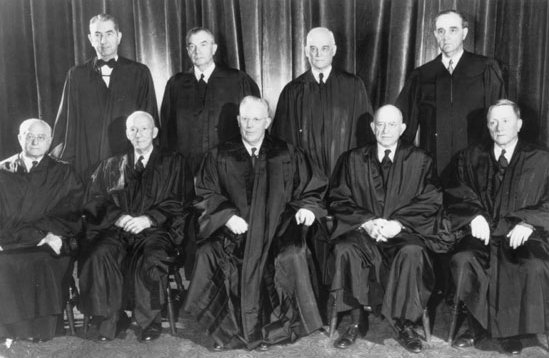 Supreme Court (12/14/1953 photo) (top row, L to R: Clark, Jackson, Burton, Minton; front row, L to R: Frankfurter, Black, Warren, Reed, Douglas)
Conference of
April 16, 1955 CHIEF
JUSTICE WARREN: I
have not formed a fixed or definite opinion at this time, and we might
want to
talk this over as we did in the main cases, I think that there are some
things
that we should not do, We should not: a. follow
the government's suggestion and appoint a master. b. indicate
to the district courts that they should appoint a master. But of course
each
district court has that power and could appoint a master. c. fix a
date for completion of the program of desegregation, or suggest to the
lower courts
that they fix such a date. That should be left to the district courts
to do what
they think best. d. require
the district courts to call for a plan for the school districts. The
district courts
might well do so-but we should not require it. e. make any
procedural requirement for the lower courts-this is an equity
proceeding. What
appeals to me: Should
we give guidance to the lower courts in an opinion or in a formal
decree? I
think, that we are better off writing an opinion which would set forth
the
factors and conditions which the lower courts should take into
consideration,
rather than issuing a formal decree. It is better done this way, and it
would
circumscribe the district courts as such. The lower courts would get
more
comfort that way than with a formal decree. I would not make the decree
a mere
bare-bones decree. We should say something that will help the district
courts.
We ought to give them guidance--it would make it much easier. It would
be
rather cruel to shift these hack and let them flounder. I would put
into our opinion the principles and limits, and then decree a
base line.
Our decree will be to act in accordance with that opinion and brief.
Here are
some ground rules for what the opinion should say: a. these are
class actions, which involve not only the named plaintiffs but all of
the students
in the education districts that they sued. b. these
rights are personal rights for the named defendants and the class they
represent. c. every
judge is entitled to take into consideration administrative
problems,
fiscal problems, or physical facts essential for completion of our
decree. I
would not say or intimate that the lower courts could take into
consideration
psychological or sociological attitudes. If that were allowed, it would
defeat
the decreed. the lower courts should consider whether the bills
submitted represent
progress, and whether there has been a real initiation of a program. We should
give the district courts as much latitude as we can, and also as much
support as
we can.
BLACK: I
have no fixed views. I am not sure that I have any definitive views
worth
submitting. I think that it is important to have unanimous action. If
humanly
possible, I will do anything to achieve a unanimous result. My
tentative ideas
vary from the Chief Justice’s. At present,
I would write a decree and quit. The less we say, the better off we
are. Certain
things may be, and probably are, true. In the South, I was brought up
in an atmosphere
against federal officials. They are just now beginning to feel some
respect for
federal officials. The root of the problem was the race question. Some
counties
won't have Negroes and whites in the same school this generation. My
law
clerk does not think that Negroes and whites could go to school
together in
Lowndes County in his lifetime. I agree that
attitudes should not be mentioned in the decree, but we cannot ignore
them. Clarendon
County in South Carolina is typical of much of the South. It has some
resemblance to Alabama counties. They would never be a party to
allowing whites
and Negroes to go to school together. We have no more chance to enforce
this in
the Deep South than to enforce Prohibition in New York City. I would
start with the thought that nothing could injure this Court more than
to issue orders
that cannot be enforced. It is futile to think that in these cases we
can
settle the question of segregation in the South. We need a careful
statement
that segregation is unconstitutional. I would remand the
Kansas,
Delaware, and District of Columbia cases for further proceedings in
accordance with
our prior decision of May 17. The South
Carolina and Virginia cases are decrees for setting a pattern. These
cases arc
not going to settle the issue or control the destiny of the South.
There is a
great deal of stubbornness. People there are going to fight this. There
will be
a deliberate effort to circumvent the decree. We can't undertake to
settle the
problem. It becomes desirable to write as narrowly as possible. I do
not
believe that an enumeration of principles would be helpful. We can't
dispose of
it merely by establishing principles for action. Not one federal judge
in the
South is in favor of this. I think I know them all. My idea may
be unworkable. I am not fond of class law suits. I am not sure how many
Negro
students would want their names included in this litigation. Many don't
want to
be included. Therefore, I would treat these as individual cases.
If the
named plaintiffs are all we deal with, the administrative difficulty
would not
be great. Second
go: There
is alternative prayer for an injunction against school boards refusing
admissions.
If we granted that, it would protect all students, but I am not sure
that the
students would want to go. My present,
tentative suggestions for a decree: First,
write an opinion in decree form saying that it is unconstitutional, and
that
these students must be admitted. Then send it back and issue a decree
that
these seven children should not be excluded by reason of their color.
Enjoin
the school board not to refuse-avoid contempt. The same in Virginia.
There
forty-three students named in South Carolina, and one hundred fifty in
Virginia. We should move gradually-like a glacier, states on the outside. I
am by no means sure, if they are to abolish public schools, whether it
is
better to do it now. Georgia is sure to do so. One of the
most eloquent men I have heard at the bar was the man from South
Carolina.
REED:
I
don't know the Deep South. I have a firm belief that there is
a
considerable group wanting to give this decision sympathetic
consideration.
When some schools are opened, it will have a further effect.
These are
class suits, and those who might come in and be parties would be
beneficiaries of
any court order. I think that all students who are not plaintiffs who
want to
intervene can do so up to the time official judgment. It might be
better,
however, not to mention that these are class suit. We can think of them
as
class suits, but not state it in the decree. We should either say
nothing about
this class, or we should specifically authorize the lower courts to
admit the class.
It is essential to say, or at least to look at what must be done. I am
agreeable either way to say that these are class suits or not. I would
remand
these cases, directing that these schools are to be opened to the named
plaintiffs
with all convenient speed. We should put it in the form of an opinion
and a short
decree. I favor a short opinion, asserting the constituttona1
principles and
some guidelines and then sending these cases back with limited ground
rules in
there. I favor an opinion as well as a decree as it would be more
flexible. I question
whether we should call for the submission of a plan. We should not
require it.
I question whether we should mention it at all. I would suggest that
the lower
courts could call for a plan if they want one and
it might be well to
authorize the lower courts who want a plan to ask for one. They might
classify
on grounds of sex, or they might integrate class by class. I would not
set a time limit or fix definite terms, but would follow the language
of the Jaybird
decree. The direction in the Jaybird case, Terry
v. Adams,
is enough. That will result in doing more with the public
schools in these
areas. Our order may result in public schools being abolished. We can't
require
public school systems. The border states will be
examples.
FRANKFURTER: I welcome greatly that we can talk in a candid, relaxed way of general direction. The Kansas, Delaware, and District of Columbia cases are easy. But we must conceive of the environment of the decree in South Carolina, Virginia, and so forth. The attitude of the South is a fact to be taken into consideration as much as administrative difficulty and so forth. The right
here vindicated was a right created only last year. The important thing
is not
the decree, but an opinion. By all means there should be an opinion.
This is a slow
process and something should be said about it. What we do is largely
educational. What we say
and the kind of feeling we impart is important. The United
States
Supreme Court is for all of the country, including the South. I do not
agree
with Thurgood Marshall that southern attitudes are to be left out of
consideration.
I do not agree with the Texas polls." By gradual infiltration of border
states, the process of desegregation can spread to the Deep South.
DOUGLAS:
We
should have an opinion. Don't add much opinion. We should say that we
have benefited
from their argument, statistics. Include the items that the Chief
Justice mentioned.
We should give a push. We should suggest as fast as
circumstances
permit. I would not suggest a date, but use language like Jaybird, and
words to show that we must get along with this matter. Like Hugo, I
have doubts
about treating these cases as class action suits. I am inclined to make
a
decree restricting relief to the named individuals. I am inclined to a
cut-off
for named plaintiffs.
BURTON:
I
favor an objective declaration of unconstitutionality, and I would
enjoin such
segregation as rapidly as possible. I would not restrict relief. In its
nature,
we are dealing with a class. The problem is the race
line, not just putting in a few colored children. Neither this
Court nor the district courts should act as a school board or formulate
the programs. There should
be no masters. We must order nothing that will be futile. It is vital
that it be
unanimous-this is the demonstrating factor. I believe in a
short opinion
followed by a decree. The decree would declare segregation and all laws
supporting it to be unconstitutional. I would
remand for the purpose of malting it effective: (a) good
faith efforts in eliminating segregation; (b) parties defending
shall present plans; and (c) pending
completion, there should be reports and the courts should retain
jurisdiction.
CLARK:
I am closer
to Felix than to anyone else. Texas is not going to present any acute
problems;
there will not be too much trouble there. But there are some Clarendons
there. The
disparity between white and colored school, is great. The
administrative
problem is great. Lots of new school buildings would have to be
erected. We
can't simply relocate between colored schools and white schools,
putting five
hundred students in shacks and five hundred students in good schools.
Whites
will go to school with colored children, but they never will allow
white
students under colored teachers. Many will still go to wholly colored
schools. We can't restrict these suits to named plaintiffs. They are
going to try to do what this Court says. We could not have a
"forthwith" order as Hugo suggests. We need to be careful
what we say. Three judge courts are good. A Jaybird
decree is desirable.
MINTON:
I
agree with Hugo and Harold, and will go along with the majority.
Unanimous
action by the Court is of primary importance. I doubt the advisability
of
writing much, and I have doubts about writing many opinions. We should
not make
big talk in the opinion and little words in the decree. The main thing
is to
get to work in the area. Democracy should never reveal its own
impotence. We
should be careful not to issue a futile decree that we cannot enforce.
But we
must do something in the area. The decree should look like this: a. a
declaration of unconstitutionality; b. we should
enjoin school authorities from admitting or excluding on the basis of a person's
color; c. we should
direct them to file with the district court on or by 9/1/55 a plan of
admissions
with equal treatment and d. rites are
to be given in the district courts.
HARLAN:
All
of my ideas have been expressed by others. I would emphasize that
whatever our conclusion,
it is of the essence that our opinion be unanimous. This is political
statesmanship.
I am deeply impressed by what Hugo Black said about the Deep South, and
the
importance of taking those factors into account. I am surprised at the
degree
of unanimity on the basic issues. We might be
mistaken in thinking that writing might not help-it might have just the
opposite effect. A properly written opinion reflecting our basic
approach might
be helpful. Issuing only a decree might be too cold and heavy-handed. I
am
disposed to have an opinion and a decree, with the decree in the
simplest
possible form. Outside of May 17, there should be no time limits. The
injunction
should carry out by the 17th. I agree with
the Chief Justice as to the scope of our opinion. We should: a. reiterate
our holding of May 17. b. make some
reference to the steps that have been taken for advice as to
implementation. c. make some
reference to the broad positions taken by the plaintiffs and the states. d. make it
clear that we have proceeded under equity powers, and that we have the
power
and duty to mold exigencies and to liquidate history. e. recognize
that the school problem is local
and that is not changed
by the views expressed here, and that we are
remanding these cases to the
local courts. |