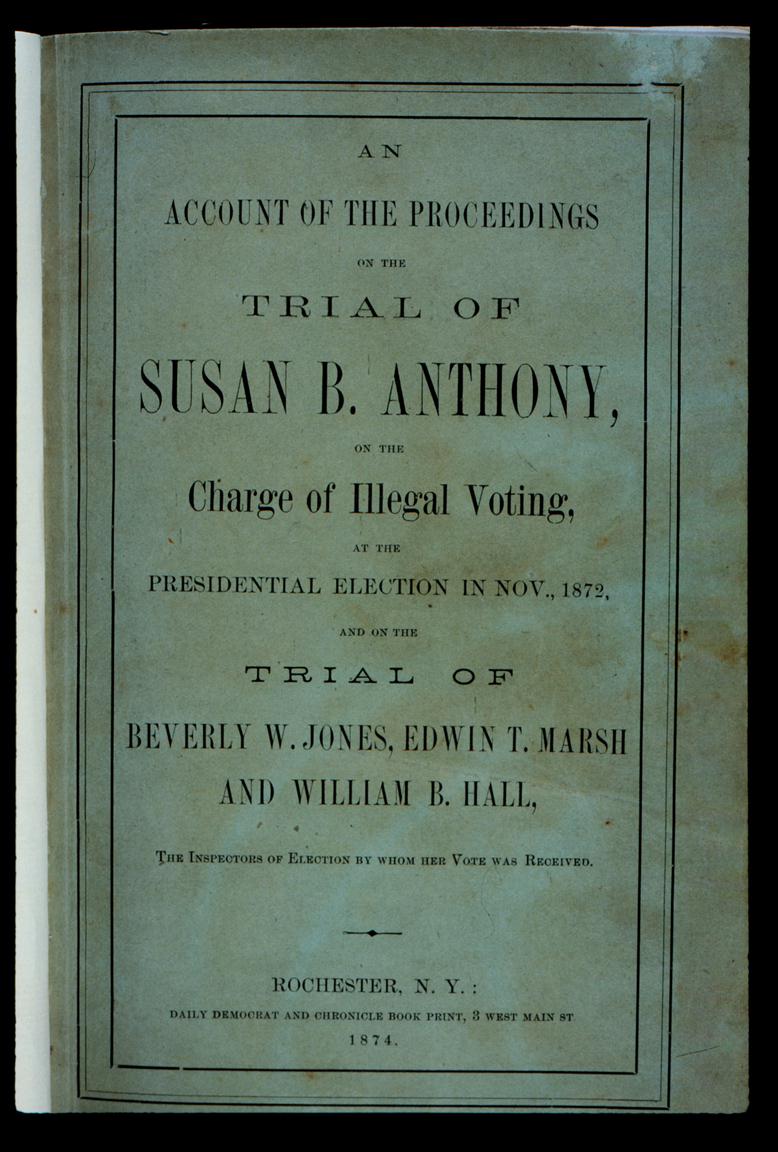
More than any other woman of her generation, Susan
B. Anthony saw that all of the legal disabilities
faced by American
women owed their existence to the simple fact that women
lacked the
vote.
When Anthony, at age 32, attended her first woman's
rights convention
in
Syracuse in 1852, she declared "that the right which
woman needed above
every other, the one indeed which would secure to her
all the others,
was
the right of suffrage." Anthony spent the next
fifty-plus years
of
her life fighting for the right to vote. She would work
tirelessly:
giving
speeches, petitioning Congress and state legislatures,
publishing a
feminist
newspaper--all for a cause that would not succeed until
the ratification
of the Nineteenth
Amendment fourteen years after her death in 1906.
She would, however, once have the satisfaction of
seeing her
completed
ballot drop through the opening of a ballot box.
It happened in
Rochester,
New York on November 5, 1872, and the event--and the
trial for illegal
voting that followed--would create a opportunity for
Anthony to spread
her arguments for women suffrage to a wider audience
than ever before.
The Vote
Anthony had been planning to vote long before
1872.
She would
later state that "I have been resolved for three years
to vote at the
first
election when I had been home for thirty days before."
(New York law
required
legal voters to reside for the thirty days prior to
the election in the
district where they offered their vote.) Anthony
had taken the
position--and
argued it wherever she could--that the recently
adopted Fourteenth
Amendment
gave women the constitutional right to vote in federal
elections. The
Amendment
said that "all persons born and naturalized in the
United States...are
citizens of the United States," and as citizens were
entitled to the
"privileges"
of citizens of the United States. To Anthony's
way of thinking,
those
privileges certainly included the right to vote.
On November 1, 1872, Anthony and her three sisters
entered a
voter registration
office set up in a barbershop. The four Anthony
women were part
of
a group of fifty women Anthony had organized to
register in her home
town
of Rochester. As they entered the barbershop,
the women saw
stationed
in the office three young men serving as
registrars. Anthony
walked
directly to the election inspectors and, as one of the
inspectors would
later testify, "demanded that we register them as
voters."
The election inspectors refused Anthony's request,
but she
persisted,
quoting the Fourteenth Amendment's citizenship
provision and the
article
from the New York Constitution pertaining to voting,
which contained no
sex qualification. The registers remained
unmoved. Finally,
according to one published account, Anthony gave the
men an argument
that
she thought might catch their attention: "If you
refuse us our rights
as
citizens, I will bring charges against you in Criminal
Court and I will
sue each of you personally for large, exemplary
damages!" She added, "I
know I can win. I have Judge
Selden as a lawyer. There is any amount of money
to back me, and if
I have to, I will push to the 'last ditch' in both
courts."
The stunned inspectors discussed the situation.
They
sought the
advice of the Supervisor of elections, Daniel Warner,
who, according to
thirty-three-year-old election inspector E. T. Marsh,
suggested that
they
allow the women to take the oath of registry.
"Young men," Marsh
quoted Warner as saying, "do you know the penalty of
law if you refuse
to register these names?" Registering the women, the
registrars were
advised,
"would put the entire onus of the affair on
them." Following
Warner's
advice, the three inspectors voted to allow Anthony
and her three
sisters
were registered to vote in Rochester's eighth
ward. Testifying
later
about the registration process, Anthony remembered "it
was a full hour"
of debate "between the supervisors, the inspectors,
and myself." In
all,
fourteen Rochester women successfully registered that
day, leading to
calls
in one city paper for the arrest of the voting
inspectors who complied
with the women's demand. The Rochester Union
and Advertiser
editorialized in its November 4 edition: "Citizenship
no more carries
the
right to vote that it carries the power to fly to the
moon...If these
women
in the Eighth Ward offer to vote, they should be
challenged, and if
they
take the oaths and the Inspectors receive and deposit
their ballots,
they
should all be prosecuted to the full extent of the
law."
Soon after the polls opened at the West End News
Depot on
Election Day,
November 5, Anthony and seven or eight other women
cast their
ballots.
Inspectors voted two to one to accept Anthony's vote,
and her folded
ballot
was deposited in a ballot box by one of the
inspectors. Inspector E. T.
Marsh testified later as to feeling caught between a
rock and a hard
place:
"Decide which way we might, we were liable to
prosecution. We were
expected...to
make an infallible decision, inside of two days, of a
question in which
some of the best minds of the country are divided."
Seven or eight more
women of Rochester successfully voted in the
afternoon. Anthony's
vote went to U. S. Grant and other Republicans, based
on that party's
promise
to give the demands of women a respectful
hearing. Later that
day,
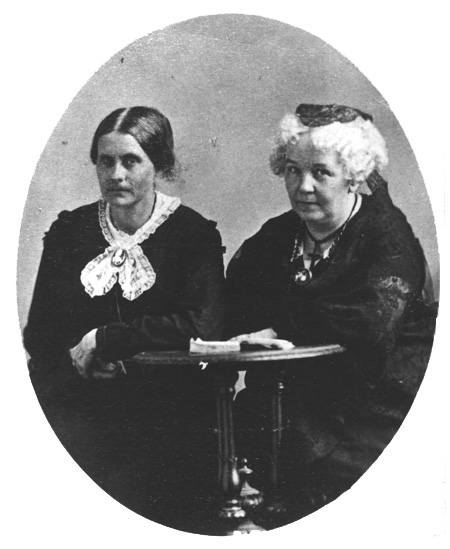
Anthony would write of her accomplishment to her close
friend and
fellow
suffragist, Elizabeth Cady Stanton:
Dear Mrs Stanton
Well I have been & gone & done
it!!--positively
voted the Republican ticket--strait this a.m. at 7
Oclock--& swore
my vote in at that--was registered on Friday....then
on Sunday others
some
20 or thirty other women tried to register, but all
save two were
refused....Amy
Post was rejected & she will immediately bring
action for
that....&
Hon Henry R. Selden will be our Counsel--he has read
up the law &
all
of our arguments & is satisfied that we our
right & ditto the
Old
Judge Selden--his elder brother. So we are in
for a fine
agitation
in Rochester on the question--I hope the morning's
telegrams will tell
of many women all over the country trying to
vote--It is splendid that
without any concert of action so many should have
moved here so
impromptu--
The Democratic paper is out against us strong &
that
scared the
Dem's on the registry board--How I wish you were
here to write up the
funny
things said & done....When the Democrat said my
vote should not go
in the box--one Republican said to the other--What
do you say Marsh?--I
say put it in!--So do I said Jones--and "we'll fight
it out on this
line
if it takes all winter"....If only now--all the
women suffrage women
would
work to this end of enforcing the existing
constitution--supremacy of
national
law over state law--what strides we might make this
winter--But I'm
awful
tired--for five days I have been on the constant
run--but to splendid
purpose--So
all right--I hope you voted too.
Affectionately,
Susan B. Anthony
Arrest and Indictment
The votes of Susan Anthony and other Rochester women
was a
major topic
of conversation in the days that followed. In a
November
11 letter to Sarah Huntington, Anthony wrote:
"Our papers are
discussing
pro & con everyday." Anthony occupied much
of her time
meeting
with lawyers to discuss a planned lawsuit by some of
the women whose
efforts
to register or vote were rejected.
Meanwhile, a Rochester salt manufacturer and
Democratic poll
watcher
named Sylvester Lewis filed a complaint charging
Anthony with casting
an
illegal vote. Lewis had challenged both
Anthony's registration
and
her subsequent vote. United States Commissioner
William C. Storrs
acted upon Lewis's complaint by issuing a warrant for
Anthony's arrest
on November 14. The warrant charged Anthony with
voting in a
federal
election "without having a lawful right to vote and in
violation of
section
19 of an act of Congress" enacted in 1870, commonly
called The
Enforcement
Act. The Enforcement Act carried a maximum
penalty of $500 or
three
years imprisonment.
The actual arrest of Anthony was delayed for four
days to
allow time
for Storrs to discuss the possible prosecution with
the U. S. Attorney
for the Northern District of New York. On
November 18, a United
States
deputy marshal showed up at the Anthony home on
Madison Street in
Rochester,
where he was greeted by one of Susan's sisters.
At the request of
the deputy, Anthony's sister summoned Susan to the
parlor. Susan
Anthony had been expecting her visitor. As
Anthony would later
tell
audiences, she had previously received word from
Commissioner Storrs
"to
call at his office." Anthony's response was
characteristically
plainspoken:
"I sent word to him that I had no social acquaintance
with him and
didn't
wish to call on him."
At the May meeting of the National Women's Suffrage
Association, Anthony
described what happened when the deputy marshal, "a
young man in beaver
hat and kid gloves (paid for by taxes gathered from
women)," came to
see
her:
He sat down. He said it was pleasant
weather. He
hemmed and hawed and finally said Mr. Storrs wanted to
see me...."what
for?" I asked. "To arrest you." said he.
"Is that the way
you
arrest men?" "No." Then I demanded that I should
be arrested
properly.
[According to another account, Anthony at this point
held out her
wrists
and demanded to be handcuffed.] My sister desiring to
go with me he
proposed
that he should go ahead and I follow with her.
This I refused,
and
he had to go with me. In the [horse-drawn] car
he took out his
pocketbook
to pay fare. I asked if he did that in his
official
capacity.
He said yes; he was obliged to pay the fare of any
criminal he
arrested.
Well, that was the first cents worth I ever had from
Uncle Sam.
Anthony was escorted to the office of Commissioner
Storrs, described by
Anthony as "the same dingy little room where, in the
olden days,
fugitive
slaves were examined and returned to their
masters." Upon
arriving,
Anthony was surprised to learn that among those arrested
for their
activities
on November 5 were not only the fourteen other women
voters, but also
the
ballot inspectors who had authorized their votes.
Anthony's lawyers refused to enter a plea at the time
of her
arrest,
and Storrs scheduled a preliminary examination for
November 29.
At
the hearing on the 29th, complainant Sylvestor Lewis
and Eighth Ward
Inspectors
appeared as the chief witnesses against Anthony.
Anthony was
questioned
at the hearing by one of her lawyers, John Van
Voorhis. Van
Voorhis
tried to establish through his questions that Anthony
believed that she
had a legal right to vote and therefore had not
violated the 1870
Enforcement
Act, which prohibited only willful and knowing illegal
votes.
Anthony
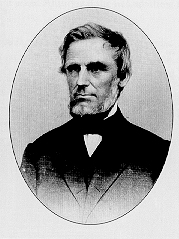
testified that she had sought legal advice from Judge
Henry R. Selden
prior
to casting her vote, but that Selden said "he had not
studied the
question."
Van Voorhis asked: "Did you have any doubt yourself of
your right to
vote?"
Anthony replied, "Not a particle." Storrs
adjourned the case to
December
23.
After listening to legal arguments in December,
Commissioner
Storrs
concluded that Anthony probably violated the
law. When
Anthony--alone
among those charged with Election Day
offenses--refused bail, Storrs
ordered
her held in the custody of a deputy marshal until the
grand jury had a
chance to meet in January and consider issuing an
indictment.
Anthony
saw the commissioner's decision as a ticket to Supreme
Court review,
and
began making plans with her lawyers to file a petition
for a writ of
habeas
corpus. In a December 26 letter, Anthony wrote
confidently, "We
shall
be rescued from the Marshall hands on a Writ of Habeas
Corpus--&
case
carried to the Supreme Court of the U. S.--the
speediest process of
getting
there." Already letters were coming in with
contributions to her
"Defense Fund." She was anxious to put the money
to use.
By early January, Anthony was already trying to make
political hay out
of her arrest. She sent off "hundreds of papers"
concerning her
arrest
to suffragist friends and politicians. She
still, however, found
her situation difficult to comprehend: "I never
dreamed of the U. S.
officers
prosecuting me for voting--thought only that if I was
refused I should
bring action against the inspectors-- But "Uncle Sam"
waxes wroth with
holy indignation at such violation of his laws!!"
Anthony's attorney, Henry Selden asked a U. S.
District
Judge in Albany,
Nathan Hall, to issue a writ of habeas corpus ordering
the release of
Anthony
from the marshal's custody. Hall denied Selden's
request and said he
would
"allow defendant to go to the Supreme Court of the
United
States."
The judge then raised Anthony's bail from $500 to
$1000. Anthony again
refused to pay. Selden, however, decided to pay
Anthony's bail
with
money from his own bank account. In the
courtroom hallway
following
the hearing Anthony's other lawyer, John Van Voorhis,
told Anthony that
Selden's decision to pay her bail meant "you've lost
your chance to get
your case before the Supreme Court." Shaken by
the news, Anthony
confronted her lawyer, demanding that he explain why
he paid her
bail.
"I could not see a lady I respected put in jail,"
Selden answered.
A disappointed Anthony still had a trial to
face. On
January 24,
1873, a grand jury of twenty men returned an indictment
against Anthony charging her with "knowingly,
wrongfully, and
unlawfully"
voting for a member of Congress "without having a
lawful right to
vote,....the
said Susan B. Anthony being then and there a person of
the female
sex."
The trial was set for May.
On the Stump
Anthony saw the four months until her trial as an
opportunity to educate
the citizens of Rochester and surrounding counties on
the issue of
women
suffrage. She took to the stump, speaking in
town after town on
the
topic, "Is
it a Crime for a Citizen of the United States to
Vote?"
By mid-May, Anthony's exhausting lecture tour had
taken her
to every
one of the twenty-nine post-office districts in Monroe
County. To
many in her audience, Anthony was the picture of
"sophisticated
refinement
and sincerity." The fifty-two-year-old
suffragist delivered her
earnest
speeches dressed in a gray silk dress a white lace
collar. Her
smoothed
hair was twisted neatly into a tight knot. She
would look at her
audience, ranging from a few dozen to over a hundred
persons, and
begin:
Friends and Fellow-citizens: I stand before
you
to-night, under
indictment for the alleged crime of having voted at
the last
Presidential
election, without having a lawful right to vote. It
shall be my work
this
evening to prove to you that in thus voting, I not
only committed no
crime,
but, instead, simply exercised my citizen's right,
guaranteed to me and
all United States citizens by the National
Constitution, beyond the
power
of any State to deny.
In her address, Anthony quoted the Declaration of
Independence, the U.
S. Constitution, the New York Constitution, James
Madison, Thomas
Paine,
the Supreme Court, and several of the leading Radical
Republican
senators
of the day to support her contention that women had a
legal right as
citizens
to vote. She argued that natural law, as well as a
proper
interpretation
of the Civil War Amendments, gave women the power to
vote, as in this
passage
suggesting that women, having been in a state of
servitude, were
enfranchised
by the recently enacted Fifteenth Amendment extending
the vote to
ex-slaves:
And yet one more authority; that of Thomas
Paine,
than whom
not one of the Revolutionary patriots more ably
vindicated the
principles
upon which our government is founded:
"The right of voting for representatives
is the
primary right
by which other rights are protected. To take away
this right is to
reduce
man to a state of slavery; for slavery consists in
being subject to the
will of another; and he that has not a vote in the
election of
representatives
is in this case...."
Is anything further needed to prove woman's condition
of servitude
sufficiently
orthodox to entitle her to the guaranties of the
fifteenth amendment?
Is
there a man who will not agree with me, that to talk
of freedom without
the ballot, is mockery--is slavery--to the women of
this Republic,
precisely
as New England's orator Wendell Phillips, at the close
of the late war,
declared it to be to the newly emancipated black men?
Anthony ended her hour-long lectures by frankly
attempting to influence
potential jurors to vindicate her in her upcoming trial:
We appeal to the women everywhere to
exercise their
too long
neglected "citizen's right to vote." We appeal to the
inspectors of
elections
everywhere to receive the votes of all United States
citizens as it is
their duty to do. We appeal to United States
commissioners and marshals
to arrest the inspectors who reject the names and
votes of United
States
citizens, as it is their duty to do, and leave those
alone who, like
our
eighth ward inspectors, perform their duties
faithfully and well.
We ask the juries to fail to return verdicts of
"guilty"
against honest,
law-abiding, tax-paying United States citizens for
offering their votes
at our elections. Or against intelligent, worthy
young men, inspectors
of elections, for receiving and counting such
citizens votes.
We ask the judges to render true and unprejudiced
opinions
of the law,
and wherever there is room for a doubt to give its
benefit on the side
of liberty and equal rights to women, remembering
that "the true rule
of
interpretation under our national constitution,
especially since its
amendments,
is that anything for human rights is constitutional,
everything against
human right unconstitutional."
And it is on this line that we propose to fight our
battle
for the ballot-all
peaceably, but nevertheless persistently through to
complete triumph,
when
all United States citizens shall be recognized as
equals before the law.
Anthony's lecture tour plainly worried her prosecutor,
U. S. Attorney
Richard
Crowley. In a letter to Senator Benjamin F. Butler,
Anthony wrote, "I
have
just closed a canvass of this county--from which my
jurors are to be
drawn--and
I rather guess the U. S. District Attorney--who is very
bitter--will
hardly
find twelve men so ignorant on the citizen's rights--as
to agree on a
verdict
of Guilty." In May, however, Crowley convinced
Judge Ward Hunt (the recently appointed justice
of the U. S.
Supreme
Court who would hear Anthony's case) that Anthony had
prejudiced
potential
jurors, and Hunt agreed to move the trial out of Monroe
County to
Canandaigua
in Ontario County. Hunt set a new opening date for
the trial of
June
17.
Anthony responded to the judge's move by immediately
launching a lecture
tour in Ontario County. Anthony spoke for
twenty-one days in a
row,
finally concluding her tour in Canandaigua, the county
seat, on the
night
before the opening of her trial.
The Trial
Going into the June trial, Anthony and her lawyers
were
somewhat less
optimistic about the outcome than they had been a few
months
before.
In April, the U. S. Supreme Court handed down its
first two major
interpretations
of the recently enacted Civil War Amendments, rejected
the claimed
violations
in both cases and construing key provisions
narrowly. Of special
concern to Anthony was the Court's decision in Bradwell
vs. Illinois,
where the Court had narrowly interpreted the
Fourteenth Amendment's
equal
protection clause to uphold a state law that
prohibited women from
becoming
lawyers. In an April 27 letter, Anthony
anxiously sought out
Benjamin
Butler's views of the decision, noting that "The whole
Democratic press
is jubilant over this infamous interpretation of the
amendments."
Even without the Supreme Court's narrow
interpretation of
the amendments,
many observers expressed skepticism about the strength
of Anthony's
case.
An editorial in the New York Times concluded:
"Miss Anthony is not in the remotest degree
likely
to gain
her case, nor if it were ever so desirable that women
should vote,
would
hers be a good case. When so important a change
in our
Constitution
as she proposes is made, it will be done openly and
unmistakably, and
not
left to the subtle interpretation of a clause adopted
for a wholly
different
purpose."
In a lengthy response to the Times editorial, Elizabeth
Cady Stanton quoted Judge Selden as confidently
telling Anthony,
"there
is law enough not only to protect you in the exercise of
your right to
vote, but to enfranchise every woman in the land."
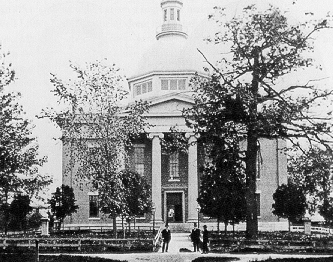
On June 17, 1873, Anthony, wearing a new bonnet faced
with
blue silk
and draped with a veil, walked up the steps of the Canandaigua
courthouse on the opening day of her
trial. The second-floor
courtroom was filled to capacity. The spectators
included a
former
president, Millard Fillmore, who had traveled over
from Buffalo, where
he practiced law. Judge Ward Hunt sat behind the
bench, looking
stolid
in his black broadcloth and neck wound in a white
neckcloth.
Anthony
described Hunt as "a small-brained, pale-faced,
prim-looking man,
enveloped
in a faultless black suit and a snowy white tie."
Richard Crowley made the opening
statement
for the prosecution:
We think, on the part of the Government,
that there
is no question
about it either one way or the other, neither a
question of fact, nor a
question of law, and that whatever Miss Anthony's
intentions may have
been-whether
they were good or otherwise-she did not have a right
to vote upon that
question, and if she did vote without having a lawful
right to vote,
then
there is no question but what she is guilty of
violating a law of the
United
States in that behalf enacted by the Congress of the
United States.
The prosecution's chief witness was Beverly W. Jones, a
twenty-five-year-old
inspector of elections. Jones
testified that he witnessed Anthony cast a ballot
on November 5 in
Rochester's Eighth Ward. Jones added he accepted
Anthony's
completed
ballot and placed it a ballot box. On
cross-examination, Selden
asked
Jones if he had also been present when Anthony
registered four days
earlier,
and whether objections to Anthony's registration had not
been
considered
and rejected at that time. Jones agreed that was
the case, and
that
Anthony's name had been added to the voting rolls.
The main factual argument that the defense hoped to
present
was that
Anthony reasonably believed that she was entitled to
vote, and
therefore
could not be guilty of the crime of "knowingly"
casting an illegal
vote.
To support this argument, Henry Selden called himself
as a witness to
testify:
Before the last
election,
Miss Anthony
called upon me for advice, upon the question whether
she was or was not
a legal voter. I examined the question, and gave her
my opinion,
unhesitatingly,
that the laws and Constitution of the United States,
authorized her to
vote, as well as they authorize any man to vote.
Selden then called Anthony as a
witness,
so she might
testify as to her vote and her state of mind on
Election Day.
District
Attorney Crowley objected: "She is not a competent as
a witness on her
own behalf." Judge Hunt sustained the objection,
barring Anthony
from taking the stand. The defense rested.
The prosecution called to the
stand
John Pound,
an Assistant United States Attorney who had attended
a January
examination
in which Anthony testified about her registration
and vote. Pound
testified that Anthony testified at that time
that she did not
consult
Selden until after registering to vote.
Selden, after conferring
with Anthony, agreed that their meeting took place
immediately after
her
registration, rather than before as his own
testimony had
suggested.
On cross-examination, Pound admitted that Anthony
had testified at her
examination that she had "not a particle" of doubt
about her right as a
citizen to vote. With Pound's dismissal from
the stand, the
evidence
closed and the legal arguments began.
Selden opened his
three-hour-long argument
for Anthony by stressing that she was
prosecuted purely on account
of her gender:
If the same act had
been done
by her
brother under the same circumstances, the act would
have been not only
innocent, but honorable and laudable; but having
been done by a woman
it
is said to be a crime. The crime therefore consists
not in the act
done,
but in the simple fact that the person doing it was
a woman and not a
man,
I believe this is the first instance in which a
woman has been
arraigned
in a criminal court, merely on account of her
sex....
Selden stressed that the vote was
essential to women
receiving fair treatment from legislatures: "Much has
been done, but
much
more remains to be done by women. If they had
possessed the elective
franchise,
the reforms which have cost them a quarter of a
century of labor would
have been accomplished in a year."
Central to Selden's argument
that
Anthony cast
a legal vote was the recently enacted Fourteenth
Amendment:
It will be seen,
therefore,
that the
whole subject, as to what should constitute the
"privileges and
immunities"
of the citizen being left to the States, no
question, such as we now
present,
could have arisen under the original constitution of
the United States.
But now, by the fourteenth amendment, the United
States have not only
declared
what constitutes citizenship, both in the United
States and in the
several
States, securing the rights of citizens to "all
persons born or
naturalized
in the United States;" but have absolutely
prohibited the States from
making
or enforcing " any law which shall abridge the
privileges or immunities
of citizens of the United States." By virtue
of this provision, I
insist that the act of Miss Anthony in voting was
lawful.
Finally, Selden insisted that even
if the
Fourteenth
Amendment did not make Anthony's vote legal, she could
not be
prosecuted
because she acted in the good faith belief that her
vote was
legal:
Miss Anthony believed,
and
was advised
that she had a right to vote. She may also have been
advised, as was
clearly
the fact, that the question as to her right could
not be brought before
the courts for trial, without her voting or offering
to vote, and if
either
was criminal, the one was as much so as the other.
Therefore she stands
now arraigned as a criminal, for taking the only
steps by which it was
possible to bring the great constitutional question
as to her right,
before
the tribunals of the country for adjudication. If
for thus acting, in
the
most perfect good faith, with motives as pure and
impulses as noble as
any which can find place in your honor's breast in
the administration
of
justice, she is by the laws of her country to be
condemned as a
criminal,
she must abide the consequences. Her condemnation,
however, under such
circumstances, would only add another most weighty
reason to those
which
I have already advanced, to show that women need the
aid of the ballot
for their protection.
After District Attorney Crowley
offered
his two-hour
response for the prosecution, Judge Hunt drew from his
pocket a paper
and
began reading an opinion that he had apparently
prepared before the
trial
started. Hunt declared, "The Fourteenth
Amendment gives no
right to a woman to vote, and the voting by Miss Anthony
was in
violation
of the law." The judge rejected Anthony's argument
that her good
faith precluded a finding that she "knowingly" cast an
illegal vote:
"Assuming
that Miss Anthony believed she had a right to vote, that
fact
constitutes
no defense if in truth she had not the right. She
voluntarily gave a
vote
which was illegal, and thus is subject to the penalty of
the
law."
Hunt then surprised Anthony and her attorney by
directing a verdict of
guilty: "Upon this evidence I suppose there is no
question for the jury
and that the jury should be directed to find a verdict
of guilty."
In her diary that night Anthony would angrily
describe the
trial as
"the greatest judicial outrage history has ever
recorded! We were
convicted
before we had a hearing and the trial was a mere
farce." During
the
entire trial, as Henry Selden pointed out, "No
juror spoke a word
during the trial, from the time they were impaneled to
the time they
were
discharged." Had the jurors had an opportunity
to speak, there is
reason to believe that Anthony would not have been
convicted. A
newspaper
quoted one juror as saying, "Could I have spoken, I
should have
answered
'not guilty,' and the men in the jury box would have
sustained me."
Sentencing
The next day Selden
argued for a new trial on the ground that
Anthony's constitutional
right to a trial by jury had been violated.
Judge Hunt promptly
denied
the motion. Then, before sentencing, Hunt asked,
"Has the
prisoner
anything to say why sentence shall not be
pronounced?" The
exchange
that followed stunned the crowd in the Canandaigua
courthouse:
"Yes, your honor, I have many things to say; for in
your
ordered verdict
of guilty, you have trampled under foot every vital
principle of our
government.
My natural rights, my civil rights, my political
rights, my judicial
rights,
are all alike ignored. Robbed of the fundamental
privilege of
citizenship,
I am degraded from the status of a citizen to that of
a subject; and
not
only myself individually, but all of my sex, are, by
your honor's
verdict,
doomed to political subjection under this, so-called,
form of
government."
Judge Hunt interrupted, "The Court cannot listen to a
rehearsal of arguments
the prisoner's counsel has already consumed three
hours in presenting."
But Anthony would not be deterred. She
continued, "May
it please
your honor, I am not arguing the question, but simply
stating the
reasons
why sentence cannot, in justice, be pronounced against
me. Your denial
of my citizen's right to vote, is the denial of my
right of consent as
one of the governed, the denial of my right of
representation as one of
the taxed, the denial of my right to a trial by a jury
of my peers as
an
offender against law, therefore, the denial of my
sacred rights to
life,
liberty, property and-"
"The Court cannot allow the prisoner to go on."
"But your honor will not deny me this one and only
poor
privilege of
protest against this high-handed outrage upon my
citizen's rights. May it please the Court to remember
that
since the day of my arrest last November, this is the
first time that
either
myself or any person of my disfranchised class has
been allowed a word
of defense before judge or jury-"
"The prisoner must sit down-the Court cannot allow
it."
"All of my prosecutors, from the eighth ward corner
grocery
politician,
who entered the compliant, to the United States
Marshal, Commissioner,
District Attorney, District Judge, your honor on the
bench, not one is
my peer, but each and all are my political sovereigns;
and had your
honor
submitted my case to the jury, as was clearly your
duty, even then I
should
have had just cause of protest, for not one of those
men was my peer;
but,
native or foreign born, white or black, rich or poor,
educated or
ignorant,
awake or asleep, sober or drunk, each and every man of
them was my
political
superior; hence, in no sense, my peer. Even, under
such circumstances,
a commoner of England, tried before a jury of Lords,
would have far
less
cause to complain than should I, a woman, tried before
a jury of men.
Even
my counsel, the Hon. Henry R. Selden, who has argued
my cause so ably,
so earnestly, so unanswerably before your honor, is my
political
sovereign.
Precisely as no disfranchised person is entitled to
sit upon a jury,
and
no woman is entitled to the franchise, so, none but a
regularly
admitted
lawyer is allowed to practice in the courts, and no
woman can gain
admission
to the bar-hence, jury, judge, counsel, must all be of
the superior
class.
"The Court must insist-the prisoner has been tried
according
to the
established forms of law."
"Yes, your honor, but by forms of law all made by
men,
interpreted by
men, administered by men, in favor of men, and against
women; and hence, your honor's ordered verdict of
guilty; against a United States citizen for the
exercise of "that
citizen's
right to vote," simply because that citizen was a
woman and not a man.
But, yesterday, the same man made forms of law,
declared it a crime
punishable
with $1,000 fine and six months imprisonment, for you,
or me, or you of
us, to give a cup of cold water, a crust of bread, or
a night's shelter
to a panting fugitive as he was tracking his way to
Canada. And every
man
or woman in whose veins coursed a drop of human
sympathy violated that
wicked law, reckless of consequences, and was
justified in so doing. As
then, the slaves who got their freedom must take it
over, or under, or
through the unjust forms of law, precisely so, now,
must women, to get
their right to a voice in this government, take it;
and I have taken
mine,
and mean to
take it at every possible opportunity."
"The Court orders the prisoner to sit down. It will
not
allow another
word."
"When I was brought before your honor for trial, I
hoped for
a broad
and liberal interpretation of the Constitution and its
recent
amendments,
that should declare...equality of rights the national
guarantee to all
persons born or naturalized in the United States. But
failing to get
this
justice-failing, even, to get a trial by a jury not of
my peers-I ask
not
leniency at your hands-but rather the full rigors of
the law--"
"The Court must insist-"
Finally, Anthony sat down, only to be immediately
ordered by
Judge Hunt
to rise again. Hunt pronounced sentence: "The
sentence of the
Court
is that you pay a fine of one hundred dollars and the
costs of the
prosecution."
Anthony protested. "May it please your honor, I shall
never
pay a dollar
of your unjust penalty. All the stock in trade I
possess is a $10,000
debt,
incurred by publishing my paper- The Revolution
-four years
ago,
the sole object of which was to educate all women to
do precisely as I
have done, rebel against your manmade, unjust,
unconstitutional forms
of
law, that tax, fine, imprison and hang women, while
they deny them the
right of representation in the government; and I shall
work on with
might
and main to pay every dollar of that honest debt, but
not a penny shall
go to this unjust claim. And I shall earnestly and
persistently
continue
to urge all women to the practical recognition of the
old revolutionary
maxim, that "Resistance to tyranny is obedience to
God."
Judge Hunt, in a move calculated to preclude any
appeal to a
higher
court, ended the trial by announcing, "Madam, the
Court will not order
you committed until the fine is paid."
Epilogue
True to her word, Anthony never paid a penny of her
fine. Her petition
to Congress to remit the fine was never acted
upon, but no serious
effort was ever made by the government to collect.
Anthony tried to turn her trial and conviction into
political gains
for the women suffrage movement. She ordered
3,000 copies of the trial
proceedings printed and distributed them to
political activists,
politicians,
and libraries. In the eyes of some, the trial
had elevated
Anthony
to the status of the martyr, while for others the
effect may have been
to diminish her status to that of a common
criminal. Many in the
press, however, saw Anthony as the ultimate
victor. One New York
paper observed, "If it is a mere question of who got
the best of it,
Miss
Anthony is still ahead. She has voted and the
American
constitution
has survived the shock. Fining her one hundred
dollars does not
rule
out the fact that...women voted, and went home, and
the world jogged on
as before."