×
Check-out the new Famous Trials website at www.famous-trials.com:
| 1837 - 1839: 25,000
Africans
brought to
Cuba as slaves.
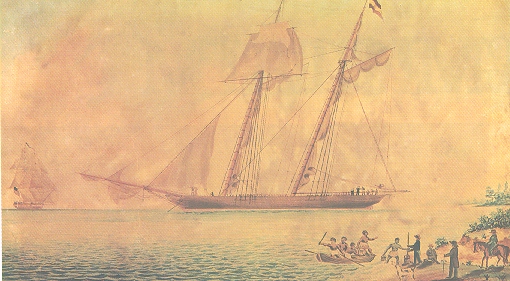
April 1839: Cinque captured by other Africans, taken to the slave factory in Lomboko and sold to a Portuguese slave trader. April - June 1839: Cinque and others resold to another slave trader and put aboard the Tecora which sailed to Cuba. June 1839: Cinque and others sold to Ruiz and Montes in Havana, Cuba. Amistad leaves Havana for Guanaja with slaves and owners. July 1839: Mutiny led by Cinque; Amistad's captain and cook killed while two crewmen escape; Africans control Amistad. July - August 1839: Amistad steered by Montes east by day and northwest by night, toward United States. August 1839: Amistad captured by crew of U.S.S. Washington off of Long Island, New York; Africans held and taken with Amistad to New London, Connecticut; Judicial hearing, presided over by Judge Judson, on the U.S. S. Washington; Africans await trial in a New Haven, Connecticut jail. September 1839: Lewis Tappan forms Friend of Amistad Africans Committee; Judge Thompson presides in Circuit Court hearing on Amistad criminal case; case dismissed by Judge Thompson for jurisdictional reasons; civil case left for District Court resolution. October 1839: Professor Josiah Gibbs locates interpreter, James Covey, and the Africans are able to tell their story; teaching Africans the English language and Christianity began; Cinque and others file charges of assault and false imprisonment against Ruiz and Montes. November 1839: District Court meets and postpones case. December 1839: Slave factory at Lomboko, Sierra Leone raided by British and all slaves there liberated. January 8, 1840: The Amistad civil trial begins in New Haven. January 15, 1840: Judge Hudson presiding in District Court rules the Africans are to be turned over to the President for return to Africa. August 1840: Africans taken to Westville. September 1840: Judge Thompson of the Circuit Court upholds District Court decision; government appeals to U.S. Supreme Court. October 1840: John Quincy Adams convinces to join Roger Baldwin in arguing the case for the Africans before the Supreme Court. Feb. - March 1841: Baldwin and Adams argue case before Supreme Court; Court orders Africans to be freed immediately. Mar. - Nov. 1841: Freed Africans go to Farmington for further English and religious education; local committee plans mission establishment in Africa. November 1841: African survivors leave with missionaries for Africa aboard Gentleman. January 1842: Arrive in Sierra Leone; mission experiences problems; many of the Africans abandon missionaries. 1846: Brother Raymond, founder of the mission in Sierra Leone dies of yellow fever and is replaced by George Thomas; 68 students attend the mission; efforts to compensate Spain for the Amistad are opposed in the House by John Quincy Adams. 1860: With the election of Abraham Lincoln as President, efforts to compensate Spain for the Amistad incident come to an end. 1879: Cinque, old and emaciated, comes to the mission to die and is buried among the graves of American missionaries. |