×
Check-out the new Famous Trials website at www.famous-trials.com:
LIZZIE BORDEN
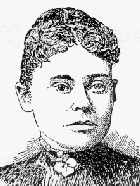 Lizzie was born on July 19, 1860. At the age of
two, she suffered
the loss of her mother. However, she remained close to her father.
Lizzie told many she had no memory of her mother. Her older sister,
Emma, appeared to be
the only constant in Lizzie's life. Emma was friend and mother to a
young
Lizzie.
Lizzie was born on July 19, 1860. At the age of
two, she suffered
the loss of her mother. However, she remained close to her father.
Lizzie told many she had no memory of her mother. Her older sister,
Emma, appeared to be
the only constant in Lizzie's life. Emma was friend and mother to a
young
Lizzie.
Lizzie knew her position in life and held it well. She was a typical high society young debutante. She belonged to numerous clubs. She was active member in her church. In all the organizations she participated in, Lizzie generally held a leadership role. She was often treasurer (because of her father's wealth) or secretary.
Despite her position, Lizzie remained unmarried. There are many reasons given for this. First, she was not a great beauty--some, unfairly perhaps, called her homely. Second, she resented her father and the fact that she was not allowed the great benefits of being well-to-do. She wanted money and the power, but her father would have none of that. Third, she was in an odd station in life. No suitor was acceptable. For those who would suit her station, she was unacceptable. Those who would have her, her father viewed as inferior and would chase them off as fortune hunters.
Lizzie was thrifty-two when the murders occurred. She inherited a substantial amount of money when she was found not guilty. After her acquittal, she fell into an unlikely circle of friends, primarily the theater and bohemian crowds. She spent many nights out with her friends spending her new found wealth at will.
Lizzie could not escape her famous name. She chose not to leave Fall River even though this might have allowed her some semblance of a normal life. Once in 1926, she entered a hospital and tried to use an alias. Everyone knew who she really was, but kept up the facade for her benefit.
Lizzie died in 1927. She planned her own
funeral, having left a list of those to be invited. When the guests
arrived,
they were told the funeral had taken place the night before. She left
her heirs
$225,000. She was buried with the rest of the family at Oak Grove
Cemetery in Fall River. On
her grave is the name "Lisbeth Andrews Borden."
ABBY DURFEE GRAY BORDEN
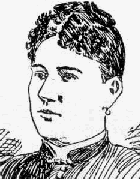 Abby Borden was the second wife to Andrew Borden.
She was 37 years
old and
considered to be an old maid when they married. Abby used the Durfee to
link her with one of the first families in the area. She desired
respect
and social status, but was often regarded as the daughter of a push
cart peddler: to marry someone of Andrew's station was unexpected. Many
at the time speculated
Andrew had proposed because he was looking for a housekeeper and a
someone
to raise his daughters.
Abby Borden was the second wife to Andrew Borden.
She was 37 years
old and
considered to be an old maid when they married. Abby used the Durfee to
link her with one of the first families in the area. She desired
respect
and social status, but was often regarded as the daughter of a push
cart peddler: to marry someone of Andrew's station was unexpected. Many
at the time speculated
Andrew had proposed because he was looking for a housekeeper and a
someone
to raise his daughters.
The relationship between Abby and her stepdaughter Lizzie remains something of a mystery. There is no documentary evidence of abuse or neglect. Several persons, however, including prosecution witnesses in the murder trial, reported that the relationship was less than loving. Many believe Lizzie killed Abby because she hated her, then felt that she had no choice but to also kill her father, who would know the truth.
Killed by 18 whacks (not
40 as the children's song goes), Abby's body was found in the second
floor
guest room, her body in an unusual position. Her skull, cleaned of
blood
and matter, was used as evidence at the trial. It showed a huge section
missing.
ANDREW JACKSON
BORDEN
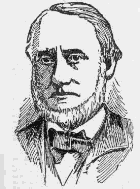 Andrew Borden was an
eighth generation high society man. He had been
married twice. His first wife was Sarah Morse. Together they had three
daughters. The middle child, Alice, died at the age of two. He married
Abby Durgee Gray two years after Sarah died. Mr. Borden was the
President
of a major bank in his hometown of Fall Rivers, owned substantial
property,
was the director of three major cloth mills, and was very wealthy.
Andrew Borden was an
eighth generation high society man. He had been
married twice. His first wife was Sarah Morse. Together they had three
daughters. The middle child, Alice, died at the age of two. He married
Abby Durgee Gray two years after Sarah died. Mr. Borden was the
President
of a major bank in his hometown of Fall Rivers, owned substantial
property,
was the director of three major cloth mills, and was very wealthy.
Andrew's father was one of the few Borden men who had not retained the wealth associated with the family. His father was a fish peddler. Andrew, not wanting to follow in his father's footsteps, began as a carpenter's helper. Eventually, he became a partner with Frank Almy in a casket company. They sold Crane's Patented Casket Burial Cases.
Mr. Borden was known for his clothing. Summer or Winter he could be
seen in his black, double-breasted Prince Albert and string tie. He was
also known for his love of money. He was well on his way to becoming a
millionaire. He worked 14-hour days. He was known to be somewhat of a
tight-wad.
One of his prize properties was nearing completion the day he was
brutally murdered. In downtown Fall River, it stands
as the A.J. Borden Building.
EMMA LENORE BORDEN
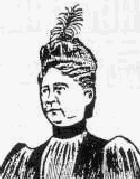 Born on March 1, 1851, Emma was the oldest of three
daughters born
to
Sarah and Andrew Borden. When Sarah died, Emma was 12.
Born on March 1, 1851, Emma was the oldest of three
daughters born
to
Sarah and Andrew Borden. When Sarah died, Emma was 12.
Emma was not home when her father and stepmother were murdered. There are several accounts of where she was. One account has her off with a suitor. The story goes that she was in love with a man beneath her station. They desired to be wed, but her father was opposed. The real story seems to be that she was off visiting some friends. She was notified by telegram by a family friend.
Some accounts have Emma as the real murderess, but there is virtually no evidence to support this theory. Unlike Lizzie, Emma never appeared unhappy about her life. She seemed to take things as they came. There is little knowledge of who Emma Borden really was. There are no records of her education, love life, etc. There are even few pictures of her.
Emma remained a supporter and friend to Lizzie. When Lizzie was charged with the murders, Emma became the sole heir to the Borden fortune. (Despite rumors that Andrew had a will, none was ever found). She used the funds from the fortune to help Lizzie in her quest for innocence. On the day Lizzie died, Emma, living a reclusive life in New Hampshire, fell and broke her hip. She died 12 days later.
When she died, Emma was worth $450,000. She left most of this to
charity.
She is buried with the rest of the Borden family in Fall River.
BRIDGET SULLIVAN
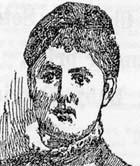 Bridget
emigrated from Ireland in 1883. She came to the Borden family
six years later as their live-in maid. No one is sure how old she was
the day of the Borden murders, but it is estimated that she was in her
mid-20's. Bridget
was in and around the Borden home on August 4, 1892. She was washing
windows (despite experiencing the stomach flu), as Mrs. Borden
had ordered her to do that morning.
Bridget
emigrated from Ireland in 1883. She came to the Borden family
six years later as their live-in maid. No one is sure how old she was
the day of the Borden murders, but it is estimated that she was in her
mid-20's. Bridget
was in and around the Borden home on August 4, 1892. She was washing
windows (despite experiencing the stomach flu), as Mrs. Borden
had ordered her to do that morning.
Some people have speculated that Bridget was Lizzie's accomplice in
the murders. How
else, proponents of this theory suggest, would Bridget not have heard
anything that fateful day? She did hear
a noise at one time. She went to the stairs to investigate and assumed
it was Lizzie.
Bridget took the stand at every phase of the trial. Her testimony neither helped nor hurt Lizzie. She always seemed, to most observers, to be truthful to the best of her knowledge.
One legend has Bridget being paid off by Lizzie and returning to
Ireland.
However, she remained in the US and spent her later years leading a
modest life in Montana..
JOHN VINNICUM MORSE
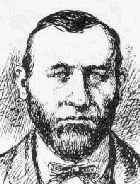 John was the brother of Andrew's first wife (Lizzie
and Emma's
mother).
He appeared to be the only true friend Andrew had in life. The two men
were always
quite close. They had, at one point, gone into the casket making
business
together. However, the business relationship ended when John chose to
move
west on the advise of Horace Greeley. He first settled in Illinois and
then moved to Iowa, where he lived for twenty-five years as
a horse breeder.
John was the brother of Andrew's first wife (Lizzie
and Emma's
mother).
He appeared to be the only true friend Andrew had in life. The two men
were always
quite close. They had, at one point, gone into the casket making
business
together. However, the business relationship ended when John chose to
move
west on the advise of Horace Greeley. He first settled in Illinois and
then moved to Iowa, where he lived for twenty-five years as
a horse breeder.
Initial speculation centered on Morse as a prime suspect in the
Borden murders. After all,
he had arrived in town the day before the murder carrying few
possessions. It seemed odd to many that he would come so far to
visit a family for an undetermined amount
of time with so little. And there was never any real reason for why he
chose to visit.
Morse, however, was identified in town at the time of the murders,
ending speculation that he and Lizzie were having an incestuous
affair--and
that he was the mastermind of the murder plot.
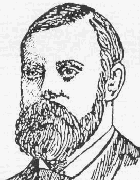 Hosea Knowlton, forty-six at the time,
was the lead prosecutor in the Borden trial. He was a well respected
attorney in Massachusetts and had a lengthy history of public
service,including fourteen years as the county
district attorney. Knowlton also had a separate career as a
statesman,
serving as a state representative and senator. In addition to his job
as a district attorney,
Knowlton was a partner in a large New Bedford law firm. He delivered
the closing
argument and was responsible for conducting most of the substantive
trial matters.
Hosea Knowlton, forty-six at the time,
was the lead prosecutor in the Borden trial. He was a well respected
attorney in Massachusetts and had a lengthy history of public
service,including fourteen years as the county
district attorney. Knowlton also had a separate career as a
statesman,
serving as a state representative and senator. In addition to his job
as a district attorney,
Knowlton was a partner in a large New Bedford law firm. He delivered
the closing
argument and was responsible for conducting most of the substantive
trial matters.
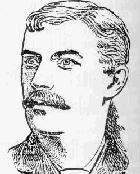 William Moody was the second chair on the
Borden trial. He was forty when the
Borden trial took place, making him the youngest attorney in the entire
trial. He was a
relatively inexperienced attorney in the role of prosecutor compared to
his co-counsel. He was a district attorney for Essex County for two
years, but had managed to develop a
reputation as a diligent attorney and spent a good deal of time
carefully preparing
pleadings in the Borden case. He delivered the prosecution's opening
statement and
conducted limited questioning of a few witnesses.
William Moody was the second chair on the
Borden trial. He was forty when the
Borden trial took place, making him the youngest attorney in the entire
trial. He was a
relatively inexperienced attorney in the role of prosecutor compared to
his co-counsel. He was a district attorney for Essex County for two
years, but had managed to develop a
reputation as a diligent attorney and spent a good deal of time
carefully preparing
pleadings in the Borden case. He delivered the prosecution's opening
statement and
conducted limited questioning of a few witnesses.
GEORGE ROBINSON
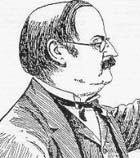 George Robinson was the lead defense counsel in the case. Robinson was
the most notable figure in the entire trial. He was fifty-nine years
of age when he tried the Lizzie Borden case. He was known throughout
Massachusetts as a
political leader. He was the Governor of Massachuset from 1884-1886. He
was elected as
a representative in the United States Congress for four terms. His
involvement in the case
came as a result of contact with Andrew Jennings and pressure from the
interest groups. Robinson handled virtually all
defense trial matters in the Borden case.
George Robinson was the lead defense counsel in the case. Robinson was
the most notable figure in the entire trial. He was fifty-nine years
of age when he tried the Lizzie Borden case. He was known throughout
Massachusetts as a
political leader. He was the Governor of Massachuset from 1884-1886. He
was elected as
a representative in the United States Congress for four terms. His
involvement in the case
came as a result of contact with Andrew Jennings and pressure from the
interest groups. Robinson handled virtually all
defense trial matters in the Borden case.
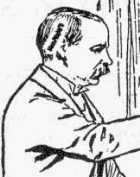 Andrew Jennings was the Borden family attorney
who
had been the first defense
attorney involved in the Borden case. He persuaded George Robinson to
assume the leadership position for the defense of Lizzie. He was a
passive player during the trial, with the exception of his delivery of
an opening
statement. His prior legal work for the Bordens had been predominantly
transactional
work, and his experience in criminal matters was modest.
Andrew Jennings was the Borden family attorney
who
had been the first defense
attorney involved in the Borden case. He persuaded George Robinson to
assume the leadership position for the defense of Lizzie. He was a
passive player during the trial, with the exception of his delivery of
an opening
statement. His prior legal work for the Bordens had been predominantly
transactional
work, and his experience in criminal matters was modest.