×
Check-out the new Famous Trials website at www.famous-trials.com:
From
William Bligh's A Voyage to the
South Sea Undertaken by
Command of His Majesty for the Purpose of
Conveying the Bread-Fruit
Tree to the West Indies, in His Majesty's Ship
the Bounty, Commanded by
Lieutenant William Bligh (1792). The
object of all the former
voyages to the South Seas, undertaken by the
command of his present
majesty, has been the advancement of science, and
the increase of
knowledge. This voyage may be reckoned the first,
the intention of
which has been to derive benefit from those
distant discoveries. For
the more fully comprehending the nature and plan
of the expedition, and
that the reader may be possessed of every
information necessary for
entering on the following sheets, I shall here lay
before him a copy of
the instructions I received from the admiralty,
and likewise a short
description of the bread-fruit. By the Commissioners
for executing the
office of Lord High Admiral WHEREAS
the king, upon a
representation from the merchants and planters
interested in his
majesty's West India possessions that the
introduction of the
bread-fruit tree into the islands of those seas,
to constitute an
article of food, would be of very essential
benefit to the inhabitants,
hath, in order to promote the interests of so
respectable a body of his
subjects (especially in an instance which promises
general advantage)
thought fit that measures should be taken for the
procuring some of
those trees, and conveying them to the said West
India islands: And
whereas the vessel under your command hath, in
consequence thereof,
been stored and victualled for that service, and
fitted with proper
conveniences and necessaries for the preservation
of as many of the
said trees as, from her size, can be taken on
board her; and you have
been directed to receive on board her the two
gardeners named in the
margin [David Nelson, William Brown.], who, from
their knowledge of
trees and plants, have been hired for the purpose
of selecting such as
shall appear to be of a proper species and size: You are,
therefore, in
pursuance of his majesty's pleasure, signified to
us by Lord Sydney,
one of his principal secretaries of state, hereby
required and directed
to put to sea in the vessel you command, the first
favourable
opportunity of wind and weather, and proceed with
her, as expeditiously
as possible, round Cape Horn, to the Society
Islands, situate in the
Southern ocean, in the latitude of about eighteen
degrees South, and
longitude of about two hundred and ten degrees
East from Greenwich,
where, according to the accounts given by the late
Capt. Cook, and
persons who accompanied him during his voyages,
the bread-fruit tree is
to be found in the most luxuriant state. Having
arrived at the
above-mentioned islands, and taken on board as
many trees and plants as
may be thought necessary (the better to enable you
to do which, you
have already been furnished with such articles of
merchandize and
trinkets as it is supposed will be wanted to
satisfy the natives) you
are to proceed from thence through Endeavour
Streights (which separate
New Holland from New Guinea) to Prince's Island,
in the Streights of
Sunda, or, if it should happen to be more
convenient, to pass on the
eastern side of Java to some port on the north
side of that island,
where any breadfruit trees which may have been
injured, or have died,
may be replaced by mangos teens, duriens, jacks,
nancas, lansas, and
other fine fruit trees of that quarter, as well as
the rice plant which
grows upon dry land; all of which species (or such
of them as shall be
judged most eligible) you are to purchase on the
best terms you can
from the inhabitants of that island, with the
ducats with which you
have also been furnished for that purpose; taking
care, however, if the
rice plants above-mentioned cannot be procured at
Java, to touch at
Prince's Island for them, where they are regularly
cultivated. From
Prince's Island, or the
Island of Java, you are to proceed round the Cape
of Good Hope to the
West Indies (calling on your way thither at any
places which may be
thought necessary) and deposit one half of such of
the above-mentioned
trees and plants as may be then alive at his
majesty's botanical garden
at St. Vincent, for the benefit of the Windward
Islands, and then go on
to Jamaica: and, having delivered the remainder to
Mr. East, or such
person or persons as may be authorized by the
governor and council of
that island to receive them; refreshed your
people, and received on
board such provisions and stores as may be
necessary for the voyage,
make the best of your way back to England;
repairing to Spithead, and
sending to our secretary an account of your
arrival and proceedings. And
whereas you will receive
herewith a copy of the instructions which have
been given to the
above-mentioned gardeners for their guidance, as
well in procuring the
said trees and plants, and the management of them
after they shall be
put on board, as for bringing to England a small
sample of each
species, and such others as may be prepared by the
superintendant of
the botanical garden at St. Vincent's, and by the
said Mr. East, or
others, for his majesty's garden at Kew; you are
hereby required and
directed to afford, and to give directions to your
officers and company
to afford, the said gardeners every possible aid
and assistance, not
only in the collecting of the said trees and
plants at the places
before-mentioned, but for their preservation
during their conveyance to
the places of their destination. Given
under our hands the
20th November 1787. HOWE, To
Lieut. Wm
Bligh, commanding By command of their
Lordships, In the
foregoing orders it
is to be observed, that I was particularly
directed to proceed round
Cape Horn; but, as the season was so far advanced,
and we were so long
detained by contrary winds, I made application to
the Admiralty for
discretional orders on that point; to which I
received the following
answer: By the Commissioners for
executing
the office of Lord High Admiral THE
season of the year being
now so far advanced as to render it probable, that
your arrival, with
the vessel you command, on the
southern coast of America,
will be too late for your passing round Cape Horn
without much
difficulty and hazard; you are, in that case, at
liberty
(notwithstanding former orders) to proceed in her
to Otaheite, round
the Cape of Good Hope. Given
under our hands the
18th December 1787. To Lieut. Wm Bligh, commanding By
command of their
Lordships, THE
BREAD-FRUIT is so well
known and described, that to attempt a new account
of it would be
unnecessary and useless. However, as it may
contribute to the
convenience of the reader, I have given the
following extracts
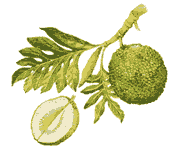
respecting it, with the plate annexed.
Breadfruit
sections Extract from the
account of Dampier's
Voyage round the world, performed in 1688. THE
bread-fruit (as we call
it) grows on a large tree, as big and high as our
largest apple-trees:
It hath a spreading head, full of branches and
dark leaves. The fruit
grows on the boughs like apples; it is as big as a
penny-loaf when
wheat is at five shillings the bushel; it is of a
round shape, and hath
a thick tough rind. When the fruit is ripe, it is
yellow and soft, and
the taste is sweet and pleasant. The natives of
Guam use it for bread.
They gather it, when full-grown, while it is green
and hard; then they
bake it in an oven, which scorcheth the rind and
makes it black; but
they scrape off the outside black crust, and there
remains a tender
thin crust; and the inside is soft, tender, and
white like the crumb of
a penny-loaf. There is neither seed nor stone
in the inside,
but all is of a pure substance, like bread. It
must be eaten new; for,
if it is kept above twenty-four hours, it grows
harsh and choaky; but
it is very pleasant before it is too stale. This
fruit lasts in season eight
months in the year, during which the natives
eat no other sort
of food of bread kind. I did never see of
this fruit any where but
here. The natives told us, that there is plenty of
this fruit growing
on the rest of the Ladrone islands: and I did
never hear of it any
where else. Extract from the
account of Lord Anson's
Voyage, THERE
was, at Tinian, a kind
of fruit, peculiar to these (Ladrone) is lands,
called by the Indians rhymay,
but by us the bread-fruit; for it was
constantly eaten by us,
during our stay upon the island,':- instead of
bread; and so universally
preferred, that no ship's bread was expended
in that whole
interval. It grew upon a tree which is somewhat
lofty, and which
towards the top divides into large and spreading
branches. The leaves
of this tree are of a remarkable deep green, are
notched about the
edges, and are generally from a foot to eighteen
inches in length. The
fruit itself is found indifferently on all parts
of the branches; it
is, in shape, rather elliptical than round; it is
covered with a tough
rind, and is usually seven or eight inches long;
each of them grows
singly, and not in clusters. This fruit is fittest
to be used when it
is full-grown, but still green; in which state,
after it is properly
prepared by being roasted in the embers, its taste
has some distant
resemblance to that of an artichoke's bottom, and
its texture is not
very different, for it is soft and spungy. Extracts from the
account of the first
Voyage of Captain Cook. IN THE SOCIETY ISLANDS. THE
bread-fruit grows on a
tree that is about the size of a middling oak; its
leaves are
frequently a foot and a half long, of an oblong
shape, deeply sinuated
like those of the fig-tree, which they resemble in
consistence and
colour, and in the exuding of a white milky juice
upon being broken.
The fruit is about the size and shape of a child's
head, and the
surface is reticulated not much unlike a truffle:
it is covered with a
thin skin, and has a core about as big as the
handle of a small knife.
The eatable part lies between the skin and the
core; it is as white as
snow, and somewhat of the consistence of new
bread: it must be roasted
before it is eaten, being first divided into three
or four parts. Its
taste is insipid, with a slight sweetness somewhat
resembling that of
the crumb of wheaten bread mixed with a Jerusalem
artichoke. OF the
many vegetables that
have been mentioned already as serving them for
food, the principal is
the bread-fruit, to procure which costs them no
trouble or labour but
climbing a tree. The tree which produces it does
not indeed shoot up
spontaneously; but, if a man plants ten of them in
his life-time, which
he may do in about an hour, he will as completely
fulfil his duty to
his own and future generations as the native of
our less temperate
climate can do by ploughing in the cold winter,
and reaping in the
summer's heat, as often as these seasons return;
even if, after he has
procured bread for his present household, he
should convert a surplus
into money, and lay it up for his children. It is
true, indeed, that the
bread-fruit is not always in season; but
cocoa-nuts, bananas,
plantains, and a great variety of other fruits,
supply the deficiency. Extract
from the account of
Captain Cook's last Voyage. IN THE SOCIETY ISLANDS. I
(Captain Cook) have
inquired very carefully into their manner of
cultivating the
bread-fruit tree at Otaheite; but was always
answered, that they never
planted it. This, indeed, must be evident to
everyone who will examine
the places where the young trees come up. It will
be always observed,
that they spring from the roots of the old ones,
which run along near
the surface of the ground. So that the bread fruit
trees may be
reckoned those that would naturally cover the
plains, even supposing
that the island was not inhabited; in the same
manner that the
white-barked trees, found at Van Diemen's Land,
constitute the forests
there. And from this we may observe, that the
inhabitant of Otaheite,
instead of being obliged to plant his bread, will
rather be under the
necessity of preventing its progress; which, I
suppose, is sometimes
done, to give room for trees of another sort, to
afford him some
variety in his food. IN THE
SANDWICH ISLANDS.
THE
bread-fruit trees are
planted, and flourish with great luxuriance, on
rising grounds.-Where
the hills rise almost perpendicularly in a great
variety of peaked
forms, their steep sides and the deep chasms
between them are covered
with trees, amongst which those of the bread-fruit
were observed
particularly to abound. Vol. III. p. 105 and 114,
containing Captain
King's Narrative. THE
climate of the Sandwich
Islands differs very little from that of the West
India Islands, which
lie in the same latitude. Upon the whole, perhaps,
it may be rather
more temperate. THE
bread-fruit trees thrive
in these islands, not in such abundance, but
produce double the
quantity of fruit they do on the rich plains of
Otaheite. The trees are
nearly of the same height, but the branches begin
to strike out from
the trunk much lower, and with greater
luxuriance. The
natives reckon eight
kinds of the bread-fruit tree, each of which they
distinguish by a
different name. 1. Patteah. 2. Eroroo. 3. Awanna.
4. Mi-re. 5. Oree. 6.
Powerro. 7. Appeere. 8. Rowdeeah. In the first,
fourth, and eighth
class, the leaf differs from the rest; the fourth
is more sinuated; the
eighth has a large broad leaf, not at all
sinuated. The difference of
the fruit is principally in the first and eighth
class. In the first,
the fruit is rather larger and more of an oblong
form: in the eighth,
it is round and not above half the size of the
others. I enquired if
plants could be produced from the seed, and was
told they could not,
but that they must be taken from the root. The
plants are best
collected after wet weather, at which time the
earth balls round the
roots, and they are not liable to suffer by being
moved. THE BOUNTY MUTINEERS TRIAL HOMEPAGE |