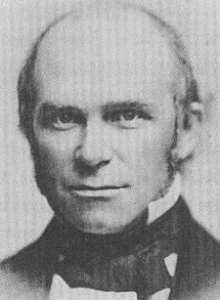
Dr. Samuel
Gridley
Howe
Boston
physician
Samuel Howe joined his wife, Julia Ward Howe
(famous for her Battle Hymn of the Republic,
based
on the tune about "the body of John Brown lies
a-moulderin' in the
grave") in championing social reforms from
better treatment for the
disabled to the abolition of slavery.
Howe disapproved of Brown's
raid of Missouri slave farms, and had only
mild enthusiasm for his
Harper's Ferry venture. After Brown was
arrested at Harper's
Ferry, Howe published a disclaimer
and fled the country.
|
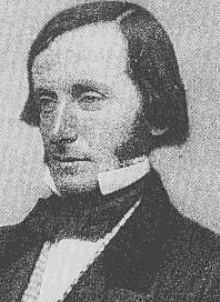
Thomas
Wentworth
Higginson
Higginson, a
Worchester, Massachusetts Unitarian minister
and devout
Transcendentalist, was an antislavery
disunionist and among Brown's
strongest backers. Higginson wrote
Brown, "I have perfect
confidence in you. All you do will be
well done."
Higginson counted among his best friends Henry
David Thoreau and Amos Alcott, the father of
Louisa May. He has
been described by historian David Reynolds in
his book
John Brown Abolitionist as "the
most radical member of the Secret Six, urging
Brown to launch the
Virginia plan early and publicly announcing
his support of Brown after
the raid failed." When he learned that
other members of the
Secret Six were abandoning Brown after his
arrest, Higginson wrote
Sanborn, "Is there no such thing as honor
among confederates?"
One historian described Higginson
as
"perhaps the most radical man in America"
during the Civil War era.
|
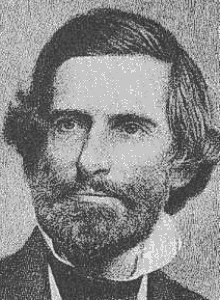
Theodore Parker
Liberal
Transcendentalist Boston minister Theodore
Parker was a strong
supporter of Slave revolts, women's rights,
temperance, and prison
reform. His radicalism fueled by
enactment of the Fugitive Slave
Act, Parker participated in attempted
rescues of fugitive slaves and
formed a vigilance committee in Boston to
fight those seeking to
capture fugitive slaves. Parker wrote
at the time of the Harper's
Ferry attack, "One held against his will as
a slave has a natural right
to kill everyone who seeks to prevent his
enjoyment of liberty."
|
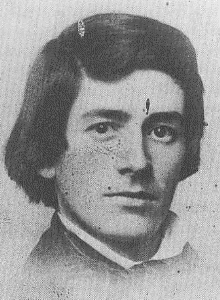
Franklin
Sanborn
Concord
resident
and Harvard-educated intellectual Franklin
Sanborn served as the
secretary of the Massachusetts State
Kansas Committee and ran a school (Ralph Waldo
Emerson's kids were
among his students) while only in his
mid-twenties. Sanborn first
provided money, arms, and books for
Brown's activities in Kansas, then later at
Harper's Ferry.
Sanborn, who saw Brown as "an unmixed Puritan
breed," introduced him to
two other members of the Secret Six, Parker
and Higginson. He
also arranged for Brown to make a plea for
financial support directly
to the Massachusetts legislature, but a bill
to aid the Kansas
antislavery efforts failed.
In 1885, Sanborn published The Life
and Letters of John Brown.
|
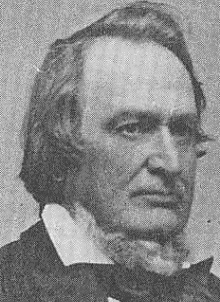
Gerrit Smith
Millionaire
antislavery philanthropist Gerrit Smith of
Peterboro, New York was the
first member of the Secret Six to meet
Brown. Smith, the only
member of the Six not to share
Transcendentalist leanings, vacillated
between supporting peaceful nonresistance to
slavery and Brown-style
militance. In 1859, he provided $700 to
aid Brown's plans, after
Brown's successful slave raid in
Missouri. Smith said, "I
was once doubtful in my own mind as to Captain
Brown's course. I
now approve of it heartily." Following Brown's
arrest at Harper's
Ferry, Smith destroyed his documents that
could link him to
Brown. He became so fearful
that his connections to Brown would be exposed
that he spent time in a
lunatic asylum.
|
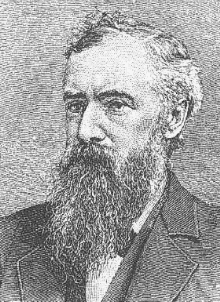
George
Luther
Stearns
When
President of the
Massachusetts Kansas Committee George Stearns
met Brown in the office of
his Boston factory, the two took to each other
"like the iron and the
magnet," according to Stearns's son.
(Brown's autobiographical
letter to Stearns's twelve-year-old son Henry
makes for compelling
reading.) Stearns became the chief
contributor of both funds and
arms to Brown.
Following Brown's capture, Stearns fled to
Canada, where he remained
until after Brown's execution. Steans
said, "I consider it the
proudest act of my
life that I gave good old John Brown every
pike and rifle he carried to
Harper's Ferry."
During the Civil War, Stearns led the effort
to recruit black soldiers
for the Union Army. On January 1, 1863,
Stearns hosted "the John
Brown party" to celebrate
the Emancipation Proclamation, issued that
afternoon by President
Lincoln. He later helped establish the
Freedmen's Bureau and
played a major role in the fight to win for
freed slaves the right to
vote.
|