|
The
question of school-sponsored prayer has proven
highly controversial. In the landmark case
of Engel v Vitale in 1962, the Court ruled
that New York's practice of beginning school days
with a prayer drafted by school officials violated
the Establishment Clause. This is the case,
the Court said, whether or not students are given
the option of not participating in the
prayer. Writing for the Court, Justice Black
said the Establishment Clause was violated when
school put "indirect coercive pressure upon
religious minorities to conform to the officially
approved religion." Peer pressure being as
strong as it is among the young, many students who
might otherwise choose not to participate in
prayer will do so for fear of otherwise
being seeing as an oddball. Engel dealt
with an officially approved prayer, not the
question of whether school officials could set
aside time for voluntary silent prayer. That
issue arose in the 1985 case of Wallace v Jaffree.
Alabama had for some time authorized schools to
dedicate part of the school day for "a period of
silence for meditation." The
period-of-silence law almost certainly did not
offend the First Amendment because it did not
endorse religious reflection over other types of
reflection, be they philosophical or
personal. Not satisfied, it seems, with how
students might be using their period of silence,
Alabama legislators amended the statute to provide
for a "period of silence for meditation or silent
prayer." The sponsor of the legislation
frankly stated that the purpose of his amendment
was to get more kids to use their time to recite
prayers. In Wallace, the Court, voting 5 to
4, held that the amendment to the Alabama
moment-of-silence law lacked
a secular purpose and struck it down.
Lee v Weisman
(1992) considered school prayer in the special
context of a graduation ceremony for a middle
school. The principal of the school had
invited a clergyman to offer an invocation and
benediction at the ceremony, and that decision was
challenged by Weisman, who contended that the
practice violated Establishment Clause
precedents. Again voting 5 to 4, with
Justice Kennedy providing the key vote, the Court
found the invocation and benediction to violate
the First Amendment. Kennedy found an
unacceptable degree of coercion, given the fact
that the ceremony was an important milestone that
students would be extremely reluctant to avoid
because of religious scruples. The options
of remaining seated during prayers or leaving
right before the benediction did not seem
realistic under the circumstances. Justice
Scalia, in a passionate dissent, ridiculed
Kennedy's opinion as a "psycho journey" and wrote
that he would not find a problem with prayer at
graduation ceremonies unless the state attached a
penalty to non-participation. Until
very recently, the Court demonstrated a
willingness to strike down any practices that
might be likely to be perceived either as coercive
or as a state endorsement of religion. That
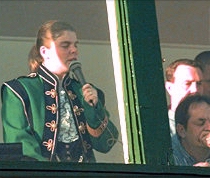
trend continued with the Court's Santa Fe v Doe
decision in 2000, which considered the policy of a
Texas school district that allowed students to
elect students to speak briefly over the PA system
before high school football games.
Traditionally, the speeches were religious in
character--the policy stated that the speeches
should solemnize the event and be nonsectarian in
nature. The Court found the Santa Fe school
policy to be a violation of the Establishment
Clause. The Court reasoned that the speeches
were at a school-sponsored event, using school
facilities, and would be taken by most observers
as a school endorsement of the student prayers
that were likely to be delivered. The
election process ensured, the Court thought, that
the religious messages would reflect the religious
views of the majority of Students, who in the case
were generally Fundamentalist Christians.
The three dissenters argued that the school policy
was neutral on its face and not a constitutional
violation. Nothing in the school policy, the
dissenters said, even required that the message be
religious in nature. In
2022, a newly emboldened conservative Court, by a
6 to 3 vote, ditched the "perceived endorsement"
and "indirect coercion" tests that had been
decisive in previous decisions striking down
prayer practices in public schools. In Kennedy
v Bremerton School District, the
Court considered a case involving a high school
football coach with a practice of praying at the
50-yard line following games, usually joined by a
number of players on the team. Players were
not asked to pray and there was no evidence that
non-praying players were treated differently than
those who did. The Court found that the
School District's decision to fire the coach
because of his practice of praying on the field
violated his Free Exercise rights, and that the
school district's argument that the action was
necessary to avoid an Establishment Clause
violation was without merit. Because no
direct coercion was involved, the Court said, the
private decision of the coach to pray, even if
some players might have perceived some pressure to
join in, did not violate the Establishment
Clause. Nor did it matter that some fans in
the stands might have assumed, incorrectly, that
the school district was endorsing the coach's
prayer.
|
Engel v Vitale (1962) Wallace v Jaffree (1985) Lee v Weisman (1992) Santa Fe Indep. School Dist. v Doe (2000) Kennedy v Bremerton School District (2022) 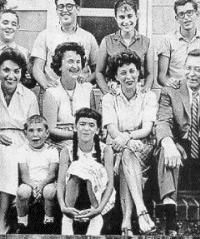 Happy members of the group that challenged New York's daily prayer in Engel v Vitale.
Questions 2. Why worry about voluntary--as opposed to mandatory--prayer? How much harm is suffered by those who must choose to opt out of prayer? 3. Is it constitutional for a teacher to tell students, in the absence of any official school policy, "Now, children, we will have two minutes for either silent meditation or prayer"? 4. Does standing for a prayer send a message that the person standing supports the prayer? Would Lee v Weisman have been decidedly differently if the principal expressly stated that those who might wish to stand for a prayer could do so? 5. What do you think about Justice Scalia's characterization of Justice Kennedy's opinion in Lee v Weisman as "a psycho-journey"? Is the Court well-equipped to draw the sort of psychological conclusions that it did in that case? 6. How
important is the history of the policy involved in
the Santa Fe case--especially the fact that the
initial policy specifically referred to "prayer"
before the football games?
7. Is it a violation of the Establishment Clause for a football coach at a public university to lead a voluntary prayer for players before the game? 8. Is it permissible for a group of players, on their own, to gather in a lockerroom before the game and pray? 9. Is it permissible for members of the crowd at a football game to plan to sing hymms and recite prayers before a football game? Does it become a constitutional violation if a school official, using the PA system, decides on his own to join the crowd in their hymm-singing and prayer?
|