×
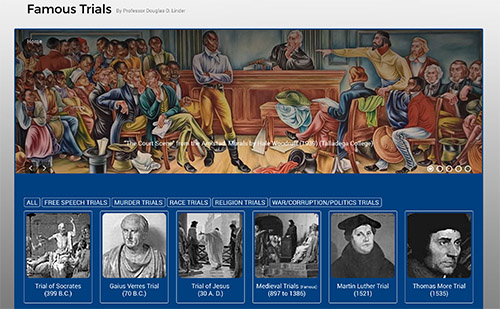
Check-out the new Famous Trials website at www.famous-trials.com:
 In
1994, James
Goodman’s much acclaimed book, Stories of Scottsboro, was
published.
Civil war historian James McPherson said about the book that Goodman
had
invented “a new way of writing history.” Although a slight
exaggeration,
Goodman did not use a standard narrative format for the telling of his
tale. Instead, his book tells the stories of various trial
participants, each from his (or her) own perspective. Goodman writes,
"I
have struggled to be true to my sources." The new approach
worked.
The reader is left to sort out contradictions and inconsistencies, but
the challenge absorbs and reminds us that historical truth is
often
unknowable. Goodman's own views, of course, are not entirely
hidden.
His ordering of the accounts, choice of whose accounts to include, and
development of central themes leaves unmistakable his belief that the
tragedy
of Scottsboro grew out of the "poisonous idea" that black men are
rapists.
Goodman's book has been called “well written and
kaleidoscopic"
and “a superb retelling of this vital episode.” In addition to
earning
him praise form the critics, Goodman’s book also earned him a position
as a finalist for a Pulitzer Prize in history.
In
1994, James
Goodman’s much acclaimed book, Stories of Scottsboro, was
published.
Civil war historian James McPherson said about the book that Goodman
had
invented “a new way of writing history.” Although a slight
exaggeration,
Goodman did not use a standard narrative format for the telling of his
tale. Instead, his book tells the stories of various trial
participants, each from his (or her) own perspective. Goodman writes,
"I
have struggled to be true to my sources." The new approach
worked.
The reader is left to sort out contradictions and inconsistencies, but
the challenge absorbs and reminds us that historical truth is
often
unknowable. Goodman's own views, of course, are not entirely
hidden.
His ordering of the accounts, choice of whose accounts to include, and
development of central themes leaves unmistakable his belief that the
tragedy
of Scottsboro grew out of the "poisonous idea" that black men are
rapists.
Goodman's book has been called “well written and
kaleidoscopic"
and “a superb retelling of this vital episode.” In addition to
earning
him praise form the critics, Goodman’s book also earned him a position
as a finalist for a Pulitzer Prize in history.
James Goodman is a professor of history at Rutgers University.