|
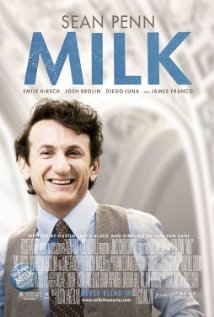
Milk (2008)
Directed by Gus Van Sant
Written by Dustin Lance Black
(Won the
Oscar for Best Original Screenplay)
128 Minutes
(R)
|
Images
Cast
Sean
Penn
|
Harvey
Milk
|
Josh
Brolin
|
Dan White
|
Emile
Hirsch
|
Cleve
Jones
|
Victor
Garber
|
Mayor
Moscone
|
Alison
Pill
|
Anne
Kronenberg
|
Joseph
Cross
|
Dick
Pabich |
Ashlee
Temple
|
Dianne
Feinstein
|
Wendy
Tremont King
|
Carol
Ruth Silver
|
Kevin
Han Yee
|
Gordon
Lau
|
Diego
Luna
|
Jack Lira
|
James
Franco
|
Scott
Smith
|
Denis
O'Hare
|
John
Briggs
|
Stephen
Spinella
|
Rick
Stokes
|
Lucas
Grabeel
|
Danny
Nicoletta
|
Brandon
Boyce
|
Jim
Rivaldo
|
Howard
Rosenman
|
David
Goodstein
|
Kelvin Yu
|
Michael
Wong
|
Jeff
Koons
|
Art Agnos
|
Ted Jan
Roberts
|
Dennis
Peron
|
Carol
Ruth Silver
|
Thelma
|
Tom
Ammiano
|
Himself
|
Boyd
Holbrook
|
Denton
Smith
|
Reviews
Roger Ebert: 
Gus Van Sant's film
begins with Harvey Milk at 48, reflecting into his tape recorder about
a personal journey that began at 40. At that watershed age, he grew
unsatisfied with his life and decided he wanted to really do
something. A researcher at Bache & Co. and a Goldwater Republican,
Milk became involved with a hippie theater company in Greenwich Village
and began to edge the closet door ajar and wave out tentatively.
Milk
didn't enter politics as much as he was pushed in by the evidence of
his own eyes. He ran for the Board of Supervisors three times before
being elected in 1977. He campaigned for a gay rights ordinance. He
organized. He acquired a personal bullhorn and stood on a box labeled
"SOAP."
His most
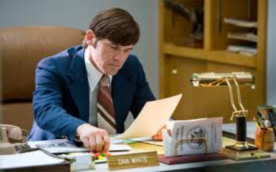
fateful relationship was with Dan
White, a seemingly straight member of the Board of Supervisors, a
Catholic who said homosexuality was a sin and campaigned with his wife,
kids and the American flag.
"Milk" tells Harvey Milk's story as one of a
transformed life, a victory for individual freedom over state
persecution, and a political and social cause. There is a remarkable
shot near the end, showing a candlelight march reaching as far as the
eyes can see. This is actual footage. It is emotionally devastating.
And it comes as the result of one man's decisions in life.
|
Mick LaSalle, San Francisco Chronicle
With "Milk," a
great San Francisco story becomes a great American story.
Director Gus
Van Sant uses the account of one of the country's first openly gay
public officials, who was assassinated in 1978, to invest the gay
rights movement with mythic grandeur, as a successor to all the heroic
social protest movements in American history. Van Sant's point of view
may be a matter of politics, outside the scope of a review, but his
success in putting over his point of view is a question of art.
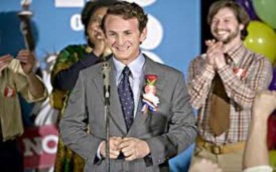
Penn gives us a man who was
once closeted and now, as if in response, lives his life completely in
the open. He's spontaneous as Penn has never been spontaneous. He's
emotional, vulnerable and generous with his laughter. Penn plays him as
an utterly liberated man . . .
Van Sant mixes archival
footage with new footage - at times, it's impossible to tell one from
the other - and it's fascinating to see San Francisco in the '70s.
There's color and beauty, but also coarseness; excitement and hope, but
with a feeling that something - or everything - just might spin out of
control.
One truth "Milk" doesn't need
to amplify or manipulate: It's that Harvey Milk's story is part of the
San Francisco story, and that story still means something. . .
|
A. O. Scott, The New York Times
One of the first scenes in "Milk" is of a pick-up in a New York subway
station. It’s 1970, and an insurance executive in a suit and tie
catches sight of a beautiful, scruffy younger man — the phrase
“angel-headed hipster” comes to mind — and banters with him on the
stairs.
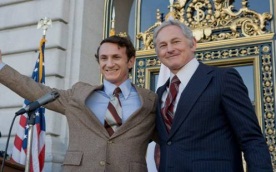
That would be Harvey
Milk (played by Sean
Penn), a neighborhood activist elected to the San Francisco Board
of Supervisors in 1977 and murdered, along with the city’s mayor,
George Moscone (Victor Garber), by a former supervisor named Dan White (Josh
Brolin) the next year. Notwithstanding the modesty of his office
and the tragic foreshortening of his tenure, Milk, among the first
openly gay elected officials in the country, had a profound impact on
national politics, and his rich afterlife in American culture has
affirmed his status as pioneer and martyr.
For more than two lively, eventful hours, “Milk”
conforms to many of the conventions of biographical filmmaking, if not
always to the precise details of the hero’s biography. Milk’s
inexhaustible political commitment takes its toll on his relationships,
first with Scott and then with Jack Lira, an impulsive, unstable young
man played by Diego
Luna with an operatic verve that stops just short of camp.
Dan White, Milk’s erstwhile colleague and eventual
assassin, haunts the edges of the movie, representing both the banality
and the enigma of evil. Mr. Brolin makes him seem at once pitiable and
scary without making him look like a monster or a clown. Motives for
White’s crime are suggested in the film, but too neat an accounting of
them would distort the awful truth of the story and undermine the power
of the movie.
That power lies in its uncanny balancing of nuance and
scale, its ability to be about nearly everything — love, death,
politics, sex, modernity — without losing sight of the intimate
particulars of its story. Harvey Milk was an intriguing, inspiring
figure. “Milk” is a marvel.
This page was created by Kaitlin Woody
|
|