×
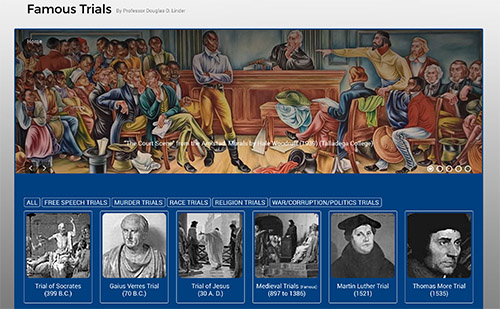
Check-out the new Famous Trials website at www.famous-trials.com:
|
The Constitution,
Article II, Section 4:
The Constitution,
Article I, Section 3:
Judgment in Cases of Impeachments shall not extend further
than to
removal from Office, and disqualification to hold and enjoy any Office
of honor, Trust, or Profit under the United States, but the Party
convicted
shall nevertheless be liable and subject to Indictment, Trial,
Judgment,
and Punishmnet, according to Law. The Framers'
Debates on the Impeachment Provisions
(from the notes of James Madison, taken at the Constitutional Convention in Philadelphia, 1787): Saturday, June 2 Mr. Dickenson moved "that the Executive be made removeable bv the National Legislature on the request of a rnajority of the Legislatures of individual States." It was necessary he said to place the power of removing somewhere. He did not like the plan of impeaching the Great officers of State. He did not know how provision could be made for removal of them in a better mode than that which he had proposed. He had no idea of abolishing the State Governments as some gentlemen seemed inclined to do. The happiness of this Country in his opinion required considerable powers to be left in the hands of the States. Mr. Bedford seconded the motion. Mr. Sherman contended that the National Legislature should have power to remove the Executive at pleasure. Mr. Mason. Some mode of displacing an unfit magistrate is rendered indispensable by the fallibility of those who choose, as well as by the corruptibility of the man chosen . He opposed decidedly the making the Executive the mere creature of the Legislature as a violation of the fundamental principle of good Government. Mr. Madison & Mr. Wilson observed that it would leave an equality of agency in the small with the great States; that it would enable a minority of the people to prevent ye. removal of an officer who had rendered himself justly criminal in the eyes of a majority; that it would open a door for intrigues agst. him in States where his administration tho' just might be unpopular, and might tempt him to pay court to particular States whose leading parfizans he might fear, or wish to engage as his partisans. They both thought it bad policy to introduce such a mixture of the State authorities, where their agency could be otherwise supplied. . . . . . On Mr. Dickenson's motion for making
Executive
removeable by Natl.; Legislature at request of majority of
State Legislatures was also rejected--all the States being in the
negative Except Delaware which gave an
affirmative vote.
Friday, July 20 "to be removeable on impeachment and conviction for mal practice or neglect of duty." see Resol: 9 Mr. Pinkney & Mr. Govr. Morris moved to strike out this part of the Resolution. Mr. P. observd. he ought not to be impeachable whilst in office Mr. Davie. If he be not impeachable whilst in office, he will spare no efforts or means whatever to get himself re-elected. He considered this as an essential security for the good behaviour of the Executive. Mr. Wilson concurred in the necessity of making the Executive impeachable whilst in office. Mr. Govr. Morris. He can do no criminal act without Coadjutors who mav be punished. In case he should be re-elected, that will be sufficient proof of his innocence. Besides who is to impeach? Is the impeachment to suspend his functions. If it is not the mischief will go on. If it is the impeachment will be nearly equivalent to a displacement, and will render the Executive dependent on those who are to impeach Col. Mason. No point is of more importance than
that
the right of impeachment should be continued. Shall any
man be above justice? Above all shall that man be above it,
who can commit the most extensive injusfice? When
great crimes were committed he was for punishing the principal as
well as the Coadjutors. There had been much
debate & difficulty as to the mode of chusing the Executive.
He approved of that which had been adopted at first,
namely of referring the appointment to the Natl.
Legislature.
One objection agst. Electors was the danger of their
being corrupted by the Candidates; & this furnished a peculiar
reason in favor of impeachments whilst in office.
Docr. Franklin was for retaining the clause as favorable
to
the Executive. History furnishes one example only of
a first Magistrate being formally brought to public Justice.
Every body cried out agst. this as unconstitutional.
What was the practice before this in cases where the chief Magistrate
rendered himself obnoxious? Why recourse
was had to assassination in wch. he was not only deprived of his
life but of the opportunity of vindicating his
character. It wd. be the best way therefore to provide in
the Constitution for the regular punishment of the
Executive where his misconduct should deserve it, and for his honorable
acquittal when he should be unjustly
Mr. Govr. Morris admits corruption & some few other offences to be such as ought to be impeachable; but thought the cases ought to be enumerated & defined: Mr. Madison thought it indispensable that some provision should be made for defending the Communi ty agst. the incapacity, negligence or perfidy of the chief Magistrate. The imitation of the period of his service, was not a sufficient security. He might lose his capacity after his appointment. He might pervert his administration into a scheme of peculation or oppression. He might betrav his trust to foreign powers. The case of the Executive Magistracy was very distinguishable, from that of the Legislature or of any other public body, holding offices of limited duration. It could not be presumed that all or even a majority of the members of an Assembly would either lose their capacity for discharging, or be bribed to betray, their trust. Besides the restraints of their personal integrity & honor, the difficulty of acting in concert for purposes of corruption was a security to the public. And if one or a few members only should be seduced, the soundness of the remaining members, would maintain the integrity and fidelity of the body. In the case of the Executive Magistracy which was to be administered by a single man, loss of capacity or corruption was more within the compass of probable events, and either of them might be fatal to the Republic. Mr. Pinkney did not see the necessity of impeachments. He was sure they ought not to issue from the Legislature who would in that case hold them as a rod over the Executive and by that means effectually destroy his independence. His revisionary power in particular would be rendered altogether insignificant. Mr. Gerry urged the necessity of impeachments. A good magistrate will not fear them. A bad one ought to be kept in fear of them. He hoped the maxim would never be adopted here that the chief magistrate could do no wrong. Mr. King expressed his apprehensions that an extreme
caution
in favor of liberty might enervate the Government
we were forming. He wished the House to recur to the primitive
axiom that the three great departments of Govts.
should be separate & independent: that the Executive &
judiciary
should be so as well as the Legislative: that the
executive should be so equaliv with the Judiciary. Would this
be the case, if the Executive should be impeachable?
Mr. Randolph. The propriety of impeachments was a
favorite
principle with him. Guilt wherever found ought to be
punished. The Executive will have great opportunitys of abusing
his power; particularly in time of war when the
military force, and in some respects the public money will be in
his hands. Should no regular punishment be
provided, it will be irregularly inflicted by tumults &
insurrecfions.
He is aware of the necessity of proceeding with
a cautious hand, and of excluding as much as possible the influence
of the Legislature from the business. He
suggested for consideration an idea which had fallen [from Col
Hamilton]
of composing a forum out of the Judges
Doctr. Franklin mentioned the case of the Prince of
Orange
during the late war. An agreement was made between
France & Holland; bv which their two fleets were to unite at
a certain time & place. The Dutch fleet did not
appear. Every body began to wonder at it. At length
it was suspected that the Statholder was at the bottom of the
matter. This suspicion prevailed more & more. Yet
as he could not be impeached and no regular examination took
place, he remained in his office, and strengthening his own party,
as the party opposed to him became formidable,
he gave birth to the most violent animosities & contentions.
Had he been impeachable, a regular & peaceable
Mr. King remarked that the case of the Statholder was not applicable. He held his place for life, and was not periodically elected. In the former case impeachments are proper to secure good behaviour. In the latter they are unnecessary; the periodical responsibility to the electors being an equivalent security. Mr. Wilson observed that if the idea were to be pursued, the Senators who are to hold their places during the same term with the Executive, ought to be subject to impeachment & removal. Mr. Pinkney apprehended that some gentlemen reasoned on a supposition that the Executive was to have powers which would not be committed to him: He presumed that his powers would be so circumscribed as to render impeachments unnecessary. Mr. Govr. Morris's opinion had been changed by the arguments used in the discussion. He was now sensible of the necessity of impeachments, if the Executive was to continue for any time in office. Our Executive was not like a Magistrate having a life interest, much less like one having an hereditary interest in his office. He may be bribed bv a greater interest to betray his trust; and no one would say that we ought to expose ourselves to the danger of seeing the first Magistrate in forign pay, without being able to guard agst. it by displacing him. One would think the King of England well secured agst. bribery. He has as it were a fee simple in the whole Kingdom. Yet Charles II was bribed by Louis XIV. The Executive ought therefore to be impeachable for treachery; Corrupting his electors, and incapacity were other causes of impeachment. For the latter he should be punished not as a man, but as an officer, and punished oniv by degradation from his office. This Magistrate is not the King but the prime-Minister. The people are the King. When we make him amenable to Justice however we should take care to provide some mode that will not make him dependent on the Legislature. It was moved & 2ded. to postpone the question of impeachments which was negatived. Mas. & S. Carolina only being ay. On ye. Question, Shall the Executive
be
removeable on impeachments &c.?
Saturday, September 8 The clause referring to the Senate, the trial of impeachments agst. the President, for Treason & bribery, was taken up. Col. Mason. Why is the provision restrained to Treason & bribery only? Treason as defined in the Constitution will not reach many great and dangerous offences. Hastings is not guilty of Treason. Attempts to subvert the Constitution may not be Treason as above defined. As bills of attainder which have saved the British Constitution are forbidden, it is the more necessary to extend: the power of impeachments. He movd. to add after "bribery" "or maladministration." Mr. Gerry seconded him. Mr. Madison So vague a term will be equivalent to a tenure during pleasure of the Senate. Mr. Govr. Morris, it will not be put in force & can do no harm. An election of very four years will prevent maladministration. Col. Mason withdrew "maladministration" & substitutes "other high crimes & misdemesnors agst. the State" On the question thus altered
Daniel Farber and Suzanna Sherry, in their book
A History
of the American Constitution (1990), report the final developments
at the Convention that led to the final language found in the
Constitution: |