|
"Innumerable suns exist; innumerable
earths revolve around these suns in a manner similar
to the way the seven planets revolve around our
sun. Living beings inhabit these worlds."
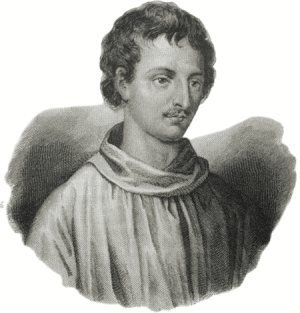
"An academician belonging to no academy",
an unfrocked monk, an excommunicated Calvinist, an
expelled Lutheran, an avant-garde and marginal
philosopher, a forgotten genius of the Renaissance
- Giordano Bruno was also an inspired magus.
http://www.bruno-giordano.net/
Brief
Biography from The Galileo Project : http://galileo.rice.edu/chr/bruno.html
Giordano Bruno: Italian philosopher original
name Filippo Bruno, byname Il
Nolano born 1548, Nola, near Naples died Feb. 17, 1600, Rome. Encyclopedia Britannica
Online. http://www.britannica.com/EBchecked/topic/82258/Giordano-Bruno
Procedure
of the Roman Inquisition: It was
strict Holy Office practice to keep detailed records
of all its proceedings from the first summons to the
final sentencing. This was intended to discourage the
inclination to ask leading questions which would
suggest to the accused how they should reply. A
permanent member of every court of inquisition was the
Notary, who took down in writing every question and
every answer, including the exclamations of pain
emitted by the victims of torture. Each official took
a solemn vow of secrecy, held interrogations in strict
privacy, and carefully guarded the records of trial
proceedings. There were several reasons for this.
First, witnesses had to be protected from possible
retaliation by the family and friends of the accused.
Second, once a defendant named his accomplices, the
Holy Office might have to move swiftly to bring them
into custody. If word leaked out to them before they
could be apprehended, the system would not be very
effective. Third, the reputation of the accused had to
be protected. It was often reiterated that inquisitors
should act cautiously when making an arrest. http://galileo.rice.edu/lib/student_work/trial96/loftis/procedure.html
1592 – 1600 From the Trial to
the Stake: Giordano's
trial lasted almost eight years. The Inquisition
initially accused him for his anti-dogmatic ideals,
which had already cost him his Dominican habit. As an
anti-Trinitarian, the philosopher rejected the
virginity of Mary and transubstantiation. His
reflections in terms of cosmology, his rejection of
geocentrism and his attraction for magic gradually
gave rise to an impressive list of accusations. In the
end, it was the whole of his freethinking that was
challenged. In February
1593, Bruno was incarcerated in the prisons of the
Holy Office. The trial dragged on for another two
years before the decision was taken to conduct an
in-depth study of his works, which were censured and
subsequently burned at St Peter's Square.
From his cell, Bruno finished writing a statement for
his defence and presented his final plea on 20
December 1594 before the Holy Office.
The trial was interrupted for six months,
during which time Bruno continued to actively defend
his theory on infinite worlds, sometimes stating that
he was ready to recant, and at other times declaring
that he was faithful to his ideas. Cardinal Bellarmin
therefore drew up a list of the theories deemed to be
heretical, over which Bruno again hesitated before
categorically refusing to renounce his doctrine: The
eight propositions that the philosopher refused to
renounce were as follows:
1 - The statement of "two
real and eternal principles of existence: the soul of
the world and the original matter from which beings
are derived".
2 -
The doctrine of the infinite universe and infinite
worlds in conflict with the idea of Creation:
"He who denies the infinite effect denies the infinite
power".
3 -
The idea that every reality resides in the eternal and
infinite soul of the world, including the body: "There
is no reality that is not accompanied by a spirit and an
intelligence".
4 -
The argument according to which "there is no
transformation in the substance", since the substance is
eternal and generates nothing, but transforms.
5 -
The idea of terrestrial movement, which according to
Bruno, did not oppose the Holy Scriptures, which were
popularised for the faithful and did not apply to
scientists.
6 -
The designation of stars as "messengers and interpreters
of the ways of God".
7 -
The allocation of a "both sensory and intellectual"
soul to earth.
8 -
The opposition to the doctrine of St Thomas on the
soul, the spiritual reality held captive in the
body and not considered as the form of the human body.
None of these final
accusations tied in with the philosopher's magic
reflections. Nevertheless, the Inquisition accused him
of having turned towards hermetism and the arcane,
branding him a sorcerer for having written in On
Heroic Frenzies that "Magi can accomplish more
using the faith than doctors using the ways of
liberty" and for recognising magic as beneficial and
lawful. Whatever the case, on 20 January 1600, Pope
Clement VIII declared that the accused was
"an unrepentant heretic, tenacious and stubborn".
Taken to the secular arm, Cardinal Madruzzi pronounced
the sentence on 8 February. Giordano Bruno was burnt
at the stake in Campo dei Fiori in Rome
around 10 days later. Defiant to the very end, Bruno
looked away from the crucifix before perishing in the
flames. http://www.bruno-giordano.net/bio.html
Summary of
the Trial Against Giordano Bruno, Rome 1597:
From the Vatican
Archives.
In one of the volumes of the
“Miscellanea Armadi” (Arm. X, 205) by the
famous canonist Francisco Peña, Auditor and then
Dean of the Rota, there is a precious document, searched
for a long time, then kept secret for a long time and
finally found on the 15th November 1940 after
15 years of unsuccessful investigation by the Prefect of
the Vatican Archives, Angelo Mercati: the summary of the
trial against Giordano Bruno. The
human vicissitudes of Giordano Bruno ended with the
Roman trial (1593-1600) and with the sentence of proven
heresy, which, due to his resolute and extreme statement
of not being guilty, changed into capital punishment,
executed at Campo de’ Fiori on the 17th
February 1600. In one of the last interrogations before
the execution of the sentence (maybe in April 1599), the
Dominican friar was questioned by the judges of the Holy
Office on his cosmogony conception, supported above all
in the “La cena delle Ceneri”(Ash-Wednesday Dinner) and
in the “De l’infinito universo et mundi”. Even then, he
defended his theories as scientifically founded and by
no means against the Holy Scriptures.
http://asv.vatican.va/en/doc/1597.htm#top
The Folly of Giordano Bruno
: by
Prof. Richard W. Pogge, Ohio State
University
In popular accounts of the life of
Bruno, it is often said that he was condemned for his
Copernicanism and his belief in life on other worlds. He
is portrayed as a martyr to free thought, and an early,
prosecuted proponent of the modern view of the universe,
hounded across Europe
by the Inquisition for his beliefs and finally paying
the ultimate price for them in a fiery public death. The
one key fact of the study of Bruno's life is that we do
not actually know the exact grounds of his conviction on
charges of heresy. The simple reason is that the
relevant records have been lost. The second often
overlooked fact of Bruno's life concerns his period of
exile between 1576 and 1591. Most brief popular accounts
state the bare facts of his peregrinations around
Europe, but what is left unsaid is that his wanderings
appear to have had less to do with his being hounded by
the Inquisition as it did with his own rather difficult
personality. http://www.setileague.org/editor/brunoalt.htm
The
Catholic Encyclopedia: Bruno’s system of thought is
an incoherent materialistic pantheism. God and the world
are one; matter and spirit, body and soul, are two
phases of the same substance; the universe is infinite;
beyond the visible world there is an infinity of other
worlds, each of which is inhabited; this terrestrial
globe has a soul; in fact, each and every part of it,
mineral as well as plant and animal, is animated; all
matter is made up of the same elements (no distinction
between terrestrial and celestial matter); all souls are
akin (transmigration is, therefore, not impossible).
This unitary point of view is Bruno's justification of
"natural magic." No doubt, the attempt to establish a
scientific continuity among all the phenomena of nature
is an important manifestation of the modern spirit, and
interesting, especially on account of its appearance at
the moment when the medieval point of view was being
abandoned. (Turner, W.
(1908). Giordano Bruno. In The Catholic Encyclopedia. New York:
Robert Appleton Company. Retrieved
February
12, 2009 from New Advent: http://www.newadvent.org/cathen/03016a.htm)
Great
Theosophists - Giordano Bruno:
http://www.blavatsky.net/magazine/theosophy/ww/setting/bruno.html
Ingrid
Rowland's Giordano Bruno: Philosopher/Heretic is an excellent starting point for
anyone who wants to rediscover the historical figure
concealed beneath a cowl on Campo de' Fiori. Her
lively and learned biography removes Bruno from myth
and polemic, where he has so often resided, and
restores him to the time and place that inspired his
dual passion for knowledge as well as faith. She also
offers a far richer and multidimensional account of
Bruno's peculiar and complex intellectual itinerary
than earlier scholars like Frances Yates, who, in her
brilliant and influential account Giordano Bruno
and the Hermetic Tradition (1964), depicted him
as a great Renaissance magus. She inspired a
generation of readers to see him primarily as a
Hermetic philosopher devoted to the restoration of
Egyptian wisdom. Generously acknowledging the more
recent work of Bruno specialists like Hilary Gatti,
who have shown us how to read his politics,
philosophy, science, plays and poetry seriously,
Rowland describes how Bruno became the kind of person
who fascinated and alarmed virtually everybody who
came into contact with him. She takes us inside his
head to see the interplay of theology, philosophy and
poetry that shaped his worldview. From
A
Hungry Mind: Giordano Bruno, Philosopher and Heretic
in The Nation at: http://www.thenation.com/doc/20080929/findlen
Bibliotheca Bruniana Electronica/ The
Complete Works of Giordano Bruno:
All texts in pdf with extensive
biographies and other studies. http://warburg.sas.ac.uk/mnemosyne/Bruno/index.html
Additional
Reading:
Blackwell, Richard and de Lucca
Robert, eds., 1998, Giordano Bruno: Cause, Principle
and Unity and Essays on Magic (Cambridge
University Press).
Broderick, James,
1961, Robert Bellarmine, Saint and Scholar
(Westminster,
MD.:
Newman Press)
Bruno, Giordanao (translation by Arthur Imerti, 1964),
The Expulsion of the Triumphant Beast (University
of Nebraska Press).
di Santillana,
Giorgio, 1955, The Crime of Galileo (Chicago: Univ. of Chicago Press)
Gatti, Hilary, 2010, Essays on Giordano Bruno.
Riehl, Agnes, 1889, Giordano Bruno: In Memoriam of
the 17th February 1600 (translation by Agnes Fry,
1900).
Rowland, Ingrid D., 2008, Giordano Bruno:
Philosopher/Heretic (University of Chicago Press).
Singer, Dorothea
Waley, 1950, Giordano Bruno, his Life and
Thought. (New York:
Schuman) [contains an annotated translation of On
the Infinite Universe and Worlds]
White, Andrew Dickson,
1896, The Warfare of Science with Theology in
Christendom (New York: D.
Appleton & Company), 1978 reprint.
Yates, Frances, 1964, Giordano
Bruno and the Hermetic Tradition (Chicago: Univ. of Chicago
Press)
A number of Bruno's
writings (most in Latin) are now available at the
Twilit Grotto
-- Esoteric Archives, including De
Umbris
Idearum ("The
Shadow of Ideas"), Ars
Memoriae ("Art
of Memory"), De
Gli Eroici Furori
("The Heroic Frenzies"), Cantus
Circaeus ("Incantations
of Circe"), De
Magia, Theses
De
Magia, Magia
Mathematica and
De
Vinculiss in Genere. http://www.historyguide.org/intellect/bruno.html
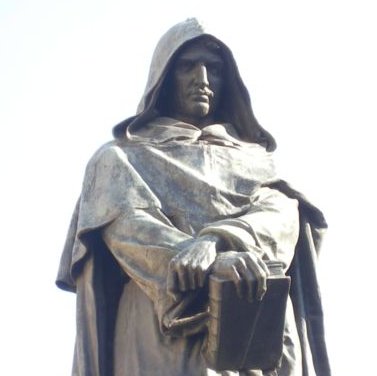
The statue of Giordano Bruno, unveiled on
24 June 1899 despite objections from Pope
Leo XIII, still adorns the Campo dei Fiori in Rome
to this very day.
|