×
Check-out the new Famous Trials website at www.famous-trials.com:
IN THE UNITED
STATES DISTRICT COURT FOR THE WESTERN DISTRICT OF
)
Plaintiff,)
) vs.
) Case No. M-95-98-H
) TIMOTHY JAMES McVEIGH,
)
)
Defendant.) you that there
is a little bird family that is in this area. We have had
the best minds in the institution to check it out, but they are
chirping. And they have advised us to
leave them alone, and
that's what we are going to do. You will
hear a little noise
so don't worry about it.
I would like to introduce you to my staff that is here: My clerk is
Bill French seated to my left; law clerks Dale Kelly and Lynn
Burch seated to my right.
Also present to my left over there behind that bench is pre-trial
services officer Marcy Gray. Court
reporters Hilton and Charyse Crawford are to my right.
I would like Counsel who are present to introduce themselves,
beginning with the Counsel for the
MR. GARLAND: Your Honor, my
name is Merrick Garland. I am an
Associate Deputy Attorney General.
MS. JOPLIN: Arlene Joplin,
Western District of
THE COURT: And Counsel for
the defendant?
MR. COYLE: Judge, I am John
W. Coyle, and I represent the accused,
and I would ask the Court if the handcuffs could be removed
during this hearing.
THE COURT: I am sorry?
MR. COYLE: If his handcuffs
could be removed during the hearing.
THE COURT: I have told the
marshal's office that is a matter within
their discretion at this time.
MR. COYLE: Would the Court
inquire of the marshals if they could
remove them? There are about forty guards,
seems like, in the
room, if we could have them removed for the hearing.
THE COURT: If the marshals
indicated that he should be cuffed, he
should stay cuffed. That will be it.
Anything else?
MS. OTTO: Susan Otto, Federal
Public Defender. I am also here to
represent Mr. McVeigh. Also with me at
counsel table, Mr.
Kevin McNally. Mr. McNally is here in his
capacity as attorney
for the Death Penalty Resource Counsel Center which is under the
auspices of the United States Courts.
THE COURT: Anyone else? I believe also present, entering an
appearance early this morning, Paul Looney and J. Brent Liedtke from Houston, possibly
privately-retained counsel for the
Defendant.
I appreciate very much the arrangements that have been made for this
room to serve as a courtroom. The Court has found that
under circumstances, unusual circumstances, that existed in the
federal courtroom in downtown federal
courthouse, the reconstruction and other clean-up operations
that are going on there, as well as the security and safety of all
persons concerned, that we should conduct this hearing in
this room.
In that regard I wanted to especially thank Warden R. G. Thompson and
his staff, as well as United States Marshal Pat Wilkerson.
At this time I am going to ask that counsel confer after the Court
makes a statement and a record regarding what has transpired
basically since he initially appeared last Friday, and especially
with regard to defense counsel.
As the defendant knows, at the time of the initial appearance
last Friday at Tinker Air Force Base, that Mr. Coyle and Ms. Otto
were appointed as counsel to represent the Defendant,
both highly qualified and skilled attorneys.
I was not aware that there was any problem in connection with their
representation until Monday, when motions were filed indicating
that counsel desired to withdraw.
After carefully considering those motions, the Court entered an
order which temporarily, at least, overruled those motions
counsel then would -- Ms. Otto and Mr. Coyle would continue to
represent the Defendant, and they are serving in that capacity
here today.
They are very fine professional lawyers and I perceive no problem with
their representation of the Defendant in connection
with these proceedings, although they -- one or more of them may be
granted permission to withdraw.
The Court's appointment of counsel is made under statutory provisions
that provides that two counsel, two attorneys, shall be appointed
for any person that may be charged with a death penalty
offense, and those attorneys are required to have certain skills
and certain experience. And I wanted the
record to show that
since that hearing, and since I learned that a motion had
been filed by the initial attorneys the Court had appointed,
that the Federal Public Defender's Office, under the statute, has
been conducting a nationwide search, in effect, to determine what
counsel might be available to replace Mr. Coyle and Ms. Otto,
if that is actually necessary.
Circumstances may have changed and this situation is developing as
we continue the hearing today. So we had
that survey
conducted and we had some recommendations of very fine attorneys that
might replace those initial attorneys if that is necessary.
And I am telling, making this statement because it's necessary for
the Court to exercise oversight in connection with the
Counsel who represent a person who is indigent. The Court understands the Defendant is
indigent. I made that initial
appointment on that basis, and in contrast to that,
privately-retained Counsel may appear, assuming that either the
Defendant, or if the Defendant is indigent, friends or relatives
of the Defendant, may be able to employ counsel, and that
situation has occurred just in the last, really in the last few hours.
I wasn't aware until yesterday afternoon sometime that Mr. Looney or
Mr. Liedtke might be interested in
entering an appearance and
represent the Defendant in this case. And
all this other has
been going on at the same time.
We have been doing a survey to determine what substitute Counsel might
be appointed by the Court, and later then learned that Mr.
Looney and Mr. Liedtke might represent the
Defendant also.
I think the attorneys have conferred some about this. I would like, if
it's necessary, to have a further conference before we
proceed with this hearing, between the attorneys, both
privately-retained counsel and court-appointed counsel, to determine who
should appropriately represent the Defendant in connection
with this proceeding.
Obviously, this requires some conferencing with the Defendant and
answering of any of his questions that he might have. I wanted the record to show what has happened
since the Counsel was
appointed because I didn't have much opportunity to explain that
on Friday evening when we had the hearing at Tinker. Does anyone want to address that issue at this
time?
MR. LOONEY: Yes.
THE COURT: Yes, sir, Mr.
Looney.
MR. LOONEY: Your Honor, if I
may be heard on that issue. I believe it's in the best interest of the
Defendant to go forward
with the team at the table.
THE COURT: All right, sir.
MR. LOONEY: At this time. The conferences have been had and that
is the desire of the Defendant, and in my opinion in the best
interest of the Defendant.
THE COURT: Anyone else want
to speak to that issue? If not, then
we will not take the recess and we will proceed with the
hearing.
Is there any statements that need to be made before we proceed with
the evidence in this case?
MR. GARLAND: Your Honor, if
the Defendant could state on the record
that he is satisfied with going forward with Counsel for
this hearing.
THE COURT: I will ask if the
defendant has any questions
about the matters of the counsel, any additional questions that
need to be asked, and certainly I will try to ask those.
MR. COYLE: He will stand
moot, Judge.
THE COURT: If there are no
further questions, I will proceed on
preliminary hearing and combined detention hearing in case No.
CR-95-98, James McVeigh.
MS. OTTO: Your Honor, if I
may?
THE COURT: Yes, Ms. Otto.
MS. OTTO: I received the
Court's order denying our request for
transfer of this case yesterday.
THE COURT: I am sorry, the
what?
MS. OTTO: I am sorry. Perhaps if I can step to the center it
would be easier and I could get over the bird noise.
THE COURT: The birds are
chirping away.
MS. OTTO: I might have to
chirp a little more loudly than they do.
Your Honor, I received a copy of the Court's order yesterday
denying our request for appointment of substitute counsel, and
in the same order our motion to transfer this case was denied,
and based on --
THE COURT: Would you hand me
the Court's order?
MS. OTTO: Based on the
Court's order and findings the Court made at
that time.
THE COURT: Do you have a copy
of it?
MR. COYLE: I have got it.
MS. OTTO: There we go, thank
you.
THE COURT: I believe that is
it.
MS. OTTO: I believe that it
is appropriate as a preliminary
matter to reurge our motion to transfer at
this time. The substance of our motion to transfer went
hand and glove with our
request to have alternate counsel appointed to represent Mr.
McVeigh. And our conflicts that arise, Mr. Coyle's
and mine, in this case are inextricably involved with our
motion to transfer.
This is a very unusual case and the government has relied essentially in
its response on the Harrelson and Shagra
cases which, of
course, arose out of the assassination of Judge Woods down in government
relies in support of its argument that transfer is not warranted
at this time.
The government's response, and I believe also the Court's order, does
not address certain aspects of our motion, and that's why I
wanted to touch on this point again at this time.
Your Honor, the essence of our motion to transfer, the essence of our
motions to have alternate counsel appointed, is simply that
this case has been so extraordinary, and has such extreme
magnitude that it impossible for any of us who were in downtown in this case.
Judge Woods, for example, was shot at his home while he was on his way to
work. There have been other attacks, the
World that occurred
that certainly are equally traumatic events.
But I have found no case in the history of this country that is of
such magnitude as the one we are involved in right now.
And certainly as lawyers one of the things Mr. Coyle and I have
considered during our representation of Mr. McVeigh is not the actual
provision of counsel in an appropriate and effective and zealous
manner that is required by the Constitution, required by
the cases effectuating the Constitution, but also the appearance
of impropriety that might arise.
It is really that appearance of impropriety that prompted us to file our
request for appointment of the substitute counsel and
our request to transfer at this juncture.
Now, certainly the judge who presided in Judge Woods' case, the case
involving the assassination of Judge Woods was an honorary Pall
bearer and was a jurist who was well acquainted with Judge
Woods. The Fifth Circuit found no flaw in
that, but that is a far
cry from a judge who is acquainted with a victim to a judge who
actually witnessed the events as they occurred.
This record may be reviewed at some later time by people
far removed from
the events, both physically and temporally, and I think it is
absolutely essential for the effective representation
of Mr. McVeigh to have a clear record of exactly what it is we
are talking about.
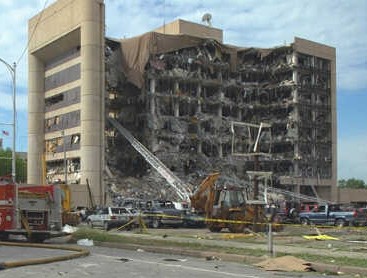
Now, the events of April 19th were obviously cataclysmic beyond
definition. The directly
across from the federal courthouse in was virtually
destroyed, demolished, right on the spot, by a very powerful
explosion.
The results of that explosion caused windows, doors, and other items
within the federal courthouse building to be blown to pieces.
The judges' chambers on the north side of the federal courthouse
building were shattered where the windows blew in, doors blew in,
and people in the building were injured during that explosion.
On the first floor, jurors who were deliberating were physically
injured. And one of the judges, the judge
who was presiding over
that trial, was out on the street assisting her jurors into
ambulances.
Judge Argo, who is on the first floor at the northeast corner of the
federal courthouse, was probably spared from certain death
by the fact his windows on the ground floor are bulletproof
glass. They appear to be sand-blasted.
In my building, my office windows on the north floor were completely
destroyed. Fortunately, I wasn't sitting
at my desk at the time. Fortunately for all of my staff, none of us
were injured.
We evacuated the building as everyone else did. One of my lawyers was
missing. She was in court.
And I spent probably five to ten
minutes running up and down the street in front of the federal
courthouse trying to find my lawyer who was lost. Once I located
her, one of my other lawyers informed me that his child was
supposed to be at the YMCA Day Care Center, and he couldn't
find his child. We spent the next 45
minutes trying to
locate his child.
I am aware that you, Judge Howland, were also present during the
events and that you witnessed what went on.
I think the record should also reflect that I am personally acquainted on
a professional basis with the following people: Cynthia Lynn
Campbell Brown, a special agent with the Secret Service. She was over in our offices discussing a case
with our
investigator shortly before she left to get married.
Aaron Coverdale and Elijah Coverdale, ages 5 and 2 are the children of
one of our former clients.
Steve Curry, who worked for General Services Administration as an
inspector, assisted us in the renovation of our offices.
Christi Jenkins, is an employee at the Federal Employees Credit with her on
many, many occasions.
Donald Ray Leonard, special agent with the Secret Service, I am
personally acquainted with him in a professional capacity.
Michael Loundenslager, a
planner/estimator for General Services
Administration, also assisted us with our renovation in our
building.
Mickey Bryant Maroney is a
Secret Service agent with whom I have handled
maybe twenty cases in the past few years.
Kenneth Glenn McCullough, special agent with the Drug Enforcement
Administration, with a very important case pending with us in our
office.
Paul Ice, who is listed -- all of those people are dead. Paul Ice, a
senior special agent with the Customs Service. I am also
well-acquainted with him as a result of his professional
capacity and mine. He is listed as
missing, and this morning's
casualty list, it's my understanding that they have recovered
his body, and he is dead.
Tresia Worton,
another Federal Employees' Credit Union worker is
still missing. I am unaware of her status.
I am personally acquainted with every one of these people. I have been
down to the federal courthouse, starting now on my 11th year. I know these people. I
have done business with these people,
and although certainly we don't work in the same agency, we
have had a cordial, working relationship that places me in the
position of knowing on a first-name, by-sight basis, victims of
these events.
I do not believe this is a case that falls within the ambiance of
Harrelson and Shagra.
This is a case of extraordinary
proportions. Mr. Coyle was personally
acquainted with an
attorney who has also been killed as a result of this bombing
incident.
I was certainly present during most of the events in the early morning
of April 19th, and at one point in the afternoon I could no
longer find my investigator because a man with whom he had been
associated with for a number of years, who is on special
assignment with the Drug Enforcement Administration, was
unaccounted for, and my investigator was down at the building
looking for him.
When I couldn't find my investigator after two hours, I went back down
to the scene and went looking for him. Fortunately I
found my investigator, and his friend was also unharmed
during these events.
This is not an instance where publicity has been limited. I respectfully
disagree with the Court's characterization that the principal
portion of the publicity has been about the factual
circumstances surrounding the bombing and the attempted recovery of
victims and potential survivors.
I don't have all the papers nationwide.
Certainly I have been contacted
by virtually every print media and video media person or
seems like I have been, requesting information about this case. But I do have the last seven editions, I don't
have the Sunday
edition of The Daily Oklahoman, and I would like to place these of
record as well.
THE COURT: Do you want to use
those at this time?
MS. OTTO: I do, Your
Honor.
THE COURT: Do you have them
numbered?
MS. OTTO: Yes, I do. Exhibit No. 1 -- Defendant's Exhibit No. 1,
is Thursday, April 20, 1995, the banner headline is "Morning of
Terror, City Struggles With Shock of Deadly Bombing."
The very next day, Friday, April 21st, this would be Defendant's
Exhibit No. 2. "FBI Seeks Two in Terrorist
Blast," and this is
the first day we have a composite photograph of the men who are
identified by the FBI as suspects.
The third came Saturday, April 22nd, is Defendant's Exhibit No. 3, "Bomb
Suspect Charged," and a large picture of Mr. McVeigh and
the escort of -- well, I can recognize one FBI agent right
off the bat, and appears to be several others and several
sheriff's deputies, Defendant's Exhibit No. 3.
Defendant's Exhibit No. 4 is the Monday April 24th, newspaper, "A
Time to Grieve." It's the banner headline. This is photograph
of the memorial services with President Clinton and Governor
Keating. But below the fold, we have
"Search Continues For
Second Suspect. Man Questioned In The Investigation
Of This Case Figures Prominently" on the first page of the
paper.
Defendant's Exhibit No. 5, "FBI Combs Through Leads In Bombing Case"
and the coverage generally continues with the FBI ongoing
investigation of this case and contains some information
about additional suspects who have been identified.
On Wednesday, April 26th, Defendant's Exhibit No. 6, we have the lead
which is "Chemical Test Point to McVeigh." And I guess it would
be the lead story: "FBI theorizes John Doe 2 May Be Dead." We have specific information about Mr. McVeigh, specific
information about this case, specific information about
incriminating evidence that the FBI is alleging links Mr. McVeigh to
these incidents.
THE COURT: Is that 6?
MS. OTTO: Yes, this is
Exhibit No. 6, correct. Defendant's
Exhibit No. 7 is today's newspaper and it contains banner
headline: "Friend puts McVeigh in City on
Easter. Bomb Suspect Talked
About Something Big."
This is an article that primarily reports the events in Terry Nichols'
court hearing had in it is all
information directly concerning Mr. McVeigh.
We do not have, and as I am sure the Court has reviewed the cases that
have been cited, publicity cases do generally turn on the degree
of saturation of the media, the length of time that has
elapsed since the events, and the court proceedings, and the nature
of the communications that have been conveyed in the courts.
Now, certainly I will agree with the Court's characterization
that a great deal of the media focus was initially on
rescue efforts, the suffering of the victims and the victims'
families, and the heroic efforts of all parties in attempting to
find survivors as quickly as possible. But
it would be very
disingenuous to behave as if the identification of Mr. McVeigh
as a suspect has been some minor sideline in these stories. It has been the story.
Mr. McVeigh has been the story since he was moved from papers and
video media have been saturated with stories about him, about the
militia, about his family, about other groups all tending to
lead or lend some larger conspiracy or larger connection,
which is the tendency of all of these facts, that are being
presented as fact in various media.
Your Honor, it would be very difficult, I think even under the best of
circumstances, if we all were from some place else and, well, all
been dropped here in the middle of to conduct
these proceedings, to be unaware of what has been going on in would be very,
very difficult to find anyone in doesn't know
something, at least, about this.
But to say that the publicity is not a factor, to say that publicity is
not a factor right at this point, just simply is untenable. That is a tenable position to take and tenable position to
maintain.
Further compounding that is the fact that we don't really have to rely
on all of this media coverage. We don't
have to rely on the
video pictures and on television and Connie Chung standing there
with a bombed-out building in the background. We know what it
looks like because we were all there and we all saw it. We heard it. We
smelled it. We lived through it. We are percipient
witnesses. Every one of us is a percipient witness to
this event. And Mr. McVeigh has the right
to have his case heard
even at this initial proceeding. This is
not some sideline,
some procedural sideline.
This is an essential part of this criminal case, and Mr. McVeigh is
entitled under the Federal Rules of Criminal Procedure and
under the Constitution to have his case heard from the very
first instance by neutral and detached people who were not
themselves percipient witnesses.
The government says, "You can't cite any cases. You can't cite any
cases." You are darned right I can't cite
any cases because this
hasn't happened before.
You must not let the fact that this is a unique situation in which there
is no case precedent cripple us to the obvious and
indisputable facts. We are not people who
come to this with perhaps
some notion of what went on. Because we are percipient
witnesses, we have our own very personal idea of what happened
because we saw it, and we were there. That
is why Mr. Coyle
and I filed the motion to transfer at this time, so that this
preliminary hearing could be conducted in another venue, in
front of another magistrate, in front of another judge, one who
wasn't run out of the courthouse by this blast, and Mr.
McVeigh to be represented by lawyers who do not personally
know victims involved in this, to be represented by a lawyer whose
office wasn't largely destroyed by this blast, and to be
heard in a truly neutral and detached forum.
I urge the Court to reconsider its position with regard to the motion to
transfer. This is not an instance where Mr. Coyle and
I are saying we want to be released because we were upset.
We want to be released because we believe it is Constitutionally
required. Right from the very beginning, Mr. McVeigh is
entitled to have this case considered by someone other than the
persons who lived through these events.
It's the thrust of our motion. It
wasn't really addressed by the
government in its response, and I certainly wanted to clarify those
points in the Court's order where I felt the Court might
have been lacking some additional information. I strongly urge
the Court to reconsider all of these matters.
THE COURT: Any objections to
Defendant's Exhibit Nos. 1 through 6?
MR. GARLAND: No, Your Honor.
THE COURT: The same are
admitted without objection.
Does the counsel's
statement?
MR. GARLAND: Yes, Your Honor,
with respect to the Motion
to Transfer, as the Government's papers show, the rule is
only for transfer from the district for trial.
As Charles Allen Wright wrote in his seminal book, Federal
Practice and Procedure, the District Court is not authorized
by this rule to transfer proceedings before the return
of the Indictment.
No case, no Court has ever made such a transfer that has ever been
recorded. Part of the reason may well be
that because,
although Mr. McVeigh may wish to transfer, there are others who are
still being sought. Those people have the Constitutional
right to a trial in the state where the crimes have been
committed, by the jury in the state and in the district where
the crimes were committed. Without their
waiver it would make
it impossible for the grand jury to proceed against those
individuals. For that reason, then, we
believe the Court's
decision against transfer at this time is correct.
However,
Your Honor, in light of the attorney's statement, I
have to once again ask the Court on the record to ask the
Defendant whether or not he objects to continuing with this hearing
with his current lawyers.
I am concerned, Your Honor, that at some later time he will say
that he did not consent; that she has made statements
today that some day would be used to suggest later that the
hearing went along without his consent. He
does not have any right
to not make a statement with respect to whether he consents to
going forward at this time. At the least
Your Honor ought to
advise the Defendant that if he does not object, his objection
will be taken as consent to continuing with these attorneys for
whatever purposes for today.
THE COURT: The Court has
carefully considered the statements of
counsel here today and oral statements which supplement the
motion which they previously filed. The
Court, as I tried to
indicate in my statement earlier about the relationship
between the retained counsel and appointed counsel, the
Court has to exercise oversight in connection with that. The Court has no question that the present
counsel who are appearing
for the Defendant will serve very professionally and
respectfully and competently.
The Court's order stated that their Motion to Withdraw was
overruled without prejudice, so that matter can be reconsidered. Other than that, in connection with the
evidence which has been
introduced, the Court believes the order satisfactorily
resolved those issues. I tried to be as specific as I
could in connection with the order in the limited amount of time
that we have all had to work on all of this, and I believe the
order is sufficiently dispositive to deal
with those issues. The record has been made, as far as I'm concerned, on
those points. The order that I previously entered is
sustained and will continue in effect. If there
is nothing further, I will consider evidence on the
probable cause issue.
MR. GARLAND: Your Honor, I
still think we need to know whether
the Defendant consents to going forward with these attorneys at
this time.
THE COURT: Well, it is
basically the Court's responsibility
to, as I said, exercise oversight in connection with the
appointment of counsel. As compared to an
entry of appearance by
a privately-retained attorney, the Court has little or no
discretion in connection with that matter. You
heard the
positions of the attorneys who are present and the Court has
exercised its judgment and oversight, which I think I'm required
to do in connection with 3005. Ms. Otto
and Mr. Coyle meet
every qualification. The Court believes
that they are
professional-enough attorneys that they will competently
represent the Defendant throughout this proceeding, which we all
agree is narrowly focused. The only issue
at this time is
probable cause. We are not going to
determine whether the Defendant
is guilty or innocent; simply probable cause and reasonable
basis.
MR. GARLAND: May I state for
the record that I have heard no
objection to the Defendant proceeding with these counsel.
THE COURT: Basically it
is the Court's decision. The Court
believes that the representation will be both professional
and competent.
MR. GARLAND: The United
States would call Special Agent Jon Hersley.
THE COURT: Mr. Hersley, step forward, face the Clerk, raise
your right hand and be sworn.
DIRECT EXAMINATION BY
MR. GARLAND: Q. State your full name and spell your last
name. A. Jon Hersley,
H-E-R-S-L-E-Y. Q. What is your occupation? A. I'm an FBI agent. Q. How long have you been an FBI agent? A. About 20 years. Q. Where were you assigned? A. To the Q. Have you had responsibilities in
connection with the investigation
of the explosion of the A. Yes. Q. In the course of that investigation,
have you spoken with other
investigating agents and experts? A. Yes, I have. Q. Tell us what happened on April 19, 1995
at the Murrah Building.
A. A bomb exploded at that building,
severely damaging the building
and causing numerous deaths and injuries. Q. Approximately what time did the
explosion occur? A. Approximately 9:03 a.m. Q. Approximately how many people were
killed, as far as you know
at this time? A. Approximately 100. I
believe it is 101 as of now. Q. What categories are the people who were
killed? A. That includes numerous Federal
employees; I believe there were
15 children that were killed at this point whose bodies have
been found, and there were also several Federal law enforcement
officers that were killed in the bombing. Q. Are there any people still missing? A. Yes. Q. How many? A. Between 100 and 150 is what I have heard. Q. Do you know how many people were
injured, approximately? A. Approximately 400. Q. What is the A. It houses numerous Federal agencies,
Federal employees that
work there. Q. Is it used by agencies of the A. Yes, it is. Q. Would you describe some of those
agencies? A. The Alcohol,
Tobacco and Firearms, the Department
of Housing and Urban Development, the Social Security
Administration, and numerous other Federal agencies. Q. Have you consulted with explosive
experts of the FBI? A. Yes. Q. What caused the explosion of the A. A bomb. Q. Have the experts informed you as to
where the bomb was located
at the time it went off? A. Yes. Q. Please describe that to the Court. A. It was located inside a Ryder Truck that
was parked in front
of the Q. How did the experts know that? A. Due to the uniqueness of the blast
damage that was suffered
on certain components of the truck, they are able to tell
that it was actually located inside that truck. Q. Has an effort been made to trace that
Ryder Truck to the point
of which it was rented? A. Yes. Q. What methods are used to trace that
truck? A. There was a portion of the vehicle
identification number that
was located and we were able to trace from that portion the
full vehicle identification number and then take that on to determine
who actually had the vehicle. Q. In addition to the vehicle
identification number, or VIN number,
was there another part of the truck that permitted tracing? A. Yes. Q. What was that? A. The license plate. Q. I have marked what will be called
Government's Exhibit 1 for
identification and I am showing it to defense counsel.
Do you recognize Government's Exhibit 1? A. Yes, I do. Q. What is Government's Exhibit 1? A. This is the Truck.
MR. GARLAND: Your Honor, the
Government moves Exhibit
1 into evidence.
THE COURT: Any objection?
MR. COYLE: No objection.
THE COURT: The same will be
admitted. Q. You said that by using the vehicle
identification number and
the license plate, that you were able to trace the truck to a
rental location; is that correct? A. Yes. Q. What was the result of that tracing? A. The Elliott's Body Shop in Q. Was the rental agent at that location
interviewed? A. Yes. Q. Did he advise as to when that truck was
rented? A. Yes. Q. When was that? A. The truck was rented on April 17th of
this year. Q. By how many people? A. One person filled out the rental
agreement; there was another
individual with that person when they picked it up. Q. What did the individual who filled out
the rental agreement
provide on the rental agreement? A. Provided his name. Q. Did he provide any other identifying
information? A. Yes, I believe a Social Security account
number, as well as
a driver's license and also his address. Q. Was an effort made to trace the Social
Security number or driver's
license and address? A. Yes. Q. What was the result of that tracing? A. They were both his numbers. Q. Did the rental agent assist in the
creation of a composite drawing
of the individual who rented the truck? A. Yes.
MR. GARLAND: Your Honor, I
have what has been marked as
Government's Exhibit 2 for identification.
(Government's counsel displays Exhibit 2 to counsel.) Q. Do you recognize Government's Exhibit 2? A. Yes, I do. Q. What is
Government's Exhibit 2? A. This is the composite drawing that was
prepared. Q. It was prepared with the information
provided by who? A. By the employee at the Elliott's Body
Shop. Q. Did he advise the FBI as to whether that
composite drawing was
a fair and accurate representation of the person that rented
the truck? A. Yes, he said it was.
MR. GARLAND: I offer
Government's Exhibit 2 into evidence.
MR. COYLE:
No objection.
THE COURT: Exhibit No. 2 is
admitted with no objection.
MR. GARLAND: I ask the Court
to take its own notice as
to its resemblance to the Defendant. Q. (By Mr. Garland) Mr.
Hersley, is there also a hotel named the
Dreamland Hotel in A. Yes. Q. Had interviewing been done at that hotel? A. Yes. Q. What did people at the hotel advise the
agents? A. That an individual had checked into the
hotel on April 14th
of this year. Q. How long did he stay? A. Until April 18th. Q. Was any connection made between the
individual and the representation
in Exhibit 2? A. Yes. Q. What was that connection? A. The individual at the hotel advised that
the individual that
had stayed at the Dreamland Hotel between April 14th and April
18th of this year strongly resembled the composite picture. Q. What name did he register under at the
hotel? A. Tim McVeigh. Q. Did he provide an address? A. Yes. Q. What was that address? A. 3616 North Van Dyke in Decker, Q. Was he seen driving any automobile at
the time? A. Yes. Q. What kind of automobile? A. A yellow Mercury. Q. What room did he register in at the
hotel? A. Room 25. Q. Were the employees at the Dreamland --
were any employees at
the Dreamland shown a photo spread which included a picture of
Mr. McVeigh? A. Yes. Q. What was the result of that photo
identification? A. The employee positively identified the
picture depicting Timothy
McVeigh as being the person that stayed at the room on that
occasion. Q. What was that room? A. Room 25. Q. Was an analysis made of telephone calls
from the Dreamland Motel
during that period? A. Yes. Q. Was there a call on April 15th -- A. Yes. Q. -- from Room 25? A. Yes, there was. Q. Is that the same room that Mr. McVeigh
was registered in? A. That's correct. Q. Where was that call made to? A. To a local restaurant in Q. Have you examined the receipt of the
restaurant for that date? A. Yes. Q. What does it show? A. It shows that the order was placed by an
individual using the
name "Kling." Q. Is "Kling" the same name as on the Ryder
Truck form? A. Yes. Q. Did it show what room number the order
came from? A. Yes, Room 25. Q. Was a photo spread shown to the delivery
man? A. Yes. Q. Was he able to identify Mr. McVeigh? A. No. Q. On April 17th, that was the day that the
Ryder Truck was rented;
is that correct? A. That's correct. Q. Did any Dreamland employee see Mr.
McVeigh? A. Yes. Q. In what connection did they see him? A. They saw him arrive at the Dreamland
Motel driving the Ryder
Truck. Q. On April 18, the following day, did any
employee of the Dreamland
Motel see Mr. McVeigh? A. Yes. Q. How did they see him then? A. At approximately 4 a.m., Mr. McVeigh was
observed in the Ryder
Truck. Q. Later in the day did they again see Mr.
McVeigh in the Ryder
Truck? A. No. Q. Now, in Paragraph 6 of the Affidavit
that was attached to the
Complaint in this case there is a discussion of three witnesses
who identified a person in Exhibit 2, the composite, as having been
in the vicinity of the morning
of the explosion; is that correct? A. Yes, it is. Q. Have those people been able to confirm
that they saw the Defendant,
Tim McVeigh? A. No. Q. On April 19th, is that the date of the
bomb? A. Yes. Q. Was Mr. McVeigh arrested on that day? A. Yes, he was. Q. Would you explain that, please. A. At approximately 10:30 a.m., Mr. McVeigh
was arrested by an
Oklahoma Highway Patrol Trooper at a location near Perry, Q. The reason for the stop? A. Mr. McVeigh's yellow Mercury did not
have a license plate on
it at that time and he was stopped for that reason. Q. About what time was the stop? A. Approximately 10:30 a.m. Q. About how long after the blast was that? A. Approximately one-and-a-half hours. Q. Where was the stop? A. Near Q. Approximately how long of a drive is it
from the Murrah Building
to A. Less than an hour-and-a-half. Q. I want to show you what has been marked
as Government's Exhibit
3 for identification.
(Government's counsel displays Exhibit 3 to counsel.) Q. (By Mr. Garland) Do
you recognize Government's Exhibit 3? A. Yes, I do. Q. What is Government's Exhibit 3? A. It is a James
McVeigh. Q. Where was it obtained? A. From Mr. McVeigh. Q. At the time of the arrest? A. Yes. Q. Does it show an address? A. Yes. Q. What is that? A. Q. Is that the same street and town as the
entry on the Dreamland
Motel register? A. Yes, it is. Q. When Mr. McVeigh was stopped, was
anything found on his person? A. Yes. Q. What was that? A. He had a Glock
.45 semi-automatic in a shoulder holster, with
two magazines. Q. Was the Glock
loaded? A. Yes. Q. What kind of bullets did it contain? A. Black talon. Q. Is there a street name for the black
talon bullet? A. Yes. Q. What is that name? A. It is referred to as a "cop-killer
bullet." Q. Was Mr. McVeigh's clothing tested? A. Yes. Q. What was the results of the test? A. It tested positive for traces of PETN. Q. What is PETN? A. Penta erythratol tetral
nitrate. Q. What is penta
erythratol tetral
nitrate? A. It is an explosive that is commonly used
in detonating cord.
MR. GARLAND: The Government
has no further questions.
I would like to move into evidence Government's Exhibit
3.
MR. COYLE: No objection to
the introduction of Government's
Exhibit 3.
THE COURT: Admitted without
objection.
MR. GARLAND: Thank you.
THE COURT: Cross-examine.
MR. COYLE: Thank you.
CROSS-EXAMINATION BY
MR. COYLE: Q. Good afternoon, Agent Hersley. A. Good afternoon. Q. Would you tell me, please, sir, if prior
to the time that you
came to court to testify today if you reviewed any papers or
documents to refresh your recollection in preparing your testimony
here before the Court? A. No. Q. So you haven't read any official
documents in connection with
this case to prepare for your testimony? A. Not to prepare for my testimony, I have
not. Q. Did you discuss any of the documents or
anything other than
the exhibits that have been introduced into evidence in court
today with any of the Assistant United States Attorneys involved
in the case prior to your testimony? A. I don't believe so. Q. Can you tell me, please, sir, the agents
that you have spoken
with to obtain the information that you have testified to
in a hearsay fashion before the Court today? A. Primarily Rick Hahn. Q. Rick? A. Rick Hahn -- Q. Okay. A. -- from the FBI; numerous agents during
the course of the investigation,
as it is ongoing. I also spoke with
another individual
that is a bomb tech for the FBI. Q. What is his name? A. I spoke with an individual from the
Medical Examiner's office. I spoke with agents in agents
throughout the Country. Q. Now, can you tell us, please, sir, what
your role has been in
the investigation? A. Yes, I have been assisting in the
investigation in regard to
Mr. McVeigh. I have also been
participating in the ongoing investigation
in an attempt to further identify and locate other
individuals who may have been involved in the bombing on April
19th, 1995. Q. In your assistance in the investigation,
what has been your
primary role? Have you been a keeper of
evidence, a maker of
calls, what has been your primary role? A. I have done both of those things, as
well as numerous other
things. If you refer to a keeping of the
original evidence,
I have not been involved in actually handling the original
evidence. I have been involved in tracking
and keeping
up with copies of that evidence insofar as further-leading
investigation material is concerned. Also
in coordinating
the efforts of other FBI offices in the ongoing investigation
in an attempt to identify the additional people that
were involved in the bombing that tried to prohibit anyone else
from getting injured or killed. Q. So am I correct that you more or less
have been involved in
all phases of the investigation -- A. Pretty much so. Q. -- to date? A. Pretty much. Q. Is that the way it is with all of the
special agents of the
FBI on this investigation, they have handled all different aspects? They call agents -- every agent is calling
agents all over
the Country, tagging in evidence and looking at it and making
sure that all of this is kept track of; is that right? A. No, that's not really an accurate
depiction of what is taking
place. The agents have been given certain
assignments and
certain responsibilities and they have been going about carrying
them out. Q. Tell us, please, sir, so that I can
specify what it is you have
been involved in, could you tell us, please, what, for instance,
your activities were on the day of Wednesday, April 19th? What was your specific assignment on that date? I assume
you had something specific. A. On April 19th, as most of the FBI agents
in were
sent down to the vicinity of the bomb
blast, I was charged with staying in the office to help communicate
the activities of everyone concerned on that date.
As
it has evolved, I have been responsible primarily for keeping
up with the activities of Mr. McVeigh. Q. Are you talking about on the 19th? A. No. Q. I believe that was my question, just on
the 19th.
Now, is that what you did on the 19th?
You were on the phone
and you never left the office? A. Primarily, yes. Q. Now it is my understanding on the 19th
at some point the offices
of the FBI were evacuated here in that
correct? A. Evacuated, except for certain personnel. Q. You were one of those who stayed behind,
sir? A. Yes. Q. Now, can you tell us, please, sir, what
your primary responsibility
and assignment was on April 20th, that would be Thursday? A. Pretty much the same as it was on the
19th. Q. So once again you were there at the
offices of the FBI? A. Yes. Q. Was your job there -- that's the offices
at not
this Command Post we have heard of, right? A. It is at Q. Your obligations on the 20th were
placing calls to other places
in the Country? A. Yes. Q. Would that be based upon evidence that
people would bring you
or tell you about that had been found in the field or tell us
how that worked on the 20th? A. We would get information about evidence
that had been found
in various locations that would require that we send out and
conduct additional investigation both here in and
other locations throughout the Country. So
I would be responsible
for help overseeing the continued investigation in that
regard to help identify other individuals who may have been
involved. Q. On the 21st, on Friday? A. The same thing on Friday and the same
thing on Saturday. Q. So essentially am I correct, sir, that
all of your duties from
the date of the 19th through the 21st were in the offices of
the FBI at A. Pretty much so, yes. Q. Now beginning on Sunday, can you tell
us, please, what your
duties were? A. I believe that's the day that I started
reporting over to the
-- Sunday or Monday I started reporting over to the Command Post
that was set up and was then responsible for the investigation
as it pertained to Mr. McVeigh. Q. So am I correct, then, that you have
been the agent in charge,
then, of the investigation as it pertains to the accused,
Timothy McVeigh? A. I have been responsible for keeping up
with the investigation
regarding Mr. McVeigh, that's correct. Q. Explain to us what "keeping up" means? A. There is a number of leads that have
been -- are being carried
out in the continuing investigation. I
keep track of that
investigation. I keep track of certain
evidence that has been
found -- although not the actual, physical custody of that evidence;
I want to clarify that. I am provided with
copies of documents
and other records that are -- have been located. We
are
cataloging those documents, keeping up with the investigation
that is going on in other offices of the FBI, including
talking to agents that are conducting investigations in
those offices regarding what they have been able to determine
and future investigation to be conducted. Q. Now, is this material all logged into a
computer, then? A. Portions of it.
MR. GARLAND: Objection, Your
Honor. We are well beyond
the scope of a probable cause hearing. The
determination
of the way in which the FBI goes about the investigation
is not a proper subject for discovery.
THE COURT: Overruled.
You may answer the question.
MR. COYLE: I asked if he has
been logging these matters,
these clues, this evidence that he has looked at, these
kinds of things that he has testified to.
THE COURT: I don't believe he
answered the question. Did he answer that question?
MR. COYLE: No, it was
objected to.
THE COURT: I overruled it.
Do you want him to answer the question?
THE WITNESS: Could you repeat
the question?
MR. COYLE: I knew he would
ask me that. Q. (By Mr. Coyle) In
the course of your investigation and during
the time particularly that you moved to the Command Post
-- and I will get back to the other place -- but since you have
been at the Command Post -- that's what it is called.
You understand
what I'm talking about by "Command Post"? A. Yes, I do. Q. Since you have been at that particular
location, as you get
leads, as you get copies of evidence, photocopies or photographs
of evidence, have you then taken those and logged them
into a computer? A. No, I don't do that.
Some of the documents and the results
of the interviews are being logged into a computer.
That
is being done by other personnel at that location and other
locations. Q. So your job is to just take a look and
keep track of all of
the evidence and then you assign other FBI agents out to do other
tasks or to make calls? A. There are other agents that are assigned
to the same types of
duties that I am there in regard to other potential individuals
that were involved in the bombing. I also coordinate
with those individuals insofar as information that is
received regarding Mr. McVeigh, in an effort to identify some
of the other subjects that were involved in the bombing here
in
That's our primary focus right now is to try to determine the
identity and the location of the other subjects so that we can
prohibit another bomb from going off. Q. You told us in your direct examination
by Mr. Garland that you
had consulted with explosive experts; is that correct? A. Yes. Q. Can you tell me who those were? A. Rick Hahn, and I believe the other
individuals -- one of the
other individuals is Bill Jockney. Q. Who is Rick Hahn? A. He is an FBI bomb expert that has been
qualified to testify
in cases and has testified on numerous occasions in cases
across the Country. Q. Can you tell me where your conversations
with Mr. Hahn -- Agent
-- is it Agent Hahn -- A. Yes. Q. -- or is he a technician? A. No, he is an agent. Q. Where your conversations with Agent Hahn
took place? A. Primarily at the Command Post. Q. Were other persons present during those
conversations? A. During some of the conversations. Q. Can you tell me when those took place? A. Over the last couple of days.
(AFTER THE RECESS, THE FOLLOWING PROCEEDINGS WERE HELD
THE COURT: Let the record
show that all parties are present and
the defendant is present.
MR. COYLE: May I have just a
minute?
THE COURT: Sure. Let the record show that counsel are present. The defendant is present in
person, and you may proceed with
cross-examination. BY MR. COYLE: Q. Agent Hersley, do
you have any indication or have but been advised that
any individuals saw the Ryder Truck explode? A. Primarily the information that I have is that
people saw the Ryder
Truck shortly before the explosion. I
don't know of anybody by
name myself that actually saw the explosion and lived through
it. Q. Okay, so -- A. There are people inside the building that made
it through obviously and
would have seen the explosion or parts of it. Q. Well, I don't think my question to you is
theoretical. Are you aware of a
witness that you know their name and might be available and
alive to testify in court? That's a better question that
saw the Ryder Truck explode. A. Not that I can recall right now. Q. That would be someone pretty important and
you're privy to that kind of
information, correct? A. Yes. Q. Now, is there any pictorial or visual
recording of the vehicle parked
over the crater, the site what you say is the site of the
explosion? A. I don't believe there is a picture actually
where that crater is. There are other pictures of the Ryder Truck on
that street. Q. And where is the Ryder Truck located at the
time of the pictures? A. Heading east on Q. It's shown heading east? A. Yes. Q. And can you see the tag on the pictures? A. No. Q. So you say there is film available that shows
the -- a Ryder Truck in
an easterly direction that is traveling in an easterly
direction on A. Yes. Q. Is it past the street that we know as A. I am not -- I have not studied that film in
detail. It's in that
general vicinity right in there. It may be
the video that I saw. I believe it is just before -- well, I am not sure. I better not say that. Q. Well, A. I don't know. A. That is correct. Q. Are the photographs that you saw or is it
still photo or film? A. What I saw was the still photos. Q. Is it a still photo that has been removed from
a film? A. Yes. Q. Were those still photos that you saw, do those
appear to you to be east
of the street that we know as A. I was not focusing on that picture to
determine whether or not -- whether
it was east or west of general
location. I can say that. Q. So it was a closeup
more of the truck than its location? A. It wasn't a closeup
photo, it was taken from a camera off one of the
buildings in the vicinity. Q. Did you make a determination of what building
it came off of? A. No, I did not myself. Q. Okay, did anyone? A. I believe one of the other agents was able to
determine that it came
from one -- one of the films came from the Regency Tower
Apartments. Q. Can you tell in the photograph who is driving
the truck? A. No. Q. And is the truck parked or is it moving? A. As I mentioned, I saw the still photographs of
the picture or the footage
was frozen at this time when a still photograph was made, but
I believe the truck due to the continuation of the still
photographs that the truck was moving in an easterly direction. Q. That is also a one-way street there from west
to east, am I correct, sir? A. That is correct. Q. What was the size of the truck that you saw in
the photographs? A. I could not tell myself exactly what the size
was from the photograph
that I saw, but I would estimate it from what I saw to be
approximately 20 feet. Q. Was there a time indicated on the picture of
the film that you saw? A. Yeah. Q. Okay, can you tell us, please, sir, what that
time was? A. It was in the proximity of 9:00 a.m. As I mentioned, I did not study the
photographs in great detail, and I don't know the exact time on
the photographs, but it was in the proximity of 9:00 a.m. Q. Can you tell us when you viewed those
photographs, please, sir? A. I believe within the last two to three days. Q. I believe you told me earlier that the license
tag is not visible on the
photographs; is that correct, sir? A. Not visible on the photographs that I have
seen, that is correct. Q. Are you aware of any other photographs in
which the license tag might be
visible? A. No, except for the recovery, and I am not
aware of that being on the
bumper. I would presume there are
photographs taken there. Q. Well, I understand that it has been
photographed by the FBI and the way
that we see it.
MR.
COYLE: May I approach?
THE COURT: Yes. BY MR. COYLE: A. Yes. Q. As we see it as Government Exhibit No. 1. But aside from Government
Exhibit No. 1, are you aware of any other photographs
aside from those photographs taken of it by the FBI subsequent to
its retrieval after the time of the explosion. Are you aware
of any photographs of a license tag prior to the time of the
explosion in front of the A. No. Q. Are you aware of any photographs that were
taken at any time prior to
the explosion at the accused
Timothy McVeigh in or about the truck that you have described as a
Ryder rental? A. No. Q. And I include in that, so we don't have a semantical difficulty of
any sort -- any sort of photographs, film footage,
surveillance cameras, any other film of any type that you are aware
of, Agent, that shows the accused Timothy McVeigh anywhere in
the vicinity of the 1995 at or
before 9:00 a.m. A. No. Q. 9:03 a.m. -- at or before 9:03 a.m. A. That is correct. Q. "No" is your answer? A. Yes. Q. I believe you told us in a previous answer
that there is no visual or
pictorial record of the vehicle parked over the bomb -- over the
site where you say it exploded in front of the A. Not that I have seen. I
have not viewed all of the film of that location
on that morning, so I can't speak to that entirely, but
I have not seen it. Q. Have you been advised that that photograph
exists. Have you been told
about that in your capacity as an agent working there at the
command post? .
No. Q. That would be something as an agent working on
the case and particularly
you told us at the outset that your responsibilities
were in regard to Mr. McVeigh; am I correct? A. Yes, and his activities. Q. And that would be something -- the movement of
the Ryder Truck and its
location is something particularly important to which the
government would be concerned in regard to Mr. McVeigh; am I
correct? A. Yes, you are correct as there are many other
things that the government
is concerned about and different agents are assigned
different responsibilities as this is a fast moving investigation
possibly involving more subjects that may have been involved
in the bombing. So other agents have been assigned
responsibilities in regard to any films or pictures that may be
retrieved for viewing purposes. Q. Well, how did you see the ones that you have
testified about here
earlier? Did you happen to see them laying
on a desk and look
at them or did someone bring them to your attention? How did you see those? A. One of the agents that have been tasked with
those responsibilities
showed me those photographs. Q. Now, I assume -- who are those agents that are
tasked with the
responsibility of reviewing photographs and film footage?
MR. GARLAND: Objection, Your
Honor, this is now purely
speculative.
THE COURT: Overruled. BY MR. COYLE: A. The agent that showed me the photographs was
Walt Lamar. Q. Is he a local agent here? A. Yes, he is. Q. Is he known to you as a photographic expert? A. No, he is not. He
is not known to me as that. Q. And is he the one that you inquired of as to
whether or not there were any
photographs of the accused, Mr. Timothy McVeigh in possession
of the government at or about the Ryder Truck? You asked him
that question I assume; did you not? A. I did not inquire of Agent Lamar about these
photographs. He brought it
to my attention because there is a possibility of a particular
car being involved in one of those photographs that he was
showing me. We are continuing
investigation to try to determine
the actual identity of that car. Q. What did that car look like in the photograph?
MR. GARLAND: Objection, Your
Honor, we were going in the area of
discovery now.
THE COURT: Sustained. BY MR. COYLE: Q. In the photograph concerning the other vehicle
or anything in any of the
surveillance photographs that you have seen exclude the
Ryder Truck, not only around the Ryder Truck? Have you seen Mr.
McVeigh in any of the other photographs period in or about the
area of the A. No. Q. Now, you told us that there were witnesses
that saw the vehicle at or
near the scene of the explosion. I am
talking about the
Ryder Truck, that saw the Ryder Truck that; do you recall
testifying to that earlier? A. There are witnesses that have advised that
they saw the Ryder Truck in
the vicinity of the morning, yes. Q. And have those witnesses viewed Mr. McVeigh? A. Have they viewed him? Q. Yes, in sort of a photo line up or live line
up. Any of those
witnesses who say they saw the Ryder Truck? A. Yes. Well, to say they saw the Ryder Truck, I
don't believe that those
individuals have been involved in a line up. Q. Okay, how many individuals are you aware of
agent Hersley that saw the
Ryder Truck at the scene of the explosion? A. At the actual seen as opposed to in the
vicinity. Q. At the actual place, the site of the explosion.
MR. GARLAND: Objection, Your
Honor, again goes to discovery of
other witnesses in the matter. It
doesn't go to the probable
cause.
THE COURT: Overruled. BY MR. COYLE: A. One or two. Q. You are not sure? A. I know of one. There
are other agents that have been interviewing
potential witnesses that may have sighted the Ryder Truck in
that vicinity. There are other, still other agents that
have interviewed people who saw the Ryder Truck in the vicinity
of the Q. So you know of one witness who says they saw
the truck at the location
where you have told the Court you have been advised that
it exploded; am I correct? A. Yes. Q. Did you interview that person? A. No, he was interviewed by another agent. Q. Do you know the location of that other person
at the time that he viewed
the truck and the location that you have described for
us? A. Yes. Q. Can you tell us, please? A. He was driving his vehicle east on right along
beside the vehicle. Q. How long or how much time passed between the
time that the witness told
you that he saw the Ryder Truck and the explosion? A. Maybe a minute or two. Q. How far was his vehicle -- had the witness's
vehicle travelled? A. When the bomb went off, that witness indicated
that he was between
Robinson and Broadway on Q. Has he been shown to your knowledge a photo
lineup of the accused
Timothy McVeigh? A. He has not been shown a photo lineup. Q. Has the FBI prepared a photo lineup that
include the picture of
Timothy McVeigh? A. Yes. Q. Have you viewed that -- A. Yes. Q. -- photo lineup? A. Yes, I have. Q. Does the witness that you have told us saw the
truck in that position,
has that witness viewed Mr. McVeigh in a live lineup? A. No. Q. Can you tell us why not? A. Yes. Q. Okay.
We are in the process of getting the line up shown to different
individuals as well trying to correlate all of the other
investigation with the other offices in an effort to try to identify
the other subjects that were involved in the bombing. That is a priority of ours in order to try to
if other people
are involved get them identified and take them into custody
to try to prohibit another bomb going off in another area
or other citizens being injured or killed. Q. Well, eyewitness testimony, you would agree
me, with fades during the
passage of the time; does it not? A. To some extent. Q. It's extremely important if you want to
identify somebody, that you show
them the picture as soon as you can, don't you? A. As soon as reasonably possible, yes. Q. And a person who said he saw the Ryder Truck
there has never been
shown any photographs of the accused in any way? A. He was shown a composite that was drawn up,
the composite that we have
testified about and he identified that composite as strongly
identifying the individual that he saw at the scene.
MR. COYLE: May I approach the
witness, Your Honor?
THE COURT: Yes. BY MR. COYLE: Q. Are we talking about Government Exhibit No. 2? A. Yes. Q. The composite photograph? A. Yes. Q. He was shown that photograph? A. Yes. Q. I am sorry. That
drawing? A. This composite? Q. That's the witness that you have been telling
us about that was driving by
there? A. Yes. .
And he said that to you. What
were the words that he used; do you
remember? A. I wasn't there. Q. So you don't know if he used strongly
resembled or exactly what he said? A. The agent that talked to him said that he
strongly resembled
whether that was actually the words of the witness. I was not
present. Q. Where did -- and as I understand you are
involved, your involvement
has been in the investigation of Timothy McVeigh. Where did this
witness, the first witness you have told us about say that
he saw the composite or a person that strongly resembled the
person in the composite in relation to the Ryder Truck? A. He was walking from the south side of the truck was
parked in a northerly direction across Fifth Street. Q. So he was walking directly across A. He was walking away from the truck, the
area where the truck
was located. Q. Well, he was walking -- I'm not trying
to be confusing -- if
he is walking north, he is walking across I
correct? A. That's what I testified. Q. Is that what the witness has told the
agent that he saw, what
has been identified there as John Doe No. 1, I think, is that
what it says on Government's Exhibit 2? Am
I correct, is that
Government's Exhibit 2? A. Yes, it is. Q. On Government's Exhibit 2, he saw him
walk across the street,
across A. Yes. Q. Did he walk in front of the vehicle or
behind the vehicle of
the witness?
MR. GARLAND: Objection, Your
Honor, as we are not relying
on identification at the time of the bombing for probable
cause. This is purely for discovery. We have an ongoing
investigation. We need to protect our
witnesses for the
purpose of determining what happened. We
are not relying on
this witness for the purpose of probable cause. All
we are doing
here is discovery.
MR. COYLE: May I respond? I have two responses. First
of all, he testified to it in direct examination, which I think
makes it an appropriate subject to cross.
Secondly, it was also in the Affidavit that bears Your
Honor's initials. I think that is very
important that the
Court has already considered that matter for purposes of probable
cause. I think as to the weight of the
evidence, the Court
can consider the agent's answers and how these particular witnesses
that they have set forth in their Affidavit, how they had
an opportunity to observe and to see the things that are set
forth in the Affidavit. That's the reason
for my questions.
THE COURT: Is that the matter
stated in the Affidavit
at the bottom of page 2, top of page 3?
MR. COYLE: Yes, sir.
THE COURT: Objection
overruled. Q. (By Mr. Coyle) Where
did the witness see him in relation to
the vehicle that he was driving, the witness was driving?
MR. GARLAND: I'm sorry to
interrupt. I want to clarify. He did not testify about this on direct. The only statement
on direct was that the paragraph he is referring to in
the Affidavit we are not relying on for probable cause.
That's
paragraph 6. Those witnesses did not
identify Mr.
McVeigh, so those are not part of what we would ask the Court
to look at for probable cause. There was
no testimony and
I asked no question about the witness that Mr. Coyle is presently
asking questions about.
THE COURT: Nonetheless it is
part of the overall probable
cause in the case. Q. (By Mr. Coyle) Do
you understand my question, Agent Hersley? A. Yes. Q. Where was the witness in relation to the
person that they described? A. The witness was walking away from the
location where the truck
was parked, walking across the street, across Fifth Street,
to the north. Q. I thought the witness was in a car. A. I'm sorry, he identified the individual
pictured in the composite
as walking away from the area where the truck was parked,
across Q. Was the person that strongly resembled
the person in the composite,
was he in front or behind of the car that the witness
was driving? A. He was in front of it. Q. How far in front of it? A. He had to slow down, as the individual
he identified in the
composite was crossing the street, to keep from hitting him. Q. What was the individual wearing who was
crossing the street? A. I don't recall the individual that was
shown the composite that
we are speaking about describing the clothing. He
may have. As I stated, I was not present during that
interview. Q. That would be something pretty important
to determine, wouldn't
it? A. Yes. Q. Now, did the witness that you have
described for me, did he
see the person that strongly resembles the composite, did he see
that before or after it was released to the news media? A. He saw the composite before he saw
anything on television or
in the news media. He later saw Mr.
McVeigh on television. Q. Did you or another agent of the FBI show
him Mr. McVeigh on
television? A. No. Q. Did he then identify Mr. McVeigh from
television? A. Yes. Once
he saw Mr. McVeigh on television, he said that he
was certain that was the individual that was crossing the street
in front of him that day, that morning. Q. When did he see Mr. McVeigh on
television? A. Shortly after -- shortly after he had
identified the composite. Not the same day; I believe it was a day or
two later. Q. When was he shown the composite? A. I don't know the exact date. There have been numerous interviews
conducted in that regard. I have not -- I
cannot tell
you each day that each one of them was done on. Q. So there have been numerous interviews
conducted of this particular
witness? A. No, there are numerous witnesses --
potential witnesses and
witnesses that have been interviewed. Q. Now, is this witness that you have been
describing for me is
he one of the witnesses who is described in the Affidavit signed
by Agent Gibbons? A. No. Q. You are familiar with that Affidavit
that is signed by Agent
Gibbons, are you not? A. Yes. Q. Were you involved in the preparation of
the Affidavit of Probable
Cause that was signed by Agent Gibbons? A. No. Q. Did this witness call you and tell you
that he had seen Mr.
McVeigh on television or did he call and advise another agent
who told you? A. He advised another agent.
He advised the agent that had spoken
with him the first time. Q. Who was that, sir? A. John Hippard. Q. Is he a local agent? A. Yes, he is. Q. I assume you reviewed prior to your
testimony here, because
you went over part of it, the Affidavit of Probable Cause
that was filed in this case, correct? A. I have read it, yes. Q. It talks about the interview of three
witnesses who were near
the scene of the explosion at the A.P. Murrah
Federal Building
prior to the detonation.
Where was -- they talk about the three witnesses were shown
a copy of the composite drawing. Were they
all shown it at
the same time, to your knowledge? Or were
they in separate areas
or all together when they were shown the photograph? A. I was not present during any of those
on-site interviews. I
don't know the exact manner in which any of those interviews were
actually conducted, so I'm not able to answer that. Q. Can you tell me, please, the witnesses
advised they observed
a person at approximately 8:40. Were these
persons together,
these three witnesses? A. I don't know if they were together or
not. You mean did they
know each other? Were they traveling
together or -- Q. Well, no. If
they were in the same general vicinity or same
general area or if they were -- maybe they were all just brought
together as witnesses? A. I don't know about those three
witnesses, where they were interviewed,
exactly where they were interviewed at that location. I did not speak with that agent about those interviews. Q. Do you know where they were purportedly
standing at the time
that they made the observations that were sworn to in the Affidavit? A. I believe that they were either at or in
the Murrah Building
at the time of the alleged sighting. I
don't know the location
where they were interviewed. Q. Well, I have gone from this interview
location. We have determined
that you don't know where they were interviewed.
Have you ever seen or talked to any of these three witnesses? A. No. Q. Have you seen reports or talked to the
agents who talked to
them? A. No, I have not. Q. Do you know where the witnesses, these
witnesses -- the three
witnesses in paragraph 6 located at the bottom of page 2 and
the top of page 3 of the Affidavit of Probable Cause filed in
this case last Friday -- do you know where those witnesses were
physically located at the time they told agents of the FBI that
they saw someone resembling a composite drawing of un-sub
one? A. They were either at the but
I do not know the exact location where they were. Q. You didn't make that determination? A. No. Q. You didn't ask anyone? A. No. Q. Were they in the building at the time of
the explosion? A. I doubt it. Q. Do you know where they were at the time
of the explosion? A. No, I do not. Q. Didn't make that determination, either? A. No. Q. And you are kind of one of the agents in
charge of evidence
against Timothy McVeigh? A. Yes. Q. It says here they again observed un-sub
one, that is this photograph
here that is Government's Exhibit 2; is that correct? A. Right. Q. I'm sorry, the composite, at
approximately 8:55 when they departed,
correct? A. That's the time -- Q. The time -- A. Could you repeat your question? I'm not sure of what you are
asking. Q. Could I approach the witness?
THE COURT: Yes. Q. (By Mr. Coyle) What
I'm doing is reading here from page 3 where
they say they again observed un-sub one still in front of the
minutes
before the explosion. A. Okay. Q. Am I correct, sir, that they left --
they told agents of the
FBI that they left and departed the scene of the explosion approximately
eight minutes prior to the time that the bomb detonated? A. That's correct. Q. Describe for us what it was that these
witnesses told agents
of the FBI that occurred at approximately 8:40 a.m. on April
19th when they saw the person in Government's Exhibit 2 in
front of the -- or somewhere when they entered the building. Do you know what he was allegedly doing? A. No, I'm not familiar with the content of
that interview, with
the exception that the sighting, the alleged sighting occurred
in or around the Q. And that they didn't see anything after
8:55, you are aware
of that? A. Yes. Q. Do you know whether or not this is a
family or whether or not
they are okay or where they are located? Do
you know anything
about them? A. I don't know if they are a family. I do know that they are
still alive. Q. How do you know? A. From the conversations with Agent Hippard. Q. You did check to find out that much? A. Yes, I spoke with Agent Hippard after these three people had
again been in contact with the FBI. Q. Have these three people viewed Mr.
McVeigh in a line-up? A. No. Q. Have any of these three people viewed a
photographic line-up
of Mr. McVeigh? A. No. Q. So they haven't been shown a photo
line-up and they didn't see
him in the live line-up conducted Saturday, correct? A. That's correct. Q. Can you tell us why not? A. Yes, these three individuals had called
back in after viewing
Mr. McVeigh on television and were not able to identify him as being
at the building. Q. So this information that you testified
earlier about these three
witnesses in terms of probable cause should be disregarded
by the Judge, then, shouldn't it?
MR. GARLAND: Objection, Your
Honor, his testimony was
that these witnesses were unable to confirm. It
should not be
disregarded. The purpose of that testimony
--
THE COURT: The Court
will make its own decision about
it. Go ahead. Q. Any other witnesses, other than the ones
that you said that
saw the man that closely resembled someone in the composite
crossing to
the explosion, any other witnesses that saw someone that resembled
the person described in the composite identified in this
hearing as Government's Exhibit 2 other than the witness you
told us about and the three witnesses who are identified in paragraph
6 of Agent Gibbons' Affidavit of Probable Cause? A. Yes. Q. Can you tell us about those? How many of them are there, please,
sir? A. There's at least several witnesses that
have identified Mr.
McVeigh as closely resembling the composite photograph and seeing
him in the vicinity of the morning. Q. Can we go to several witness number one. Tell me where that
witness viewed the person who you say closely resembles Mr.
McVeigh? A. Yes. Q. Okay. Where
was witness one? A. Witness one observed the individual that
she identifies as strongly
resembling Mr. McVeigh and identified in the composite,
saw Mr. McVeigh at the approximately
one week before the bombing and possibly again on the
17th and 18th of April.
MR. GARLAND: Your Honor, I
really would like to once again
object to continuing discovery with respect to additional witnesses. We have an ongoing investigation.
The ability to conduct
that investigation is hampered by this. We
are not relying
upon identification at the time of the bombing. It
is not
relevant to our probable cause determination.
THE COURT: Overruled. Go ahead. Q. (By Mr. Coyle) Witness
one, sir, this lady that you have told
us about, said she identified him from the composite? A. She identified him from the composite
and she identified him
from a photo line-up. Q. Was she shown Mr. McVeigh in a live
line-up? A. Yes. Excuse
me, I believe it is in the live line-up rather
than the photo spread. She picked him out
of the live line-up.
Q. Am I correct, sir, that this witness
does not place Mr.
McVeigh at the 1995? A. Yes, that's correct. Q. Witness two, please, sir? A. Witness two identified the composite as
being identical to Mr.
McVeigh; saw this individual leave the scene of the bomb blast
shortly before the bomb went off. Q. How long before the bomb went off, do
you know, Agent? A. Very shortly before. Q. What does "very shortly" mean? A. In fact the individual saw the 19 -- saw
the Mercury, the yellow
Mercury, speeding away from the location, obviously in an
effort to avoid the bomb blast. Q. Where did this witness see the yellow
Mercury speeding away? A. Over in the direction -- in the parking
lot, in an area where
the witness I had previously testified about said that the
individual he identified as Mr. McVeigh was walking in a northerly
direction towards. Q. Where is that parking lot, sir? A. Over on the north side of Q. It is on the north side of A. Yes. Q. Is it that parking lot that we have seen
in photographs where
there are a lot of cars that were set on fire, I believe, were
they not? A. Yes. Q. This witness, this particular witness,
is it a male or female,
sir? A. Male. Q. This particular male witness has
indicated that he saw the --
a yellow Mercury speeding away? A. Yes. Q. Did this particular witness indicate to
agents of the FBI how
many persons were in the speeding yellow Mercury? A. Two. Q. Did this witness also identify the
person that we know as number
two, un-sub two at the scene?
MR. GARLAND: Objection. Un-sub two is not before the
Court.
THE COURT: The question was,
did he identify un-sub two?
MR. COYLE: Yes.
The fact that everybody knows who that
is. You understand who that is, do you
not?
THE COURT: The question, he
objected to it. The Court
sustains that objection.
MR. COYLE: Yes, sir. Q. Now, I think you told me that this
particular -- do you know
where this witness was located at the time that the witness
made the observations that you have testified to? A. Right there in that area of the Q. The witness was inside the A. I don't know if he was inside it or if
he was standing outside
of it. I believe he had observed it -- the
yellow Mercury,
and the individual resembling the composite drawing in the
yellow Mercury before, at approximately 8:30 to 8:45, and then
he went inside the building and came back out. That's
when
he observed the yellow Mercury with the two individuals in it
speeding away from the bomb site location. Q. Now, did this particular witness, you
told us that he saw this
composite photograph, did this particular witness view the photographic
line-up that has been prepared by agents of the FBI? A. I don't know if that individual has
viewed the line-up or not. As I testified, that portion of the
investigation is still
ongoing. I don't know exactly who has
viewed it and who hasn't
at this point. We have been working long
hours and that is
an ongoing process. I don't know exactly
who has seen the photo
line-up. As of yesterday, this individual
had not seen the
photo line-up. Q. Had this individual viewed Mr. McVeigh
in the live line-up? A. No. Q. Did this witness see Mr. McVeigh, did
they -- the persons that
were listed or that they say were located in this yellow Mercury,
did this witness see those persons anywhere other than on
or
what did they do then? A. The individual that the witness
identified as resembling the
composite number one, of un-sub number one, he observed that
individual seated in the yellow Mercury when he was outside
the building the first time. Then he
went back inside the
building. It was not until when he came
back out the second
time that he saw the yellow Mercury speeding away from the
location. Q. I assume speeding away on A. Well, I think it is actually the alley
area that would be immediately
north of Q. Immediately north of Are
you talking about the -- A. The north side of that parking lot. Q. So the alley between the parking
lot? I'm sorry to interrupt you, I didn't
mean to. Are
you talking about that area, that alley? A. I'm talking about the area on the north
side of the parking
lot that we have been speaking about. Q. That's where you are telling the Court
that the yellow Mercury
was speeding through that particular alley? A. Yes. Q. Was it going east or west? A. I believe east. Q. Witness number three -- you said you had
several -- number three.
A. There was another witness that advised
that before -- approximately
20 minutes before the bomb went off, that this witness
observed the Ryder Truck heading south on Robinson, being
driven by an individual that resembles the individual pictured
in the composite of un-sub one. Q. Was this a male or female? A. Female. Q. Was this female in a vehicle at the time
that she observed this
Ryder Truck? A. Yes. Q. Was she heading in the same direction? A. The Ryder Truck was heading towards her. Q. So am I correct, Agent Hersley, that she said she observed the
Ryder Truck proceeding south on A. Yes. Q. At that time it was being driven by, you
have told us, someone
who resembles Government's Exhibit 2, correct? A. Correct. Q. Did you interview this particular
witness? A. No, I did not interview any of the
witnesses. Q. I'm sorry.
So in the interview of this witness you say she saw the truck
coming toward her? A. Yes. Q. She was in the vehicle, then, proceeding
in a northerly direction? A. No, she was -- she was a meter maid that
was at the vicinity
of Robinson and approaching
her. It was going at a very low rate of
speed. She
thought the person in the Ryder Truck was going to stop and ask
her some questions. Q. Was there -- go ahead. A. However, as it approached that
intersection, the driver turned
west on the
meter maid was behind the truck. Q. Did she get a look at the license tag on
that particular Ryder
Truck? A. I don't believe so. Q. Did she view Mr. McVeigh or did she view
the line-up that was
conducted at the Saturday? A. No. Q. Has she looked at an FBI composite of
photographs? A. Yes. She
looked at this composite and advised that this individual
closely resembles the individual that she saw in the truck. Q. Well, did you show her -- did you all
put together some photographs,
photographic line-up? A. Photo spread, yes. Q. Photo spread. In
the photo spread that was prepared by the
FBI, I assume they have been using the same one to show everybody,
have they not? The same photo spread; they
haven't been
changing the pictures? A. No, it is the same, the same line-up. Q. In the photo spread, was this witness
shown -- this female meter
maid, was she shown the photo spread? A. Not as of yesterday. Q. When -- what time of day did she say
that she saw this Ryder
Truck with someone possibly resembling the composite? A. Approximately 8:40 a.m. Q. How many occupants were there in the
vehicle, does she recall? A. I believe she just spoke of the one
individual that was driving
the vehicle. Q. Was she asked if there were two? A. I'm not aware of that. Q. Any other witnesses? A. Yes. Q. Can you tell me, please, sir? A. Yes, there was another individual that
observed the Ryder Truck
on not
too long before the actual bomb. Q. Was this a male or a female, sir? A. I believe a male. There
may have been two individuals at that
location. I know there was at least one
male that observed
the Ryder Truck and the occupants of the Ryder Truck. That
person also advised that the individual in the truck closely
resembled the individual depicted in composite one. Q. Did you tell me he saw occupants of a
Ryder Truck and there
were more than one?
MR. GARLAND: Objection. The only person on trial at this
hearing is Mr. McVeigh. It doesn't matter
whether there were
two or a hundred people in that truck as long as there was somebody
representing Mr. McVeigh there. It is
discovery and totally
outside the scope of this hearing.
MR. COYLE: May I respond? I think it is important to
see if we distinguish it as the same truck or not.
I think it
is very important to the credibility of the witnesses and credibility
of the evidence and what they saw as to whether or not
the next person saw three or five or six or --
THE COURT: Objection
overruled. Go ahead. A. This witness advised that there were two
individuals in the
truck. The individual resembling Mr.
McVeigh was the driver. Q. You said you thought this was either on
Harvey or Hudson. What
direction was the vehicle -- were you told the vehicle was traveling? A. The vehicle was not traveling at that
point. It had pulled
into a business location there and asked for directions to
Fifth and Q. What was the name of that business? A. I don't recall the name of it. Q. You say this was a male witness? A. Yes. Q. Has this witness viewed Mr. McVeigh in a
photo spread? A. Not yet. Q. How about the line-up? A. I'm not certain of the line-up. Q. You are not certain if this was one of
the witnesses in the
line-up? A. Yes, I'm not certain if this witness
attended the line-up. Q. Did not -- there were four different FBI
agents at the line-up,
that brought witnesses in to the line-up. Were
you aware
of that? A. No. Q. You mean none of these agents told you
anything about the line-up
that occurred on Saturday, and this is Thursday, the 27th
of April? A. That wasn't your question. Q. Well, that's my next one.
None of the agents told you? A. I knew there was a line-up and I knew
that individual witnesses
at that line-up had identified Mr. McVeigh. I
didn't know
that each individual witness was brought in separately by a
particular FBI agent. That was your
question. Q. The first witnesses who came to the
line-up, were you advised
that they did not identify Mr. McVeigh and could not pick
him out? A. I know that there were four witnesses at
the line-up and I know
that one witness identified Mr. McVeigh; one witness picked
out two individuals pictured in the line-up and said that
the individual they saw was one of those two pictures.
One
of those two pictures was Mr. McVeigh. And
two other witnesses
were unable to identify Mr. McVeigh from the line-up at
that time.
Now, one of the witnesses later informed the FBI agent that
he did not want to identify Mr. McVeigh because Mr.
McVeigh was looking right at him, but that was the individual.
Q. The business on either Harvey or Hudson
that you say the occupants,
that they saw two people in the Ryder Truck and they asked
for directions, who was the person who did the talking and
asking for the directions according to the witness? A. Mr. McVeigh, the driver of the vehicle. Q. Anything else that Mr. McVeigh has
alleged to have asked this
witness at the business on Harvey or Hudson? A. To my recollection, or what I was told
by the agents was that
it was for directions to Fifth and been
something else asked, but I don't recall at this time. Q. The next one, the next witness that you
say who saw the person
that closely resembles the person in the composite drawing? A. On the day of the bombing? Q. Well, was this on the day of the bombing
or some other day? A. No, these ones that we have been talking
about, the last several
were on the day of the bombing. There are
other witnesses
that have identified Mr. McVeigh on the day before the
bombing. Q. Where was he on the day before the
bombing?
MR. GARLAND: Objection, this
is wholly outside the scope
of probable cause.
THE COURT: Sustained.
MR. COYLE: I will withdraw
that. Q. (By Mr. Coyle) So
the female that you say, that you told me
about before that saw him at 8:40, that was on the day of the
bombing. These are all the day of the
bombing.
The guy who saw him on talked
to him? A. The day of the bombing, shortly before
the bombing. Q. Approximately what time, can you tell me? A. Between 8:30 and 9. Q. In your review of the surveillance
photos, did you find any
surveillance photos of that parking lot across the street from
the A. Yes. Q. Okay. A. You characterized that as my review of
the photographs. I was
shown those particular photographs by Agent Lamar. Q. Have you been shown a photograph of that
particular parking
lot, sir, across the street from the that
includes the speeding Mercury in the photograph? A. We don't know for sure yet.
Those photographs are not real
clear. They are taken from a pretty good
distance away. There
appears to be a light-colored car in the very vicinity where
this witness testifies -- or provides the information was speeding
away from. We are not able to determine
yet if that is in fact the
yellow Mercury. Q. Can you clearly tell in the photographs
that you have seen or
have you been advised that you can clearly tell in the film the
time of the explosion? A. I'm not sure I understand your question. Q. Well, I don't know how to -- can you
tell in the film or the
photographs when the explosion occurs? A. The film that I viewed was before the
explosion. I did not
view the entire film. The pictures that
were shown to me were
before the explosion. Q. The pictures that you saw of that
particular parking lot
-- now I'm talking about the parking lot across the street from
the A. Right. Q. -- in a northerly direction, that
parking lot, there is film
of that parking lot prior to the time of the explosion? A. Yes. Q. Correct? A. Yes. Q. Is it time-stamped so that you can tell
a particular time of
day on the 19th of April that that camera is viewing, scanning
that parking lot? A. Yes. Q. Can you tell me where that particular
camera was located? A. I believe that particular camera was
located on the apartment
building there that we have been speaking of. Q. So those were some more pictures from
the Regency? A. Yes, those are the pictures from the
Regency. Q. So the camera from the Regency -- is
this the camera at the
very top of the A. I don't know the exact location of the
camera, but it kind of
scans that whole area there, is what has been represented to me. It scans in front of the Tower building and
also over towards
the parking lot. Q. Any other witnesses who saw Mr. McVeigh,
or someone resembling
him or resembling the composite photograph on April 19th
at or about the location of the A. There were other witnesses that were
being talked to yesterday
that we had just learned the identity of that advised that
they had seen an individual that they believed resembled the
composite. Those individuals --
arrangements were being made
to talk to them as well, but I'm not aware of the results of
those interviews. Q. Well, if they saw them yesterday, they
have seen a lot more
than the composite, haven't they? A. I haven't spoken
with those individuals. I don't believe they
have been interviewed by any agents, so I can't really address
that; what they have seen and what they haven't. Q. So you don't know that they have seen the
picture of Mr. McVeigh on
every cover of every newspaper, magazine, and television set
in A. I don't know what they have seen. Q. Is that something that the FBI has been very
careful in asking them
going over with them? .
Yes. Q. And you have discussed that with the agents
and the importance an
significance of the suggestiveness of the fact that his
picture has been broadcast like that throughout our land; have you
not? A. I have not been the one to discuss that, but I
know that is being
discussed. I have spoken with a couple of
the other agents about
that, but another agent has been assigned to oversee that
portion of the investigation. Q. Who is that agent? A. It would fall under the purview Rich Baker. Q. Who are the two agents you discussed it with? A. Two agents that are in here on a temporarily
basis from San Antonio
assisting us in the investigation, John Oza,
and the second agent's
name is Mike. I don't recall his last name at the current
time. Q. Now, other witnesses, sir, that you may have
seen I am sorry that you
may have interviewed or heard of interviews in connection
with this?
MR. GARLAND: Objection, Your
Honor that is a complete
fishing expedition and has nothing to do with probable cause.
MR. COYLE: Well, that was a
bad question. I was looking over
and wanting a drink of water and asking a question.
THE COURT: Objection
sustained and Counsel will rephrase the
question.
MR. COYLE: I will get a drink
and I phrase. BY MR. COYLE: Q. This would be number five.
The witnesses you have told us about that
identified a person closely resembled the composite or that was at
or about a Ryder Truck or at or about the A.P. Murrah Building that
saw Mr. McVeigh or someone who resembled him April 19, 1995 prior to the hour of 9:03 a.m-- any other persons fit
that description that you previously described to me in these
proceedings? A. Not that I recall now. Q. Now, the persons who viewed Mr. McVeigh in the
lineup, the first one was
a young black man. Can you tell me who did
not fit Mr.
McVeigh is that the man that you now recanted that previously unidentification and has now told the agents
that he in fact did
identify him? A. I am not aware of each person who participated
each witness that
participated in the line up by name. I am
aware. Q. I didn't ask his name? A. You recall asking about a particular witness
in what he identified and
what he didn't identify and I am not able to tell which
witness you are referring to by your description of him. I am not aware of the names of those witnesses
and exact with what each
one of them had seen. I am aware of what
the overall
results were of the four witnesses. Q. But of the particular witnesses in the lineup,
you have not been given
information as to what those witnesses said they saw or where they
saw the person accused in this case? A. Yes, I have been given that information along
with numerous other reports
as part of the continuing investigation and -- Q. Okay, but particularly important to you is the
agent in charge of the
investigation of Mr. McVeigh are persons who identify him,
that's particularly important, isn't it? A. It will be, yes. Q. So tell us of the persons in the line up, can
you tell us anything about
where they saw him reportedly? A. Yes, at the federal building. Q. All right, can you tell me what any of the
male witnesses said where
they saw him? A. At the federal building. Q. When? .
Yes, on those dates leading up to the 19th, 17th and 18th of April, I
believe. Q. Are you familiar with a business by the name
of Johnnie's? A. There's a hamburger store, I guess they are
called Johnnie's. Q. You are not familiar with any Johnnie's that
has any connection to
this case? A. No. Q. Are you aware of what -- let me ask it this
way. Are you aware of what
the four witnesses who reviewed Mr. McVeigh in the lineup
what the substance is of what they saw or told you hey saw that
has connection with this case? A. As I mentioned I did not interview any of
these people myself so they
did not tell me anything directly. Q. I think you told us you haven't interviewed
any of the people I have
asked you about so far, correct? A. That is correct. Q. Okay. A. They saw Mr. McVeigh, an individual resembling
composite one at the
federal building on particular days. Q. They all saw him at the same time? A. No. Q. Can you tell me what one of the witnesses saw
in particular? A. Of those four witnesses that you are talking
about that were shown,
the lineup party in the lineup, the information that I have is
that they saw Mr. McVeigh or an individual resembling the
composite at the federal building on the 17th and 18th of
April. Q. Okay, so the four witnesses who saw Mr.
McVeigh at the -- so the lineup
that was conducted, none of those four witnesses saw Mr.
McVeigh at or about the location of the on the date of
April 19, 1995? A. They may have, Mr. Coyle.
I am not familiar with what each one of them
saw and the particular date that they saw it on. I am aware of
the witnesses that I have testified about about when they saw
the individual resembling the composite and/or Mr. McVeigh
shortly before the bombing occurred on April 19th. Q. Maybe I have got myself to a semantical trap here and I want to make
sure I ask this question artfully, and we have established a
number of witnesses who you say saw someone at various
locations about Truck and so
forth. Some of those witnesses that you
have described to
me earlier also and in the lineup; is that correct, sir? A. Yes. Q. Or also viewed the lineup.
I am sorry. They didn't appear in it. A. Yes. Q. And particularly that's one lady that you told
me was number one and
we talked about as number one, she saw the composite and
she saw him at the federal building about a week before was
your testimony; do you remember that one? A. Yes. Q. And is that a black lady to your knowledge.
MR. GARLAND: Objection, Your
Honor, we are talking about a
witness who saw a witness before the date of the bombing and
indication of the color of the witness is not relevant or
even of the witness's identification relevant to probable cause.
THE COURT: This is a person
observed before.
MR. COYLE: One he testified
to at the time of the lineup. What I am trying to do -- I will strike that
question. That's am good
objection. I will go on.
THE COURT: Question is
sustained. BY MR. COYLE: Q. She was at the lineup. The
next one you told me about a male saw him
at the scene you say shortly before and saw the yellow Mercury
speeding away. Did that man view the lineup? A. No. Q. You told me about a female that observed a
Ryder south on Robinson, this
young lady I believe was the meter maid, and she viewed the
lineup? A. Not as of yesterday. Q. Well, it happened on Saturday night, so if she
didn't see it on Saturday
night, she can't see it at any other time unless there is
another lineup; am I correct? A. Yeah, the lineup. Q. Yeah. A. The witnesses that you are referring to did
not participate in the lineup. The witnesses that you are referring to now are not the ones
that participated in the lineup. You are
getting those confused
with the witnesses that did. Q. If I ask you if they were in a lineup, what
does that mean to you? A. You have been referring to a particular lineup. Q. What does a lineup mean to you?
THE COURT: Counsel, let the
witness answer the question. Please, go ahead. BY MR. COYLE: A. A line up to me means when you have if actual
person present, you
don't have pictures. I referred to it if
you have pictures as a
photo spread. Q. Okay, well, that's been my questions to you. Were you confused by
that? What the difference between a lineup
and a photo spread? A. No, I think you have been confused about it, though. Q. I think so. That
we can draw a distinction here. I am talking about
the line up. A. All right. Q. Okay, did any of the agents of the FBI tell
you anything about -- I am
talking about those eight people standing there, right? You know what I am talking about? A. The lineup. Q. The eight people. Did
any agents of the FBI tell you anything that
those witnesses saw. Did they make you
aware of what they say
they saw at or about the Tim McVeigh or
anything about this case? A. Yes. Q. Okay, can you tell us what that is, please, as to
each witness individually? A. One of the witnesses was able to positively
identify Mr. McVeigh. Q. From where? A. From being at the Q. When? A. I don't know the exact date.
I believe that was on the 13th and then
possibly again on 17th and the 18th of April. Q. Oh, saw him there on several different
occasions? A. Yes. Q. And that's the female witness; is that correct?
MR. GARLAND: Objection, it's
now been clear that witness saw
him before the bombing and therefore it's irrelevant to
this hearing.
THE COURT: Is that correct?
MR. COYLE: I don't know, she
may have seen him at other times I
think it's very important as to the credibility as to all
these. They didn't pick him out of the
lineup. That he seems to me
important.
THE COURT: Objection
sustained. BY MR. COYLE: Q. As to number two, as to the other witness? A. There was another witness that
picked out two individuals and said that
Mr. McVeigh, the individual that they saw most closely
resembled those two individuals and Mr. McVeigh was one of those two
individuals. Q. Do you know where that individual said they
saw the person that resembled
Mr. McVeigh? A. I believe at the federal building also. Q. Do you know when? A. I am not sure of the date. Q. Do you know when? A. No, I am not sure. Q. They didn't tell you. The
agents didn't tell you when they said they may
have seen or this witness may have seen Mr. McVeigh? A. No. Q. And number three? A. It was either on the 19TH or the days leading
up to that. I mean we are
talking about that time period in there. We
are not talking
about a lot of time before that. So it's
in that time period. I do know that. I
don't know the exact dates, though. Q. Well, some of them you told me about you knew
they were on the date of
the 19th and that's particularly critical those hours before
nine o'clock on the 19th; you will agree with me on that, won't
you? A. Yes, we are not talking about individuals who
have participated
in a lineup. Q. Okay, number 3 in the lineup, four people. We have covered two? A. There was another individual that I was told
that was not able to or did
not pick Mr. McVeigh out of the lineup, but later told the
agent that he did recognize Mr. McVeigh, but did not want to
identify him because Mr. McVeigh was looking right at him. .
And that individual, where did he see Mr. McVeigh? A. Again, I believe that all of these witnesses,
the four that participated
in the lineup observed Mr. McVeigh either at or in the federal
building. Q. When? A. I am not sure. Q. When on number three? The
one that say changed his observations
after the lineup? A. I don't know the exact date. Q. Do you know the time? A. No, I don't. Q. Do you know where this particular person was
at the time that he later
told the agent that he saw the accused? A. I believe it was shortly after the lineup had
occurred. Q. Now, this particular witness, do you know
where he was at the Building on
whatever day you don't know that he says that he possibly saw
Timothy McVeigh? A. Well, no, I don't know. Q. That wasn't important to you? .
It's important to me. It's
very important in time. It's not absolutely
necessary for this hearing. There are other things. Q. I don't think that is up to you.
Isn't that up to the Judge, Agent? A. What's important in the hearing. Q. Isn't that up to the, Judge? A. Did you not ask me the question?
THE COURT: Ask the question. BY MR. COYLE: Q. I asked you a simple question; don't you know?
THE COURT: Mr. Coyle, don't
argue with the witness. Ask the
question. BY MR. COYLE: Q. Don't you know where this witness was? Someone who claims he looks at
Mr. McVeigh in a lineup and doesn't pick him out and tells an
agent later that he saw him, and you are telling us here in
Court that you don't know where this witness saw him? A. That is correct. Q. All right. The
next one in the lineup? A. The last one in the lineup did not pick out
Mr. McVeigh. They advised
that they had seen an individual resembling composite one
at the federal building. Q. Is that the A. Yes. Q. On the 19th? A. I don't know the date, and the date either on
the 19th or the days
leading up to that date. Q. Well, I thought Mr. McVeigh was at the
Dreamland Motel? A. He was. Q. In A. He was. Q. Okay. A. On some of those days and some of those times. Q. Have the agents of the FBI asked these
witnesses at the Dreamland
Motel, have they told them about the testimony of the people or the
statements that the people made to the FBI that he was in somewhere in country?
MR. GARLAND: Objection, there
has been no testimony to that fact.
THE COURT: Sustained as to
the phrase. Rephrase the question. BY MR. COYLE: Q. The last person in the line up, did that
person -- do you know where
that person was at or about the federal building at the time they
purportedly saw Mr. McVeigh in some time the days leading up to
explosion? A. No, I do not. Q. Did you ask? A. No, I not. Q. Okay, now, it talks about employees of the
Dreamland Motel in affidavit. You've reviewed Agent Gibbons' affidavit of probable
cause; have you not? A. Yes. Q. It says employees of the Dreamland Motel in composite
number one ,that is, Government No. 2 there, had been a guest at the
motel from April 14th through 18th. Do you
know how many
employees were interviewed? A. At least three. Q. Do you know the outcome of those interviews? A. No, the outcome of one interview in particular
where the manager of the
Dreamland Motel was interviewed. Q. Has the manager been shown the composite the
photo spread or was she at
the lineup? A. The manager has been shown the photo spread. Q. Was the manager shown the photo spread prior
to the time that the
affidavit was prepared in this case? A. No. Q. But since that time the manager has been shown
the photo spread? A. Yes. Q. Did she identify Timothy McVeigh as being a
guest in that motel on the
dates April 14th through 18th? A. Yes. Q. Have handwriting comparisons been performed on
any documents that
he's signed? A. I don't believe yet. That's
still on-going. Q. Has an analysis been prepared to your
knowledge on any other forensic
evidence at the motel? A. No, I don't believe so. That
is still part of the on-going investigation. Q. Well, you mean you haven't been to the motel
and gathered it or you are
going to gather it and you are going to look at something? A. It has been gathered from the motel and been
sent back to the FBI
Laboratory in Q. Can you tell me what was gathered at the motel?
MR. GARLAND: Objection, Your
Honor, once again this is discovery. It is unrelated to the probable cause hearing.
THE COURT: How does this
relate to probable cause?
MR. COYLE: Sir?
THE COURT: How does this
relate?
MR. COYLE: It goes to whether
he was at the Dreamland Motel in substantiate
that. What I have had -- what I asked him
is what evidence has
been sent to the lab for comparison. That's
all I need to know
in that regard.
THE COURT: Objection will be
overruled go ahead and answer. BY MR. COYLE: A. That investigation is being conducted in sent direct to
the FBI Laboratory in not aware of
the contents of all the information or items that may have been
taken from that location. Q. Do they tell you, any of them, what they might
have taken or anything
they found that they wanted tested? A. I know that the registration card in Tim
McVeigh's name was at that
location. They obtained that and that has
also been forwarded. Q. Anything else that you know of? A. No, I don't know the contents of what was sent
back. Q. Let me ask you about the Elliott's Body Shop
in Junction City, interviews
that have been conducted with anyone employed at the Elliott's Body
Shop? A. Yeah. Q. Was it a male or female? A. There has been --
MR. GARLAND: Your Honor, I
object to the sex of the people. It is not relevant to probable cause.
THE COURT: Overruled. BY MR. COYLE: A. There was one female and two males interviewed
that I know of at that
location. Q. Did the female identify Timothy McVeigh? A. The female advised that participated in the
composite that was drawn of
the individual that rented the Ryder Truck on April 17th. Q. I think my question to you was did the female
witness identify
Timothy McVeigh? A. The female witness was not shown a photo
spread nor did she participate in
a lineup. She did advise that the composite that was drawn
up closely resembles the individual that rented the truck. Q. Have you been made aware, sir, that whether or
not she has called agents
of the FBI or just the local police or anybody and said I
have seen his picture in the paper or on television or somewhere
and that's him. That's the guy that rented
the truck too. Have you heard any such statements? A. No, I have not. Q. Has anyone from the FBI talked to anyone that
saw the person who
rented the truck to your knowledge? A. I don't know, not to my knowledge. Q. You are the guy that would know.
You are working on the investigation
of Timothy McVeigh.
MR. GARLAND: Objection, Your
Honor is that a statement or
question?
THE COURT: That will be
stricken from the record go ahead. BY MR. COYLE: Q. Has the witness there at the Ryder Truck
rental there in resembled the
composite? A. Yes. Q. The first male, did they see the composite or
did they assist in its
preparation? A. Both. Q. What was that particular persons involvement
with Mr. -- or with the
person in the composite in the rental of the truck? A. When the person that rented the truck was in
the Elliott's Body Shop on
the 17th, this person was also in the body shop and in a
position to observe that individual that was renting the truck. Q. So this is not an employee of the body shop,
but it's another patron
or someone who was in there visiting? A. This is another employee of the shop. Q. Okay, and was in a position to look at the man
that rented the truck? A. Yes. Q. And was this male involved in the rental of
the truck, involved in
the specific conversations with a person who rented the truck? A. No. .
Did this person overhear conversations to your knowledge with the
person that rented the truck? A. Yes, I believe so. Q. Was the truck rented by a male or a female? A. By a male. Q. Is that the male that you are telling me about
now? A. Yes, that he used the name Bob Kling. Q. Okay, that was a bad question, thank you. Was the person who was
employed by Elliott's Body Shop in in the
composite as Government Exhibit No. 2 was that person the employee
of the body shop a male or a female? A. A male. Q. And that person, one who did the renting, is
that the male that you have
been telling me about -- you've just told me? A. I am not sure of the question that you said I
have been telling you
about. Q. Okay, let me make it clear.
You told me there were three people there
at the body shop in A. Three employees. Q. Three employees. We
have been over one, that female. Did the female
employee of Elliott's Body Shop in 2? A. Yeah. Q. Was that the person who filled out the
paperwork? A. Yes. Q. Was that the female employee? A. Yes. Q. And the next male you told me about then you
told me about a male who
overheard some conversation, do you know what conversation
that male overheard? A. Overheard the conversations as the rental was
taking place that person
was seated in that same area where the actual rental was
taking place. Q. What did that agent tell agents of the FBI
that he overheard? A. I am not aware of what he said he overheard. I am aware that he said
he was able to see the individual and that the individual was
the -- that the composite that was drawn was a fair and
representative likeness of that individual. Q. Do you know what the individual who -- who
supposedly rented the
truck, the one in the composite, do you know what he was wearing --
what he was said to have been wearing that day? A. No, I do not. Q. Okay, do you know what the female said that
the person who rented the
truck, not the one employed there, the one in the composite was
wearing on that date? Now, the third
witness that you have
described for us, the male there at Elliott's Body Shop,
employee in participate in
the preparation of the composite? A. Yes, to some extent? Q. Now, how did this -- were you there when they
did the composite? A. No. Q. What was this person's participation in the
composite? A. To provide description of information
regarding individual that he had
observed renting the Ryder Truck and the two provided
information that the composite fairly represented the individual
that rented the truck. Q. Can you tell me what his involvement was in
the rental of the truck? A. I believe he was just there.
He is the owner of the business, I
believe. Q. Do you know where he was in location to the
person in the composite at
the time of the rental of the truck? A. Not exactly, but I believe he was in close
vicinity. I know that this
individual asked to use the phone in there. This male that
we are talking about now is the one that said that he could. Q. Okay, has this man been shown a photo line up? A. No. Q. I mean a photo spread. Has
this man viewed Mr. McVeigh in a lineup? A. No. Q. Has he called anybody anyone of the males, the
owner or the other fellow
there that was employed, has either one of those called the FBI
and said we have seen this man on television, we have seen him
in any of a thousand newspapers across the country and
that's the man we have rented the truck to? A. No, not to my knowledge. Q. Don't you think you would know that? A. I don't know. There
are also others conducting investigation
very rapidly. If that had happened several
days ago, the
answer would be likely yes. If it happened
within the last day or
two, I don't know. Q. You really don't think they would let you know? A. I think they will let me know.
They will eventually let me know
MR. COYLE: Judge, could we
take a short break?
THE COURT: How many longer do
you anticipate?
MR. COYLE: I don't think too
much longer. I will gather my
thoughts and try to conclude.
THE COURT: We will take a
recess at this time and the marshals may
remove the Defendant.
(AFTER THE RECESS, THE FOLLOWING PROCEEDINGS WERE HELD IN OPEN COURT:)
THE COURT: Let the record
show that counsel are present and
the Defendant is present. We are on cross-examination. You may proceed. Q. It says, Agent Hersley,
in the Affidavit prepared by Agent Gibbons
in connection with this case that on April 20th, the rental
agent was recontacted and assisted in the
creation of composite
drawings. It says "the rental agent." Does that mean
all of the agents, all of the rental agents, all three of the
people you told us about? A. My understanding is the individual that
was in a position to
watch the individual that was renting the truck on that day assisted
primarily in compiling the composite. And
the other individuals,
the other two employees, also assisted to some extent. Q. It says in the paragraph of the
Affidavit by Agent Gibbons that
a fair and accurate depiction of the individuals who rented
the truck; is that correct? A. There were two composites drawn, one of
each individual that
was in there that day. Q. The other composite, did he do the
renting of the truck? A. No. Q. So the person -- you have been advised
that the person who is
identified in Government's Exhibit 2 is the person who gave the
identification and rented the truck? A. Yes. Q. What is your understanding of what the
other individual did
during the time that the individual in Government's Exhibit 2
was renting the truck? A. I believe he is the one that brought the
individual pictured
in composite one to the rental location and was there while
the individual pictured in composite one was getting the paperwork
completed and actually renting the truck. Q. Have you been made aware of what he was
doing at the time that
he rented the truck? A. I believe he was just standing in the
office there. Q. Was he standing close and assisting in
the rental? Did he give
money, did he do anything active that you have been advised
during that time? A. I don't believe so, no. Q. Now, you have testified here in court
earlier about some calls
made from Room 25. Is Room 25 the one that
was rented by the
person that has been identified in composite one? A. Room 25 was rented by Mr. McVeigh. Q. It was rented by a Mr. Tim McVeigh,
correct? A. Yes. Q. At the Dreamland Motel? A. That's correct. Q. You said that certain calls were made
from that room? A. Yes. Q. You said something about a call to a
restaurant or can you explain
that to me? I didn't understand that. A. Yes, there was a call from Room 25 to a
local restaurant in
and
gave the Room 25 and the phone number at the Dreamland Hotel
and used the name Kling. Q. Was that an order to go or a delivery? A. Delivery order, excuse me. Q. Delivery order? A. Yes. Q. In other words, he called the place. Was it a pizza restaurant? A. No, it was a Chinese food restaurant. Q. Was the Chinese food then delivered to
Room 25 of the Dreamland
Motel? A. Yes. Q. That was on April 15, which would have
been Saturday, I believe,
right? A. That's correct. Q. Was that food delivered? A. Yes. Q. I believe you told us that that person
-- I believe you told
us on direct, these are some of my notes, I'm not sure if I
asked you this -- after being shown a photo spread that contained
the accused in this case, the young man who brought the
Chinese food was unable to identify the accused? A. That's correct. Q. Any other telephone calls that were made
from this room that
there is a record of?
MR. GARLAND: Objection, Your
Honor. This is again purely
discovery and unrelated to probable cause.
THE COURT: Overruled. Q. Any other telephone calls? A. Yes. Q. Okay. Can
you tell me where those were made to, sir? A. Yes, they were made to Terry Nichols. Q. Where was Terry Nichols at the time the
calls were made? Where
were the calls made to, someplace in
MR. GARLAND: Your Honor --
MR. COYLE: I'm sorry, I
interrupted you.
MR. GARLAND: I'm sorry. Well, we are both sorry.
The location to which the calls were made is again unrelated
to probable cause. The discovery of this
would interfere
with the rest of the investigation.
THE COURT: As to the
location, the objection is sustained. Q. (By Mr. Coyle) Terry
Nichols, anyone else, sir? A. Those are the ones that I recall. Q. Were the calls to Terry Nichols? A. To Terry Nichols' residence in Herington. Q. Any other calls that you recall that
were made from Room 25
at the Dreamland Motel from the dates of April 14th through 18th,
'95? A. Not that I recall now.
Those are the ones that I recall. Q. Were the calls charged to the room?
MR. GARLAND: Objection, Your
Honor. Once again whoever
it was charged to is not relevant to probable cause.
These
are leads being pursued in an ongoing investigation.
MR. COYLE: There is no way
that us knowing whether they
were charged to the room or not is going to jeopardize any ongoing
investigation.
THE COURT: Overruled. Q. (By Mr. Coyle) Were
they charged to the room or were they put
on a telephone credit card or how were those billed, Agent Hersley? A. The call to the Chinese food restaurant
was a local call. The
other calls were the -- to a credit card, debit card. Q. Who -- A. Through the debit card.
A credit card, debit card was used
to make those calls. Q. It was a debit card? A. Yes. Q. As opposed to a credit card? A. I believe so, yes. Q. You understand the distinction of what
we are talking about? A. Yes. Q. Do you know whose debit card it was? Have you been advised? A. It is in the name of Bridges, I believe.
Q. Have you found the person Bridges who is
the owner of the debit
card?
MR. GARLAND: Objection, Your
Honor.
THE COURT: Sustained. Q. Now is there a list of all calls made,
whether or not they were
local calls there in the Ft. Riley-Junction City area or they
were long distance calls? Do you have a
record of all of those
calls? A. From the Dreamland Hotel? Q. Yes? A. Yes. Q. Is there a call among those to Elliott's
Body Shop in A. No. Q. How many employees of the Dreamland
Motel in Junction City,
A. Three. Q. Are they all males or all females? A. I'm aware of the identity of the
manager, who is a female. I believe that at least one of the other
individuals that
was interviewed is also female. I'm not
aware of the identity
of the third person. Q. Has the manager female identified Mr.
McVeigh? A. Yes. Q. Has she identified Mr. McVeigh from what
you say is the composite or a
photo spread or a live line-up or just from TV and
newspapers and radio? A. She positively identified Mr. McVeigh
through the photo spread. Q. When was she shown that photo spread? A. Within the last two days. Q. After the time that his picture has been
broadcast all over
A. Yes. Q. The other female there at the Dreamland
Motel, how did she identify
Mr. McVeigh, if she did? A. From the composite. Q. Has she been shown a photo spread? A. No. Q. When was she shown the composite? A. Several days ago. She
was shown the composite and she identified
the composite as very strongly resembling the individual
that was staying in Room 25, Mr. McVeigh. Q. Do all of these people use the word
"very strongly resembling"
or do they use other words to describe that, don't they? A. The employees at the Dreamland, that is
the way they described
it. Q. So the composite to the second female
employee was shown after the
photos were available several days ago? A. There is not a second composite of a
female employee. Q. I'm sorry, okay. The
second employee, was that a female or
a male? A. Female. Q. The first one we talked about is the
manager. She was shown
the photo spread after Mr. McVeigh's photograph has been published
around the world, correct? A. Correct. Q. Then there is a second employee there,
male or female? A. Female. Q. Now the female employee, not the
manager, what sort of composite
photo spread or line-up of what has she been shown? A. The composite. Q. Only the composite? A. Yes. Q. That was several days ago? A. Yes. Q. Can you tell me the reason or the
strategy behind not showing
her the photo spread?
MR. GARLAND: Objection to the
characterization.
THE COURT: Sustained. Q. Do you know why she was not shown the
photo spread? Because
it was available at that time, am I correct? A. No, I do not know. Q. The manager, is she the one that rented
the room to the person
who identified himself as Tim McVeigh and checked in as Tim
McVeigh; is that correct? A. Yes. Q. Is she the person who is alleged to have
rented the room? A. Yes, she rented the room to Mr. McVeigh. Q. To a Mr. Tim McVeigh, correct? A. Yes. Q. The other female employee, can you tell
me her involvement? A. "Her involvement," I'm not sure what you
mean by your question. Q. Well, okay. The
second female employee, who is not the manager
of the Dreamland Motel, what has she told or in what manner
has she observed the person she identified from a composite
as number one in Government's Exhibit 2 in these proceedings,
what she saw him do during the time that he was a guest
of that motel? A. She just saw him at the hotel. On one particular occasion she
was going to go into the room, thinking that Mr. McVeigh had
left the hotel. When she started to open
the door, Mr.
McVeigh did so and she observed him on that occasion. Q. He opened the door for her -- A. Yes. Q. -- as she came to the door.
Did she knock on the door? A. I don't know. I
believe she thought he was gone. She was going
to clean the room. She was a maid. Q. Now, was there -- did she see him on any
other occasions that
you are aware of? A. I'm not aware of how many occasions that
she actually observed
him at the hotel. Q. You told us, I believe earlier, that
there were three and there
is also a male? A. No, I didn't say -- I said that I didn't
know the identity of
the third one. Q. You don't know the sex or the identity
of the third one, but
that's another witness from the Dreamland, am I correct? A. Right. Q. Is that an employee of the Dreamland? A. I believe so, yes. Q. Tell me, please, sir, how that person at
the Dreamland, who
was employed by the Dreamland, observed the person who identified
himself as Tim McVeigh? A. This person, to my knowledge, observed
the individual who identified
himself as Mr. McVeigh at the Dreamland Hotel. I
don't
know whether that was in the office or whether that was out
in the area where the rooms are. Q. Now, you told us that persons -- a
person at the Dreamland Motel
saw Mr. McVeigh, or saw someone who resembled the photograph
-- or I'm sorry, the composite, which is Government's
Exhibit 2 in this case, arrive at Dreamland in a Ryder
Truck? A. No. My
testimony was that that person observed Mr.
McVeigh arrive at the motel in the truck. That
person has positively
identified Mr. McVeigh from the photo spread. Q. From the photo spread.
Is that one of these employees? A. That's the person that rented the room
to Mr. McVeigh. Q. Who is the female manager, am I correct,
sir? A. Yes. Q. When did she allegedly see Mr. McVeigh
arrive at the Dreamland
Motel in a Ryder Truck? A. On April 17th of this year. Q. What time? A. Sometime in the afternoon to early
evening hours. Late afternoon
to early evening. Q. Was there anyone else in the truck with
him -- A. No. Q. -- at the time she saw him? A. No. Q. Now, you say that someone also saw Mr.
McVeigh at 4 a.m. in
a Ryder Truck, correct? A. Yes. The
manager said that she observed Mr. McVeigh in the
same Ryder Truck at 4 a.m. that next morning. Q. You mean he was driving in it on the
18th at 4 a.m. in the morning? A. No, he was sitting in the truck with the
light on in the passenger
compartment, seated in the driver's seat. She
said he
appeared to be studying something, possibly looking at a map. Q. She saw a map? A. No. She
said possibly. He was looking at something. He had
the light on inside the passenger compartment inside the Ryder
Truck. Q. How long did she see him? A. She just looked out the window and
noticed he was in there. Q. Was she sure that it was Mr. McVeigh? A. Yes. Q. Did she get the tag of that truck? A. No. Q. What time did the truck leave the motel? A. She didn't say exactly.
She doesn't know exactly when it left. She looked out the window again around 5
o'clock and it was
gone. Q. At 5 a.m. in the morning? A. Yes. Q. When did Mr. McVeigh check out? A. She did not see him again after that. Q. Well, is that 5 a.m. on the 17th? A. No, I think you are getting confused on
that. I think it is
-- Q. I don't know. I
didn't ask. A. My testimony was it was on the 18th. Q. 18th? A. Yes. Q. Okay. We
want to be accurate on these things, don't we?
MR. GARLAND: Objection.
THE COURT: Sustained. Q. (By Mr. Coyle) So
is it your testimony from any the employees
of the Dreamland that Mr. McVeigh -- from interviews of
all of them, that Mr. McVeigh did not actually physically check
out of the Dreamland Motel? A. I believe that's correct.
He paid for the room in advance for
four days; argued with the manager about the rate and paid the
entire bill up front. He then just left
sometime between four
and five on the morning of the 18th. Q. Are you aware of any evidence of the
whereabouts of the Ryder
Truck between that time that you told us on the 18th at five
o'clock in the morning, O500 -- so we won't be confused -- and
the time that you say persons saw it in the downtown area of
MR. GARLAND: Objection. Discovery; not probable cause.
MR. COYLE: This goes directly
to everything in the Affidavit
between --
THE COURT: Overruled.
MR. COYLE: -- that time. A. No. Q. You told me something about the pistol
that Mr. McVeigh was
alleged to have had on his person at the time that he was placed
under arrest by a trooper of the Patrol. You said something about a certain kind of a
bullet. What
kind of bullet was that? A. It is referred to in the law enforcement
circles as a cop-killer
bullet. Q. Well, he didn't kill the cop that walked
up to the car, did
he? A. No. Q. In fact, isn't it your information,
Agent Hersley, that he told
the cop that walked up to the car, instead of killing him with
a cop-killer bullet, he said, "I have a gun?" A. That was after the officer had already
observed it. Q. Oh.
So is it your testimony, then, that the highway patrolman drew-down
on this young man, then? He saw the gun
and drew-down
on him at that point?
MR. GARLAND: Objection. We are talking about something
occurring after the bombing. THE COURT: I sustain the objection.
MR. COYLE: We have the
highway patrolman here, so we'll
-- I was just trying to save some time with that. Q. (By Mr. Coyle) In
fact, part of your testimony about this cop-killer
bullet business, is there any evidence that Mr.
McVeigh killed a cop on that day? Is there
any evidence of that? A. Yes. Q. That he is a cop killer? A. Yes. Q. What is that? A. The evidence points toward the fact that
he blew up several
Federal law enforcement officers in the Federal Building
that morning. Q. With this Glock
.45? A. No, with a massive bomb. Q. With these cop-killer bullets, is what
I'm asking. With the
cop-killer bullets? A. What is your question? Q. With the cop-killer bullets? Any evidence that he had shot
anybody with the cop-killer bullets? A. No. Q. Is there any evidence that Mr. McVeigh
-- that this young man
had ever been arrested at anytime in his life prior to the time
he was arrested by the Highway Patrol in A. No. Q. Have you heard of any statements that
have been made by the
accused in this case to any agents in law enforcement? A. No, I don't believe so. Q. So he hasn't made any statements to
anyone in law enforcement
in connection with any of the events in this case? A. He provided some descriptive background
to law enforcement at
the time he was arrested, but no further information, I don't
believe. Q. Tell me about the descriptive background
that you tell us that
he provided.
MR. GARLAND: Objection. This is long after the bombing
at this point. It has nothing to do with
probable cause
here.
THE COURT: It might have
something to do --
MR. COYLE: It is a statement
of the accused.
THE COURT: Overruled. A. Just information regarding his name and
date of birth and physical
description. Q. He gave them his name? A. He also, I believe, made some statements
to the officer that
stopped him in regard to the Glock .45. Q. What did he say about the Glock .45? A. I believe he recited the serial number
of it to the officer. Q. Now, the vehicle that we have heard
described as the yellow
Mercury, are you familiar with that vehicle? A. Yes. Q. You know which one we are talking about,
the one that Mr.
McVeigh was allegedly in? A. He was arrested in that vehicle. Q. You saw him arrested in that vehicle? A. No. Q. Okay. Where
was that vehicle located when the FBI secured that
vehicle? A. Up close to Q. When was it that the FBI got the vehicle? Had it been towed
in and impounded?
MR. GARLAND: Objection, this
is purely discovery. It
has nothing to do with probable cause.
THE COURT: Yes.
MR. COYLE: Okay. Q. That's the car that he was arrested in,
am I correct? A. Yes. Q. At the time of his arrest, do you know
whether or not that car
was towed by the Highway Patrol to a secure location or whether
or not it was left on the side of the road?
MR. GARLAND: Objection, this
is discovery.
MR. COYLE: That's right in
the middle of the stuff that
he testified to when they were picked up.
MR. GARLAND: He didn't
testify about anything --
THE COURT: Go ahead to the
next question, Counsel. Q. (By Mr. Coyle) Agent
Hersley, tell us about any evidence in
the possession of the FBI that Timothy McVeigh actually detonated
the bomb that exploded in front of the Murrah
Building,
that he detonated the bomb? A. The results of the test that came back
from the FBI laboratory
that Mr. McVeigh's shirt had residue of PTEN on it indicates
that Mr. McVeigh was likely in the vicinity of the Ryder
Truck at the time the time fuse, or similar type object to
ignite the blast, was activated. Q. Tell me what PETN (sic), what did you
say that was? A. It is an explosive that is used in --
commonly used in detonating
cord. Q. Where was it found on his shirt? A. I'm not sure of the exact area of his
shirt. Q. I think you -- didn't you say that word
before? I mean, it
was a series. I couldn't write that fast. The chemical name
for this PTND (sic)? A. It is penta
erythrite tetral
nitrate. Q. When you say it is commonly found in
detonating cord? A. Yes. Q. Have you determined other uses for it? A. No, I have not. Q. Have you asked? A. Aside from that it is very commonly
found in detonating cord,
I have not asked that, no.
MR. COYLE: May I have a
moment with my colleagues?
THE COURT: Yes.
(Whereupon, an off-the-record discussion was had between Defense
counsel and the Defendant. Thereafter:) Q. Can you tell us, Agent Hersley,
if the FBI or anyone else in law
enforcement is aware of any statements of other persons that implicate
the accused Timothy McVeigh on the bombing of the federal
building?
MR. GARLAND: Objection, Your
Honor, only after indictment,
they would be entitled to that Kind of information. Under the
James Act, they would not be entitled to such information
until the witnesses testified at trial. This
is purely and
only discovery that is barred by the Federal Rules of Criminal
Procedure.
THE COURT: Sustained. BY MR. COYLE: Q. Who did you talk to about the PTND? A. Rick Hahn. Q. Rick Hahn was the guy on that too? A. Yes. Q. When did Rick Hahn tell you that? A. Within the last two to three days. I also spoke with Jim Q. What is Jim Norman's specialty? A. Bombing matters. Q. He is another one of these bomb guys? A. He is a bombs explosives guy. Q. Was he making up the test on the shirt that
was allegedly worn by Mr.
McVeigh? A. Did Agent Q. Yes? A. No, that was done by our laboratory back in
MR. COYLE: I believe that's
all. Thank you, sir.
THE COURT: Anything further
of this witness?
MR. GARLAND: No further
questions.
THE COURT: Any other further
evidence on behalf of the
MR. GARLAND: No.
THE COURT: The
MR. GARLAND: Yes, Your Honor.
THE COURT: Any others on
behalf of the Defendant?
MR. COYLE: May I have a
moment, Judge?
THE COURT: Yes.
MR. COYLE: Your Honor, the
accused would call the trooper of the
highway patrol identified as Charles Hanger. We would ask, I
believe he is here. He has been subpoena duces tecum.
MR. GARLAND: Your Honor, the
government moved to quash that. I would like to have a moment to argue.
THE COURT: Very well.
MR. GARLAND: The government
has filed a copy of its motion to
quash with the Court and has delivered copies to the defense
attorney. The only purpose of preliminary
hearing --
THE COURT: Excuse me I don't
believe I have your motion.
MR. GARLAND: I don't have a
copy.
THE COURT: Here is a copy.
MR. GARLAND: Your Honor,
actually I would encourage the Court to
take another brief break in order to read the paper.
THE COURT: Go ahead make your
statement and I will read as you go
on.
MR. GARLAND: The
purpose of the preliminary hearing and only
purpose under the Tenth Circuit rule under the Robbins case is to
determine probable cause.
Discovery is emphatically not a purpose.
Other evidence which might be
relevant for suppression is not the purpose of this hearing. They, therefore, cannot subpoena a witness, particularly,
a government witness which is who this trooper is unless they
can show that that witness has evidence that would negate the
existence of probable cause. You see
the citation the Second
Circuit Cirtina.
Following that citation are two district court cases, one in affirmed by
the Third Circuit which rejected attempts by Defendant to
call a government witness in its case in chief in a preliminary
examination.
Even in the most liberal of all circuits which happens to be the circuit
from which I come, the D.C, that Court has held unless the
Defendant is able to make a plausible showing that the witness
would contribute significantly to the accuracy of the probable
cause determination, they may not call him.
This witness did not see the bombing.
He did not see anything other
than the arrest. He cannot contribute to
the question of
probable cause in a way that would assist the Defendant. For that reason, only purpose for bringing him
here is to obtain
discovery of that witness and we urge that he not be permitted
to testify at this hearing.
THE COURT: Defendant?
MS. OTTO: Your Honor, if I
may, I believe
THE COURT: If you would like
to stand there, that's fine.
MS. OTTO: I believe I was the
attorney who prepared the subpoena
application request and submitted it to the Court so most proper
for me to respond to this.
As the Court is aware, Rule 5.1 of the Federal Rules Of Criminal
Procedure 5.1A expressly provides the Defendant may cross-examine
adverse witnesses and may introduce evidence. Under the
subpoena power of the Court, that is defined in rule 17, Mr.
McVeigh as an indigent defendant may ask the Court to cause a
subpoena to be issued for a witness. That
is exactly what we have
done.
The fact that the government wants to characterize a particular
person as a quote unquote government witness, does not place him
outside the purview of the Court's subpoena power.
As I understand the government's contention during this preliminary
hearing, they are alleging that Mr. McVeigh detonated a
bomb that exploded in front of the A.P. Murrah Building
approximately 9:03 in the morning. I think
the circumstances
surrounding the arrest of Mr. McVeigh on Interstate 35
just outside to the issue
of probable cause.
Mr. McVeigh's demeanor at the time, the government has introduced
evidence attempting to establish that Mr. McVeigh had a loaded
firearm on his person at the time of his arrest, his
interaction with the police officer, his general presentation
of himself, his reaction to the stop and the arrest and the
circumstances surrounding the arrest are highly relevant to
the issue of whether or not Mr. McVeigh was the person who
detonated the bomb.
I have not heard any hearsay evidence or any direct evidence from
any government witness establishing that there is proof, a
witness, Mr. McVeigh detonated the bomb. The
only thing I heard
was listening fairly closely for this was a laboratory
test that indicated the presence have some substance on his shirt
and from that we are deducing that he was in contact I
guess with det cord.
Again, we have no witnesses. None
of these various witnesses
identified and unidentified by the government have established
that they saw Mr. McVeigh detonate the bomb. That's all
there is to it.
They allegedly saw him in the
area, and we can argue about the eyewitness
identification during allocution, but there is no direct
evidence of this.
I think the evidence about the circumstances surrounding the arrest is
highly material. Certainly the government
in ever case that
I have ever had with them always makes a great deal about the
nervousness of a suspect who is stopped, his general
demeanor, his or her actions during the arrest, that's always
intrinsic in the government case.
Lots of people looking guilty and get the stopped. I think it's very
important that we hear what Trooper Hanger has to say about this
traffic stop and about Mr. McVeigh's interaction with him at
the time.
It is very close in time to the event in downtown City. It isn't something where he stopped three days
later. This is an
hour and some minutes after the explosion in downtown to the issue
of probable cause, and that's why we asked the Court to issue
the subpoena in the first place.
THE COURT: Would it be the
Court's understanding that the trooper's
testimony would essentially follow what is stated in paragraph
13?
MS. OTTO: Paragraph 13
of the affidavit?
THE COURT: I am sorry of the
affidavit.
MS. OTTO: Well, that is
certainly part of it.
THE COURT: What additional
evidence?
MS. OTTO: The demeanor of Mr.
McVeigh. Agent Hersley testified that
its his understanding that Mr. McVeigh talks about the
weapon only after the trooper sees it. That's
not in paragraph 13. There is some additional information that is contained in
paragraph 13 and I don't think this witness is going to take
all that long anyway.
THE COURT: Does the
government disagree with anything stated in
paragraph 13?
MR. GARLAND: Your Honor, I
don't think that the demeanor of
the witness is relevant to the negation of probable cause. That is even if a witness's demeanor were
perfectly normal in
every other way it wouldn't make any difference to the probable
cause determination.
THE COURT: Do you disagree
with Agent Hersley?
MR. GARLAND: With what's in
13?
THE COURT: Do you disagree
with Agent Hersley's testimony
about the witness at the time -- the Defendant.
MR. GARLAND: No, I certainly
do not disagree.
THE COURT: Do you disagree
with statements made in paragraph 13
of the affidavit and part of complaint.
MR. GARLAND: No, Your Honor,
I do not.
MS. OTTO: This is the arrest
that starts the whole chain of
events that causes Mr. McVeigh to be present in the courtroom. I assumed it was relevant because they put it paragraph 13
of the affidavit.
THE COURT: I don't believe
there is any dispute about that. Why do we need a witness?
MS. OTTO: There are facts
outside 13.
THE COURT: What other facts
is he going to testify?
MS. OTTO: There is nothing
about Mr. McVeigh's demeanor.
THE COURT: We have the
agent's testimony there -- Agent Hersley.
MS. OTTO: I do dispute it. I am sorry I do dispute Agent Hersley.
THE COURT: What do you
dispute about Agent Hersley's testimony?
MS. OTTO: That Mr. McVeigh
doesn't have a conversation
with Trooper Hanger about the circumstances of the firearm.
THE COURT: Your evidence is
going to be that the trooper will
testify something contrary to what Agent Hersley said about the
weapon?
MS. OTTO: He is going to
testify in amplification and it may indeed
contradict. I haven't had an opportunity to talk to Trooper
Hanger to have an interview with him prior to this although I did
read his interview with the newspaper.
THE COURT: I don't think we
have much dispute as far as the Court
is concerned it is very peripheral concerns relating to
the arrest and maybe some testified that has some bearing on the
demeanor of the witness that will might be relevant but
it's a periphery of probable cause I believe. However, you
desire to call Trooper Hanger, you may call him.
MS. OTTO: Thank you.
MR. COYLE: We do desire to
call him.
THE COURT: Much of this wi has been stipulated perhaps this
testimony can be abbreviated.
MS. OTTO: Yes, Your Honor.
MR. COYLE: It's not going to
be very windy. I am tired. We would call Trooper Hanger.
MR. GARLAND: I am sorry to
interrupt. With respect to the
documents which they have also subpoenaed I would also like to be
heard as to why they should not be --
THE COURT: Are we going to
introduce some documents?
MR. COYLE: I don't know. We have subpoenaed along with the trooper. We issued subpoena duces
tecum to get all of the documents
relative to the arrest whether or not they are consistent
with the affidavit of probable cause and his testimony, I
think is important. I assume that he
prepared in somewhat
immediately after the events and all those things are important and
I think we are entitled to them.
THE COURT: You are entitled
to them eventually. The question is
whether or not now.
MR. COYLE: We would like to
be able to review prior to the time
that we put the trooper on the stand more look at them
concurrent with the time we put him on. I
don't seek to delay. I seek to see what it is that the trooper has
to say particularly
about the demeanor and so forth of this young man. That's what I
wanted to go through. Not all --
THE COURT: I am going to
allow him to testify about the demeanor. I think the other matters are going to be developed
later in this case and wouldn't be critical for probable cause
concerning, but I am allowing you to do it to try to permit
you to get in all the evidence that might have any bearing
upon probable cause.
MR. COYLE: Yes, sir.
THE COURT: Testimony about
demeanor is what I understand you
are concerned about.
MR. COYLE: That's the main
thing we are concerned with and I
will assure you I will keep it.
THE COURT: Put the trooper on
about demeanor and go on.
MR. COYLE: Very well.
CHARLES HANGER, having been
first duly sworn to tell the truth, the whole truth, and
nothing but the truth, testified as follows:
D I R E C T E
X A M I N A T I O N
MR. COYLE: If I may have just
a moment, judge, I am getting
organized. BY MR. COYLE: Q. Good afternoon, sir? A. Good afternoon. Q. Would you tell the Court your name, please,
sir? A. Charles J. Hanger. Q. How are you employed, sir? A. I am a state trooper with the Oklahoma Highway
Patrol. Q. How long have you been with the Highway Patrol? A. Since September, 1976. Q. And is it correct, sir, that you were served
with a subpoena duces tecum in a
criminal case in this matter to bring with you
certain items relative to the arrest of Timothy McVeigh? A. Yes, I was. Q. And did you bring those items? A. Yes, I did. Q. Your Honor, may I approach the witness and
retrieve the items?
THE COURT: Unless there is
some objection?
MR. GARLAND: Yes, if we are
going to be produce documents I
want to heard on this. I believe this I
expressly barred by 18 bars the
subpoena to be used for this purpose until after the witness
testifies at trial for the adverse party.
MR. COYLE: The James Act? He is my witness.
MR. GARLAND: That's right.
MR. COYLE: He is my witness. You can discover it after he
testifies at trial. He is my witness.
THE COURT: If you would like
to identify the documents I
will let you do that. I think introduction
of the document will
be discovery.
MR. COYLE: If the Court
please, you issued an order asking him to
bring the documents for us under those circumstances.
THE COURT: I sustained your
motion ex parte motion.
MR. COYLE: For us to review
them. I can't know what they are until
I look at them.
THE COURT: I said they can't
be introduced in evidence I
said they would brought to the courtroom.
MR. COYLE: Could I see the
documents?
THE COURT: I am telling you
at this time to identify the documents
that I believe the documents themselves the discovery. If you would like to identify them -- Trooper,
what documents did
you bring with you? A. I have a --
THE COURT: Describe them in
the general. A. Probable cause affidavit, confiscated property
report, copy of the summons
that I issued, and some jail booking information.
THE COURT: Is that all? A. I believe that's all, sir. Q. Anything else? Can
I see that now.
THE COURT: No, it's discovery. A. Sir, I do have one more.
THE COURT: I am sorry. Go ahead. A. Videotape.
THE COURT: What is that have? A. This is a videotape of the car that I stopped
there is no audio on this.
THE COURT: Video that is in
your vehicle? A. Mounted video.
MR. COYLE: May I
inquire?
THE COURT: Yes, sir. BY MR. COYLE: Q. Is this the dash mounted video that you say
that you have with you today
when you brought in response to the subpoena, did that
record the arrest of the accused in this case, Mr. Timothy
McVeigh? A. It did not. Q. Can you tell us why you brought it then? A. Listed on that sheet as evidence. Q. So you don't have a video of the Mercury in
this case or Mr. McVeigh or
any of your activities relative to the stop that you have told
us you performed upon the 19th of April? A. You asked if I had a video of the actual
arrest. Q. Of any of the part of your interaction with
Mr. McVeigh on April 19th? A. It depicts the vehicle. It
shows me moving about the vehicle. It does not show the arrest nor does it
have any video of Mr.
McVeigh. Q. All right, can you tell us on the date, sir of
April 19, 1995 at about
10:30 a.m. if you came in contact with a person by the name of
Timothy McVeigh? A. Yes, it was somewhat before that. Q. All right, can you tell us where you first
encountered Mr. McVeigh? A. A little over a mile south of the state
highway 15 at Billings exit
on Interstate 35 northbound lane. Q. What was the reason for this particular
vehicle to catch your attention? A. It was not displaying a tag. Q. And after you saw it, did you fall in behind
it? Where were you
parked at the time you observed the vehicle? A. I was traveling north in the left lane. He was in the right lane. Q. He was traveling in a north direction? A. Yes. Q. And you passed that vehicle? A. Yes. Q. What kind of vehicle was that, sir? A. It was a yellow 1977 Mercury Marquis with a
primer spot on the left rear
quarter panel. Q. Did you then pull that vehicle over? A. Yes, sir. Q. As you approached the vehicle, what was the
driver of the vehicle doing? A. Sitting in it and the door open. Q. Did he get out of the vehicle? A. Yes. Q. And what did he do upon getting out of the
vehicle? A. He approached me. Q. Do you see that man in the courtroom today? A. Yes. Q. Would you point him out to the judge, please? A. The young man with the white t-shirt, khaki
pants, and blue tennis shoes
with short dark hair. Q. That young man that you see seated there
today, he approached you? A. Yes. Q. And did he say anything to you at that time? A. I believe I made the first statement. Q. What did you say to him? What
did you say to him? A. I said I stopped you because you don't have a
tag. Q. What was his response? A. He said he had recently purchased the automobile and didn't have a
tag. Q. What did you tell him at that point? A. I said could you produce me a bill of sale. Q. And tell us what he did? A. He said I don't have a bill of sale, the
person I bought it from was still
filling it out. Q. What did you ask him to do then? A. I said how long does it take to fill out a
bill of sale. Q. And he replied to you? A. I don't have one with me. Q. What was the next think you said to him? A. I asked him for his driver's license. Q. Did he retrieve that for you? A. He did. Q. Was the driver's license that he handed you --
MR. COYLE: Your Honor, may I
approach?
THE COURT: Sure. BY MR. COYLE: Q. Let me hand you please, Trooper Hanger what's
been identified,
sir, these proceedings previously as Government Exhibit No. 3
and ask you is that the driver's license that you were handed
that day? A. Yes, it appears to be the same. Q. What's the name on that, sir? A. Timothy James McVeigh. Q. And after you saw that driver's license, what
did you then do after he
handed you the driver's license? A. I looked at it. Q. Okay. A. By this time I had noticed a bulge in the left
side of his jacket up
under the left edge under his arm. I
looked at the license,
looked at him, and I said would you slowly move your jacket back so
I can look underneath it. Q. At that time he told you there was a gun
underneath there? A. Close to the time as he was easing back, he
said I have a gun. Q. Okay, he never made any sort of offensive
moves toward you did he or any
sort of aggressive moves toward you? A. No, sir. Q. At any time did he? A. No, sir. Q. Was he polite with you? A. Yes, sir. Q. Was he cooperative you in retrieval of license
and removal of his jacket,
every action this young man took during the course of that
stop? A. Yes, sir. Q. Had you been made aware of the bombing in the time of
your stop of this vehicle? A. Yes, I had. Q. Now, did he then remove the pistol? A. No, I grabbed a hold of the jacket and the
pistol. Q. So you took it away from him and had you drawn
your weapon at that time? A. Not at that immediate moment. Q. When did you draw your weapon? A. I grabbed the jacket and the pistol and
instructed him to out his hands
up and as we walked toward the back of the car, his car, I
drew my pistol. Q. Did he cooperate in the what you told him to
do walk to the back of the
car? A. Yes, sir. Q. Did he at any time make any aggressive moves
toward you during that
period of time? A. No, sir. Q. And then what did you have him do? A. Had him put his hands on the trunk. Q. Did he cooperate with you? A. Yes, sir. Q. Did you then handcuff him? A. I removed the pistol first, then I removed a
pouch that contained an
extra clip which he told me he had from the same area where the
pistol was on a belt. Then he told me that
he had a knife. I removed it through all these items on the shoulder of
the road way then I handcuffed him. Q. During all that was he cooperative? A. Yes, sir. Q. He did that he didn't try to struggle or
resist or anything else, did he? A. No, sir. Q. Did you transport -- did you place him in your
car? A. Yes. Q. And then what did you do after he was placed
in your car? A. I seatbelted him
in and left him there while I was running some checks
via my cellular phone. Q. Did you run those checks? A. Yes. Q. And how did his license -- did his license
turn up as valid.
MR. GARLAND: Objection, Your
Honor, I thought we were going to with
demeanor. He has wholly testified on that subject.
THE COURT: I thought that's
what we were doing.
MR. COYLE: Okay, that's good. BY MR. COYLE: Q. Then did he get in the car -- got in your car,
right? A. I had already put him in my car. Q. Okay did you have any conversation with this
young man that you have
identified that day? A. Yes. Q. What was your conversation after you put him
in the car? A. We had talked about where he purchased the car. Q. What did he tell you? A. In Q. Did he tell you from whom? A. He said it was from a Firestone dealer. Q. Anything else he told you? A. He told me the salesman's name. Q. What was the salesman's name? A. Tom. Q. What else did he tell you? A. I had also mentioned that he had a tag from a
car that he had traded in
when he bought this car, but he chose not to put it on there
because it didn't belong there. Q. Okay, anything else? A. Not that I can think of. Q. Did -- he didn't tell you anything else during
the whole time that you
had him in custody? A. Right after I had handcuffed him and we were
standing at the trunk of
his car. Q. Yes, sir? A. I asked him why was he carrying a weapon. He said he felt like he had
the right to care am weapon for his own protection. .
Anything else he said to you at that point? A. No, sir. Q. If he wanted to up until the time that you
noticed the bulge out or
about his arm, he was cordial and polite with you; was he not? A. Yes. Q. And he in fact had a number of opportunities
to pull that weapon from
its location at or about his shoulder; did he not then you were
approaching his vehicle? A. Yes. Q. As a result of this stop, did you connect him
with the bombing in
anyway at the time you stopped him? A. Not at all. Q. After you talked to him about where he had
possibly purchased the
car or where he had purchased the car at Junction City, did you
have any other conversations with him? A. Yes, and I am not sure just when it took
place, you know but we talked
about where he was coming from. Q. Where did he tell you? A. He said from there, had
taken a load of belongings to there and was going back to get
more of his belongings. Q. Anything else he told you?
MR. GARLAND: Your Honor, what
we are trying to do here is
discover statements.
MR. COYLE: This is statement
of the accused.
MR. GARLAND: It is statement
of the accused, but he is not
entitled to it at this hearing.
MR. COYLE: Goes to demeanor,
what he was doing.
THE COURT: Overruled. BY MR. COYLE: Q. What else did he tell you? A. You are talking about statements that he
volunteered to me? Q. Yes, sir, statements that he made. You-all talked I guess all the way to
the jail -- wait a minute. How far were you from the jail? A. I am guessing 18 to 20 miles, maybe not quite
that far. Q. Took you 15 to 20 minutes to get there, am I
correct? A. Yes. Q. During that time you visit with him? A. Yes. Q. And he was still polite to you, wasn't he? A. Yes. Q. Did he appear scared or nervous at that point? A. No. Q. And tell us, please what else he said? A. While I was on the cellular phone talking to
my dispatcher I was trying
to determine where the car might be registered at. Couldn't find anything in the car might
be registered in type of safety
sticker on the windshield. And he heard me talking on the
phone to my dispatcher. He said that is an in Q. And did it come back? A. Came back to some individual in registration. Q. What else -- what other conversation? A. I didn't take any notes. It
was just friendly chit chat. I had read him
his Miranda warning. He said he understood. I asked him if
he would talk with me. He said yes,
depending on what you want
to ask. I said would you visit with me
just like we were
visiting earlier while we are standing outside. He said yes. Some of those statements I have already told
you followed that. Q. Did you read him his Miranda Warning? A. Yes. Q. Did you read it from a card? A. Yes, I did. Q. Was he under the influence of anything in your
opinion?
MR. GARLAND: Your Honor,
objection all goes to the question of
possible suppression. Has nothing to do
with probable cause.
MR. COYLE: Sure goes to his
demeanor.
MR. GARLAND:
The rule expressly states the evidence is not
relevant at this hearing.
THE COURT: Sustained. BY MR. COYLE: Q. Any other conversation that you recall all the
way to the Noble
I had told him how dangerous it was to carry a weapon like that that a
furtive move, wrong move could result in some officer
mistakenly shooting him. Q. Anything else that he told you.
What did he say in response
though that statement? A. I think he said something like that's possible. Q. Anything else he said? A. No, it was just chit chat.
I don't remember. It was nothing that
meant anything to me at the time. It was
just might have
said a few things on the way down there. I
didn't take any notes
and I can't expressly tell you what that was. Q. Do you keep a tape-recorder with you? A. No, I do not. Q. Did you search Mr. McVeigh's car? A. Yes, I did.
MR. GARLAND: Objection, Your
Honor. I thought this was going --
objection, Your Honor I thought this was going to be only about
the demeanor of the witness.
THE COURT: Sustained.
MR. COYLE: I believe that's
all. Thank you, sir.
THE COURT: Any questions.
MR. GARLAND: No.
THE COURT: You maybe excused. May we open the documents that
have been heretofore sealed with regard to this?
MR. COYLE: I would ask.
MS. OTTO: Are the documents
we are talking about are applications
for the subpoena and issuance of the subpoena?
THE COURT: I just wanted to
know.
MS. OTTO: I don't see any
particular problem with that.
THE COURT: They will be
unsealed then. Anything further?
MS. OTTO: No, Your Honor,
nothing further.
THE COURT: All the evidence
in on behalf of the Defendant?
MS. OTTO: Yes, Your Honor.
THE COURT: Counsel care to
make any statements regarding
probable cause or the detention issue.
MR. GARLAND: I would like to
be heard on detention. Do you want to make a ruling on probable cause or
do you want to do them
both at the same time?
THE COURT: Same time.
MR. GARLAND: Your Honor, we
will rest on entry of the evidence with
respect to the probable cause.
With respect to the detention, Your Honor I would ask that he be detained
pending the trial. 18 U.S.C. Section 3142E finds that the
Court-- states that the Court must order detention if
it finds no conditions were reasonably assure the appearance of
any person as required and the safety of any other person
in the community.
First, Your Honor, we believe that the presumption that no condition can
assure these -- both the appearance and safety apply here. The statute provides that if there is
probable cause to
believe that the Defendant has violated 18 U.S.C. 924C that
presumption applies.
You have heard evidence, Your
Honor, more than sufficient to establish
that during and relation to a crime of violence the Defendant
used and carried a destructive device that is a bomb. Therefore, the presumption applies and should
be detained. Even without the presumption, we would make the following
arguments, Your Honor: With respect to
appearance, this Defendant
has no fixed residence or community ties. He has lived in
multiple states over the last small period of time.
He gave a He had a his arrest
investigation has shown he has resided in both New question of
whether he has community ties. It's one of
the factors listed. In addition, Your Honor, as everyone knows he faces the
possibility of the death penalty in this case and enormous
incentive to flee. The government
represents no condition
would prevent a person in that situation from fleeing.
Finally, Your Honor with respect to the safety of the community, the
statute directs us to look at the nature of the offense and
could not imagine a more heinous offense than this.
The Defendant has shown a willingness to kill innocent children, law
enforcement officers, and ordinary people
going about their
ordinary lives. No series of the
conditions could reasonably
assure his appearance or the safety of other persons in the
community. For that reason, he should be
detained.
MR. COYLE: We will waive
argument.
THE COURT: All evidence is in. All arguments have been submitted by counsel. This
is before the Court on decision of
issue of probable cause and the government for detention. The Defendant is charged with the statute that
is set out in
Section 844 Title 18 specifically paragraph F principal
elements of that statute are malicious damage by an explosive to a
federal -- to federal property and if death results to any
person then the penalties provisions are also included in
that statute.
The Court finds that all elements of that statute are satisfied by
probable cause evidence that has been introduced in the case. The Court also finds that an indelible train of evidence --
trail of evidence that starts in ends up at the
front door of the
The Defendant has been identified in person at both locations both
several
witnesses, also vehicles that the specific Ryder Truck and also the
Mercury were identified at both locations.
I will not detail all of the evidence because I think the evidence is
highly credible as introduced by the and that the
Court believes and finds there is ample and sufficient
probable cause to hold the Defendant for further proceedings in
District Court.
He has been identified both in person and also through the elements of
this offense. The Court has no idea of what further
prosecution or how that will take place that is in discretion of
the United States Attorney's Office.
The detention issue I think is taken care of the severity of the offense
and the Court makes a finding ample clear and convincing
evidence based upon the nature of the offense and what I think
is highly credible probable cause evidence to detain the
Defendant pending further proceedings, and I believe that evidence
is clear and convincing and I believe he should be detained
for both risk of flight and serious dangerous to the community.
At this time I want to express my appreciation
to defense counsel who
have performed with great skill and professionalism at the Court's
direction representing the Defendant in these proceedings.
I would like to ask if the Defendant desires to proceed with appointed
counsel or if the Court's receive a financial affidavit
which he should complete and I will ask counsel to confer with
him about that so that its accurate and I would ask if he could do
that at this time before we leave this proceeding.
MS. OTTO: Yes, Your Honor, we
can assist him in that. He would have to be unhandcuffed
to assist us in the preparation of
that.
Also before we leave today I would like to request that the Court consider
a matter that we take very seriously. We
have heard a great
deal of testimony today about various witnesses, some of whom
place Mr. McVeigh in dates. Some of these witnesses claim to have seen Mr.
McVeigh on the date in
question, and many of these witnesses have not been shown at
this point either a photo spread or a live lineup.
Ms. Joplin contacted Mr. Coyle and I late last week, I think, it
would have been Saturday. Leslie Maye was actually person who
contacted Mr. Coyle initially about the live lineup that was
conducted Saturday night at the Oklahoma County Jail. Mr. Coyle and
I were present. We were present during the composition of
the lineup although we were not allowed to participate in
it.
We were also present in the room when the witnesses were brought into
participate in the live lineup and we certainly agree with Ms.
Joplin's assessment that was was an
appropriate procedure. One of the great concerns in any case that
release in part on
eyewitness identification is a part of eyewitness identification
taint.
And I certainly believe there is a high degree of probability in
this case that any eyewitness or alleged eyewitness who
is brought forward by the government will in all likelihood
have witnessed Mr. McVeigh in essentially a repeated every half
hour for a couple days show up on CNN and the local stations in
the company of Federal Bureau of Investigation, United States
Marshals, and local deputies. He is the man in orange
surrounded by all of the other gentleman,
and we are very concerned
that because of the intense and pervasive publicity in
this case that there is a very high degree of probability of
all of the alleged eyewitnesses at this point have been
tainted.
We were therefore going to request that an order be entered directing the
government to conduct only live lineups with these
witnesses and that we be present at any and all live line ps.
In the event the Court declines to enter such an order and allows the
government to proceed with FBI photo spread, identification,
again we ask to be present during any photo spread display
that might be conducted by the government.
I think it is absolutely critical as long as we are Mr. McVeigh's
attorneys and I make this request on behalf of any counsel who
would succeed us as Mr. McVeigh's representatives in this case,
it is absolutely essential to the preparation of an effective
defense that we be allowed to see and hear from the witnesses
own mouth what he or she says about this identification.
I understand Agent Hersley was not present at the live lineup. I was. And the
eyewitness identification of those two people who
sort of identified Mr. McVeigh in the lineup was equivocal at
best.
Without Counsel being present during any attempted identification
of Mr. McVeigh, Counsel will lose that opportunity
forever. We simply cannot rely on any
government agent or
government lawyer, however, well intentioned to listen with a degree
of critical discernment that any criminal defense lawyer would.
I understand the government -- I understand the government is actively
pursuing this case and that they want to see justice be
done, and I think this is a request that is entirely consistent
with seeing that justice is done.
THE COURT: I would prefer
your oral request matter of record and I
prefer that you submit a written motion and brief.
MR. COYLE: Yes, Your Honor,
could we ask the government to refrain from conducting any lineups until I am able to do that? We would also like for it to be recorded a
video record to be made so
that the jury in the future could judge for themselves.
THE COURT: You want to agree
to that?
MR. GARLAND: No, Your Honor,
in the most strenuous way. With respect to live lineups, of course, we will
allow them to be
present. We allowed them to be present at
the last one we have
notified. I have never heard of a court
making the order which
they just cited, and I would be surprised
if we ever see one. We will drastically put behind this investigation
if you prevent us from doing photo spreads until such time they
were able to put together --
MS. OTTO: If the government
is concerned about delaying this
investigation, I suggest we could cure that problem by
simply asking the government to record any conversations
that they have with the eyewitnesses. I do
know that the FBI
is in possession of tape-recorders because they tape-recorded
one of my clients.
I understand it is not their usual course of business, but in light of
the severity of this case and the possible punishment
that Mr. McVeigh faces if he is convicted, I think it's a small consession for the
government to make to record any
conversations that they have during the course of a photo spread lineup. It seems a very modest request under the circumstances.
THE COURT: My basic
responsibility at this point I think are over
in this case. However, for whatever
authority I may have in
connection with this. I prefer that you
submit a written motion.
MS. OTTO: Your Honor, Your
Honor, you are the only judicial
officer with jurisdiction at this point and I am very serious about
this request.
THE COURT: I just prefer, Ms.
Otto, that it be a written motion.
MS. OTTO: I certainly will
prepare that and I hope to have it
submitted tomorrow. I would hope that the
government would at least
record any conversations with witnesses in the meantime.
MR. GARLAND: Your Honor, we
will not. We will only do what the
law requires and what the law requires with respect to lineups we
will provide them with information. We
will not record
conversation with prospective witnesses. I
want to make that very
clear. I do not believe they will find a
single case in which that
has been ordered. I don't believe that is
within the authority
of this Court to order.
THE COURT: I have some
divergent opinions. I think I would rather
have a motion.
MS. OTTO: I understand, Your
Honor. I doubt the government
will find a single can case that says its outside your authority.
THE COURT: Anything further
at this time?
MS. OTTO: Nothing further
upon behalf of the Defendant.
THE COURT: May I ask that
this affidavit be completed and since if
the Defendant has any questions and perhaps that can be taken
care of so I can -- I understand he desires at this point to
proceed with appointed Counsel, so I would like to have that
affidavit on file.
THE COURT: Hearing is
recessed and everyone can be excused.
(THE PRELIMINARY HEARING WAS CONCLUDED AND THE COURT WAS IN RECESS.) |